|
Last time I listed some of the more common functions Engineers and Physicists run into. Today I'd like to list some more. Many of the ones I'll be listing in this entry are complicated solutions to differential equations (Legendre, Laguerre, Hermite, etc.). It may become tempting to become bogged down in the "why" as in "why is the Legendre polynomial the solution to Legendre's differential equation in special circumstances?". You are certainly welcome to research that yourself but that falls outside the scope of this entry.
The point of this entry is to put these functions in front of you. Hopefully seeing Hermite, Legendre, Laguerre Differential Equations, reading the biographies of the men they are named after and noticing the similarity of the polynomial solutions will make it apparent that these functions are not useless abstract identities but in fact practical solutions to the types of differential equations that we run into in engineering and physics.
Functions are tools that have been developed to help us solve problems. As the solutions to differential equations, they provide real answers to help us understand the real world better. For instance, the equation describing electrons in the Hydrogen atom is given by the differential equation:

To understand what that means in terms of electron orbitals, we need to find the function (ψ) that solves the differential equation above. That solution tells us how electrons behave in the Hydrogen atom. To solve it, you convert the equation above to Spherical coordinates, you separate the equation into three independent differential equations. Each of the separated differential equations will have a characteristic form that has a characteristic solution. You ask some guys from the Age of Enlightenment who have already worked it out for you what the solution is to those particular differential equations, multiply the solutions together and you have the solution to the differential equation.
.
.
Legendre's Differential Equation (Adrien-Marie Legendre)
.
Legendre's Differential Equation is a differential equation of the form:

with solutions of

where Pn(x) is Legendre's function of the first kind and Qn(x) is Legendre's function of the second kind.
.
Legendre Polynomials of the First Kind
.

.
Spherical Harmonics
.
 , ,
where

is called the associated Legendre polynomial of the first kind.
.
.
Solution to Bessel's Differential Equation (Friedrich Bessel)
.

is

where Jn(x) are Bessel Functions of the first kind and Yn(x) are Bessel Functions of the second kind.
.
Bessel Functions of the First Kind
.


.
Bessel Functions of the Second Kind
.


.
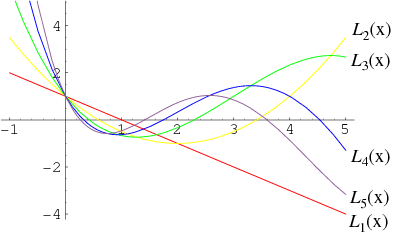
Laguerre's Differential Equation (Edmond Nicolas Laguerre)
.

with solution for when n is a positive integer of
y= Ln(x)
where Ln(x) is called the Laguerre Polynomial
.
Laguerre Polynomials
.
.
Hermite's Differential Equation (Charles Hermite)
.

with solution
y = Hn(x)
for positive integer values of n, where Hn(x) are the Hermite Polynomials
.
Hermite Polynomials
.


.
The Delta Function
.
f(x) = δ(x)
where

Example
Surface Area of a Sphere
S.A.=∫∫∫δ(R)r2sinθdrdθdφ
but since the area under the Dirac delta function is 1, the integral:
∫δ(R)r2dr = R2
so,
S.A.=R2∫∫sinθdθdφ=4πR2
.
Hyperbolic Sine Function
.
f(x)=sinh(x)
.
Heaviside Step Function (Oliver Heaviside)
.

.
Error Function
.


.
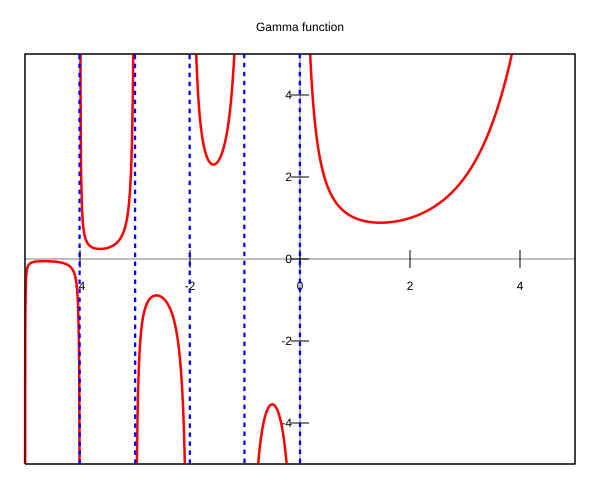
The Gamma Function
.

.
The Riemann Zeta-Function (Bernhard Riemann)
.

Special thanks to the following websites:
https://www.efunda.com/home.cfm
https://en.wikipedia.org/wiki/Main_Page
https://mathworld.wolfram.com/
If any of you have a particular subject you'd like to see covered in Roger's Equations, you're welcome to email your suggestions to me. Future entries include CGS Units, Tensors, and Fourier Transforms. Till next time.
| 



 Re: Functions Part II