Hi friends. I've asked this question to about 15 or so scientists all over the world and have many different answers, only one matching my own, and virtually none matching the other. Who >> PhD fluid mechanics professors, developers of pipeline hydraulic modelling software, PhD chief engineers of pump companies, double PhD Mechanical Engineering Science professors or staff at laboratories, my mother-in-law . . . none have the same answers . . . . . so now I ask you.
First, I know fluids are compressible so this should eliminate 30 replies telling me this known fact, so lets assume a pipe theoretically full of water (or whatever fluid you wish to put in your virtual model) without any air bubbles, blocked on one end and a PD pump on the other (similar to a hydrostatic test of a length of pipe laying on a shop floor). Once I begin to increase the pressure with the PD pump, what is the pressure mechanism occurring at molecular level to cause the pressure to increase in the pipe? This is not a question about what the pump is doing and how the pump is doing it, but what is taking place inside the pipe itself. Keep in mind before answering I'll likely ask you "Why" 5 times so ask yourself "why" a few times to your answer until we arrive at the root mechanism for pressure rise. This is for a class I teach on pumps and pipelines and I have two professors (40+ years experience each) who disagree with what I put in my class for this theory, and those two professors don't agree with each other at all. Only one person in the world agreed on my theory, a retired chief technology engineer of a major pump supplier. Thanks in advance for a reply. I'll share my theory I use in my class after I read some replies. George (willing to learn a thing or two here)


 What causes pressure in an noncompressible fluid?


 Re: What causes pressure in an noncompressible fluid?


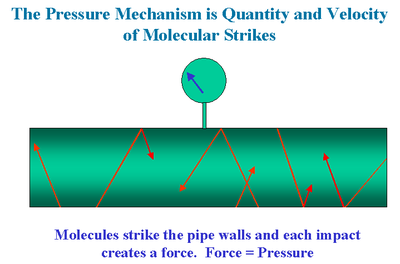


"Almost" Good Answers: