Previous in Forum: 110/220V Power System   Next in Forum: Generator Differential and Earth Faults
Close
Close
Close
26 comments
Rate Comments: Nested
Participant

Join Date: Dec 2007
Posts: 4

Electrical Motors

12/17/2007 11:05 PM

how can we recognize d.c motor and induction motor just by watching it ?

what is rating of fan motor?

Register to Reply
Interested in this topic? By joining CR4 you can "subscribe" to
this discussion and receive notification when new comments are added.
Power-User

Join Date: Apr 2006
Location: USA
Posts: 252
Good Answers: 6
#1

Re: information about electrical motors

12/17/2007 11:32 PM

It is called the motor nameplate- Conveniently it is located on the outside of the motor, thus can be read while looking at the motor.

And answering your second question: You always rate fan motors big enough to do the job. Just call it a rule of thumb.

Register to Reply
Guru
United Kingdom - Member - Indeterminate Engineering Fields - Control Engineering - New Member

Join Date: Jan 2007
Location: In the bothy, 7 chains down the line from Dodman's Lane level crossing, in the nation formerly known as Great Britain. Kettle's on.
Posts: 32175
Good Answers: 839
#2

Re: information about electrical motors

12/18/2007 4:06 AM

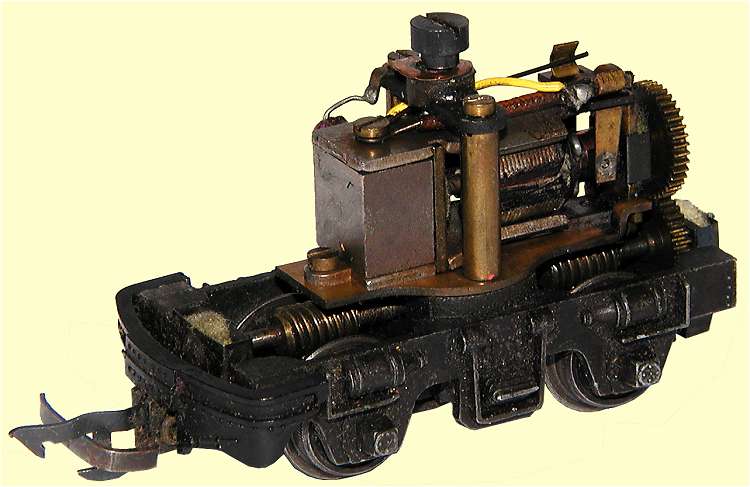
If it has a permanent magnet, then it is certainly a DC motor, like this:

If it has an electromagnet instead, then look at the motor nameplate as it is the only way of telling.

__________________
"Did you get my e-mail?" - "The biggest problem in communication is the illusion that it has taken place" - George Bernard Shaw, 1856
Register to Reply
Guru
Popular Science - Weaponology - New Member Safety - ESD - New Member Hobbies - Fishing - New Member

Join Date: Sep 2006
Location: Near Frankfurt am Main, Germany. 50.390866N, 8.884827E
Posts: 17996
Good Answers: 200
#24
In reply to #2

Re: information about electrical motors

12/21/2007 8:47 PM

This looks like 50s HO or OO Hornby or Triang stuff, badly soldered!! I cannot see under to see if it is two or three track pickup.....but it certainly looks old!!!

__________________
"What others say about you reveals more about them, than it does you." Anon.
Register to Reply Off Topic (Score 5)
Guru

Join Date: Nov 2006
Posts: 729
Good Answers: 2
#3

Re: information about electrical motors
12/18/2007 8:09 AM

By looking at it u can confuse between a DC Motor and wound rotor motor.

__________________
To avoid crticism do nothing,say nothing,be nothing
Register to Reply
Power-User

Join Date: Oct 2007
Location: Hartwell Georgia N34* 56.770 / W83* 35.431
Posts: 222
Good Answers: 1
#4

Re: Electrical Motors

12/18/2007 6:38 PM

You will see arks & sparks at the commutator end. Also the Brushes have small dime size access areas for brush replacement.

James

__________________
" adapt, improvise, overcome "
Register to Reply
Guru

Join Date: Jun 2007
Posts: 1035
Good Answers: 40
#5
In reply to #4

Re: Electrical Motors

12/19/2007 12:55 AM

"hastingselectric" wrote:

"You will see arks & sparks at the commutator end. Also the Brushes have small dime size access areas for brush replacement."

The original post was: "how can we recognize d.c motor and induction motor just by watching it ? what is rating of fan motor?

Not all DC motors are so small as to have "dime sized" covers over the brushes, and not all dime-sized brush covers are on DC motors (e.g., your 120vac Skil-Saw).

There is no single / set standard for appearance of any category of electric motor. Nameplate data is the best suggestion; but, without a nameplate, either investigation of the application/installation , or , Education is your best bet.

Try buying the Rosenberg "Bible" of electric motors and do some serious studying~ http://www.amazon.com/Electric-Motor-Repair-Robert-Rosenberg/dp/0030595843

You'll recognize everything from tiny skeletal "C"-frame motors to synchronous motors in no time ... and understand how to troubleshoot & repair them as well!

Air-handling is one of the most demanding applications for a motor (unbeknownst to many). The rating of a fan motor depends on how much air it is being asked to push, and under what conditions ... i.e., through duct-work, under pressure, etc.

Any additional specifics in the post will bring you much better responses....

y e r m o s t i n d u b i t a b l y w e l c o m e

Register to Reply
Guru
Popular Science - Weaponology - New Member Safety - ESD - New Member Hobbies - Fishing - New Member

Join Date: Sep 2006
Location: Near Frankfurt am Main, Germany. 50.390866N, 8.884827E
Posts: 17996
Good Answers: 200
#8
In reply to #4

Re: Electrical Motors

12/19/2007 5:06 AM

Look at a "Universal" AC motor, it also has brushes and sparks....Used in Electric hand tools, hairdryers etc....!!

So having Brushes is not a prerequisite for DC only....sorry.

__________________
"What others say about you reveals more about them, than it does you." Anon.
Register to Reply
Power-User

Join Date: Dec 2006
Location: Vietnam
Posts: 153
#6

Re: Electrical Motors

12/19/2007 3:43 AM

You can watch the name plate of motor.

__________________
Nature is unlimited, human's knowledge is limited
Register to Reply
Anonymous Poster
#7

Re: Electrical Motors

12/19/2007 4:12 AM

This looks like a good place for this...

Hello this is guest2pence. Pictured is a motor where the plate can't be seen. And it can't be seen running because the box it's in comes to life but won't start--blows fuse instantaneously. The fan is in a so-called inverter microwave oven. (As far as I can tell, an inverter oven is a cheaper way to make, and yet charge more for, microwaves, which are also of lower weight (cheaper shipping) than "normal" microwaves.) Does this mean it's a dc fan motor?

Also, looking at the rotor, it looks like some reddish coating (shellac?) is removed exposing the bright-colored winding. This could be a "normal" artifact of motor manufacture, but (and without a new motor for comparision) I'm thinking this might be the cause of the sparking and blowing of main fuses whenever the 5-8-hour-old oven tries to start cooking. Any ideas?

Hope this contributes to the original question. Apologies to all if not.

Register to Reply
Guru

Join Date: Jun 2007
Posts: 1035
Good Answers: 40
#10
In reply to #7

Re: Electrical Motors

12/19/2007 10:01 AM

"As far as I can tell, an inverter oven is a cheaper way to make, and yet charge more for, microwaves"

See: http://panasonic.ca/english/appliance/microwave/inverter.asp

Since you have the thing apart ... and haven't already suffered electrocution ... d'ja try the first 3 rules of troubleshooting: 1) Isolate 2) Isolate 3) ISOLATE ...

disconnect wires to the motor; attach "safe length" test leads (to motor leads); turn 'On' instantaneously while observing voltmeter from safe distance...

{note that the m/w energy is essentially all contained / directed thru the waveguide}

If this is too difficult, there's always scratching the head with left hand, whilst wetting right index finger and looking for a large cylindrical thing with 2 terminals on it to bridge with the finger...

On 2nd thought, please DON'T! ... Have a safe & happy holiday season, please!

Register to Reply
Guru

Join Date: Jun 2007
Posts: 1035
Good Answers: 40
#11
In reply to #10

Re: Electrical Motors

12/19/2007 10:20 AM

Sorry; I "skipped" ~ "Also, looking at the rotor, it looks like some reddish coating (shellac?) is removed exposing the bright-colored winding. ... I'm thinking this might be the cause of the sparking and blowing of main fuses whenever the 5-8-hour-old oven tries to start cooking. Any ideas?"

In 'the old days' shellac was used ... now it may look the same, but it's much higher-tech stuff; tougher film with higher temp ratings. You say the bare copper can be seen on the 'rotor' (armature, if it's DC). Is this bare copper in the slots of the laminated core, or is it simply excess stripping at the points where the wires are soldered to the commutator?

Some excess stripping at the commutator is typical, and unless the wires can move a significant amount they will not contribute to arcing. Any insulation missing ELSEWHERE just might be doing so ... especially if the "scrape" goes through adjacent turns (a "shorted-circuit" condition).

Register to Reply
Anonymous Poster
#16
In reply to #11

Re: Electrical Motors

12/21/2007 6:20 AM

Guest2pence again.

Tom, as you can see in the pic, the lighter area seems to continue in a band all the way around the reddish brown rotating part to which the fan is attached--as if it "occurred" while the fan was spinning. There are reasons--apart from the sparking that seemed to be emanating from this area just before fuse blow--for suspecting this seeming defect, but first let me respond to your troubleshooting hints...which will in turn reveal those reasons.

You have said: isolate, isolate, isolate. I would add to that, that witnessing the failure (mode), and thinking things through systematically from effect to cause (a posteriori reasoning, some might say) can also be effective at determining a fault--sometimes even eliminating the isolate... step. In this case there were actually two failures observed: the first, when the oven began exhausting dark smoke in a matter of seconds after cook start; the second, when, after immediately stopping it, waiting, and then restarting at full power, the oven responded by making a sparking/popping sound and then went dead (no display, no control response) immediately and instantaneously.

After confirming that neither the food, operator actions, the microwave cavity, nor the house service loop was involved (i.e., there had been neither flame-up in the cavity nor charring (nor even palpable heating) of the food), it occurred to me that, where there was smoke there should be evidence of burning--burning within the oven cabinet by outside the cooking cavity. It further occurred (this was after opening [but not touching] and finding all oven components and wiring in pristine condition)... that since the smoke had been blown unimpeded out the exhaust, it was not unreasonable to suspect that the smoke originated near or at the fan. Based on this, a closer inspection of the fan assembly--it's partially concealed by supports and other items, so was not so readily examined at first--revealed what seemed might be a flaw in the fan motor, as shown in the pic and previously described.

At this point it seemed to me that my option was to, either, troubleshoot the motor by testing/metering, or by substitution with known good (newly purchased) fan motor. While contemplating the choice, I advanced a negotiation with the oven selling merchant for replacement of the oven. While they were considering my proposal, and the reasons I put forth as to why they should share any loss, I contacted the mfr's technical support to ask whether their inverter ovens present a stored-charge hazard like "conventional microwaves"; and, if so, how they recommend such charges be discharged. (So, you can see that there was reason not to perform any fault isolation aside from solely visual inspection--or any actual disassembly or test action which might further compromise....) As it turned out, as the manufacturer's tech rep listen to my description of failure mode and inspection, and after satisfying herself as to the same conclusions I had drawn regarding the oven itself being "at fault," she made the election to exchange the (out of warranty but prematurely failed) oven for a new equivalent. Today, the new oven arrived and the defective oven departed on its way to mfr. So it seems, that to isolate, isolate... and think it through, might be added, persuade persuade?

Now I have thought about checking the new fan motor to see if the old motor was really the culprit. However, hopefully it won't be necessary...if mfr keeps it's agreement to let me follow up and find out what the mfr's failure analysis result turns out to be. But, even if they don't, I can't help but be impressed with the way they supported their product when giving the brush off might have been just as easy. Kudos to Matsutshita.

Sorry for the hyperduration.

Register to Reply
Guru
Popular Science - Weaponology - New Member Safety - ESD - New Member Hobbies - Fishing - New Member

Join Date: Sep 2006
Location: Near Frankfurt am Main, Germany. 50.390866N, 8.884827E
Posts: 17996
Good Answers: 200
#19
In reply to #16

Re: Electrical Motors

12/21/2007 9:27 AM

Nice post, thanks for the full explanation and we are all pleased that you are

a) still alive b) proud owner of a new oven!!

__________________
"What others say about you reveals more about them, than it does you." Anon.
Register to Reply
Guru

Join Date: Jun 2007
Posts: 1035
Good Answers: 40
#22
In reply to #16

Re: Electrical Motors

12/21/2007 4:51 PM

As post 19 says: "Congrats on the new oven!" ~ (Merry Christmas, early) ~ I could not see your photo clearly enough to tell where the scraped wire-insulation was, or that it continued 'round the wound rotor ... [in fact, that's the first non-squirrel-cage rotor I've seen in a shaded pole design. But, new things are produced with incredible rapidity nowadays!]

These motors are typically impedance-protected, and thus won't blow fuses unless shorted (which is apparently what occured / let us know what the mf'r tells you!).

You could have put a cheater-cord in series with a 100 watt light bulb and tried powering-up the motor itself, with the oven apart, to see if the motor was the culprit: "Bright light with no spinning" (just humming) = bad motor. Then move to next step troubleshooting, etc. Again, glad for your happy ending!

Register to Reply
Guru
Popular Science - Weaponology - New Member Safety - ESD - New Member Hobbies - Fishing - New Member

Join Date: Sep 2006
Location: Near Frankfurt am Main, Germany. 50.390866N, 8.884827E
Posts: 17996
Good Answers: 200
#23
In reply to #22

Re: Electrical Motors

12/21/2007 8:45 PM

The idea is not bad if you or I had designed the oven, but designers of such equipment follow a strange logic sometimes and find for a example a place where there is 50Volts AC available, that he has no other usage for and he places a 50Volt motor, specially built at an incredibly low price, to make use of this voltage.......so never assume unless it is marked as being for mains voltages....... you never know!!

The mains test blows the motor up and you might surmise the motor was defective, buy a new motor and low and behold, the motor was not the first problem!!!!!!

__________________
"What others say about you reveals more about them, than it does you." Anon.
Register to Reply Off Topic (Score 5)
Guru

Join Date: Jun 2007
Posts: 1035
Good Answers: 40
#25
In reply to #23

Re: Electrical Motors

12/22/2007 1:01 AM

Sorry...my post (22) should have said: "See my Post #10, first" ... then, "assuming 110v was detected...." ~~~ [["Hurry-up-and-goof..."!...leaving some to wonder...]]

Register to Reply Off Topic (Score 5)
Guru
Popular Science - Weaponology - New Member Safety - ESD - New Member Hobbies - Fishing - New Member

Join Date: Sep 2006
Location: Near Frankfurt am Main, Germany. 50.390866N, 8.884827E
Posts: 17996
Good Answers: 200
#26
In reply to #25

Re: Electrical Motors

12/22/2007 7:52 AM

Not a problem,n one here considers that a ooooooooooo, we watch out for ech other too a lot of the time.....

Thats not a goof, we watch out for each other here as much as possible!

Have a great day.

__________________
"What others say about you reveals more about them, than it does you." Anon.
Register to Reply Off Topic (Score 5)
Anonymous Poster
#18
In reply to #10

Re: Electrical Motors

12/21/2007 6:57 AM

I was shocked at first by one of your recommendations...or would have been but for the fact I'm out of printer paper and the computer monitor's too far away to refer to while troubleshooting. So it looks like my holiday's saved for now.

I have asked myself, however, if inverter (read, Panasonic) ovens actually present the same power-off hazard as conventional microwaves--there's not nearly as much online "talk" about the former as the latter, so there's very little to judge by.

For one thing, since the inverter ovens (their magnetrons) are always running at different levels, as opposed to cycling like conventionals, seems possible there might be less charge buildup, if any. The shielded areas of the inverter innards are clearly marked for hazard, but it doesn't say whether that's when connected or disconnected from mains, or both. The oven's part list gives nominal 50-volt, 100PF as the largest "chip" capacitor. While it might give a jolt, not sure it would be a "terminal" shock? When I asked the mfr techs, they evade the question...rather than stressing the hazard as I might have expected. Whether it's one or the other, its probably something they prefer oven owners to just not ask about.

Best wishes in return to you and members all for fine holidays.

Guest2pence

Register to Reply
Guru
Popular Science - Weaponology - New Member Safety - ESD - New Member Hobbies - Fishing - New Member

Join Date: Sep 2006
Location: Near Frankfurt am Main, Germany. 50.390866N, 8.884827E
Posts: 17996
Good Answers: 200
#20
In reply to #18

Re: Electrical Motors

12/21/2007 9:30 AM

Charge is not always on a cap!! CRTs can hold a charge on the screen for months, that will more than make you swear!!!

I am not a microwave oven professor, but I have read enough to know that there are components, especially in cheap ovens, that the voltage can hang around on..... hopefully someone here can tell us more....

__________________
"What others say about you reveals more about them, than it does you." Anon.
Register to Reply
Anonymous Poster
#9

Re: Electrical Motors

12/19/2007 5:28 AM

If you have fluorescent lighting, you can see that the induction motor turns slightly slower than synchronously with the mains frequency. The fluorescent lights act like a poor quality stroboscope.

Register to Reply
Active Contributor

Join Date: Nov 2007
Location: Scotland
Posts: 20
#12

Re: Electrical Motors

12/19/2007 2:02 PM

It can be difficult to give a rule of thumb, as the motor size is not stated. If you look at the outside of the casing of a DC motor, you should see radially around the casing, equally spaced, single or sometimes double hexagon bolt heads. These are the securing bolts for the main and interpole yokes. They are normally positioned midway between the end covers. These will not be present on an AC motor.

Register to Reply
Commentator

Join Date: Aug 2007
Posts: 86
Good Answers: 2
#13

Re: Electrical Motors

12/19/2007 3:39 PM

Your motor is a shaded pole induction motor,consisting of a coil,pair of poles,one pole having a thick shorted turn embedded in it,and a laminated rotor.

The shorted turn gives an effective phase shift to the mag field across that pole face,which is actually in two parts with the shading ring on one half,giving in effect a rotating field.The rotor follows this field,running around synchronous speed for two poles,you Yanks can work this out I dont function at 60Hz

The coil is usually quite thin wire and lots of turns,so unless seriously shorted isn't whats causing your blown fuse.These motors are used ubiquitously in domestic and light industrial products,fan heaters,shredders,microwave cooling fans,turntable motors etc etc.The rotor can be locked and you wont measure any change in current as most of the power goes into heat anyway.

Please be careful if this is a microwave,they are lethal with covers off and have nasty voltages stored even when unplugged.

Register to Reply
Anonymous Poster
#17
In reply to #13

Re: Electrical Motors

12/21/2007 6:25 AM

Oldeng,

Both interesting and informative! Many thanks. Just wondering: Is there a place to see a pictorial or block diagram to visually show the shaded pole induction functionality? Would really appreciate.

G2p

Register to Reply
Commentator

Join Date: Aug 2007
Posts: 86
Good Answers: 2
#21
In reply to #17

Re: Electrical Motors

12/21/2007 10:17 AM

Try www.zeitlauf.co.uk/technology/motoren/shaded_pole_motor.html

This shows a motor with permanent magnet rotor as used in electric clocks,but the types used in appliances such as washing machines (emptying pump) dishwashers,dryers etc etc has a laminated rotor with embedded bars which becomes a magnet under the action of the magnetic field produced by the coil and main poles. This type will run at any speed down from synchronous reducing speed as it is loaded.

How do these things get invented?

I tell you what,I'm going to get an ac electromagnet,ram a couple of copper washers on the poles and I bet this rotor from an old motor will spin between the poles.

Dont be stupid the whole lot will just fry with those massive shorted turns.You remember the problems we had with accidentally shorted turns in 3 phase motors.

OH look,its going round,I'm going to call it something snappy like shaded pole summat.

Register to Reply
Anonymous Poster
#14

Re: Electrical Motors

12/19/2007 4:12 PM

Perhaps it would help to look at the circuit in which it is located.

Register to Reply
Associate

Join Date: Mar 2007
Posts: 40
#15

Re: Electrical Motors

12/19/2007 6:43 PM

On the body of a AC motors you may find cooling fins in most of the cases.

This is because the stator coil, carrying load current, is the major heat source.

But on a small size DC motor, you probably won't find such cooling fins thing, because the stator coils only take excitation current which is much lower than the armature current, emitting less heat therefore calling for no sepcific cooling measures.

Register to Reply
Register to Reply 26 comments
Copy to Clipboard

Users who posted comments:

Andy Germany (6); Anonymous Poster (6); halibutA (1); hastingselectric (1); Larry Lai (1); Mevel123 (1); nam70 (1); ndt-tom (5); nesubra (1); oldeng (2); PWSlack (1)

Previous in Forum: 110/220V Power System   Next in Forum: Generator Differential and Earth Faults

Advertisement