Previous in Forum: Single shot pulse circuit   Next in Forum: intools training
Close
Close
Close
3 comments
Rate Comments: Nested
Anonymous Poster

VFD Output Signals

10/10/2009 2:46 PM

Hello,

On a particular VFD I noticed two field powered 4-20mA outputs, one for motor speed and the other for motor amperage. Both signals share a common (-) terminal at the VFD. The two loops utilize a three-conductor cable, with the two negative terminals jumpered at the DCS termination. No signal isolators are in-use. Will this configuration cause interference between the two loops?

Thanks!

Reply
Interested in this topic? By joining CR4 you can "subscribe" to
this discussion and receive notification when new comments are added.
Guru

Join Date: Sep 2009
Posts: 1056
Good Answers: 88
#1

Re: VFD Output Signals

10/10/2009 3:24 PM

Worry more for interference by HF output from your drive using them as a way in and root accordingly. On a decent VFD these should be electrically isolated from HV and low pass filtered.

__________________
Life is complex. It has a real part and an imaginary part.
Reply
Commentator

Join Date: May 2009
Location: Mumbai
Posts: 73
#2

Re: VFD Output Signals

10/10/2009 4:52 PM

Yes definatly the value of rpm & Amp displayed in DCS will not correct in this case.

In VFD itself seperate outputs for AM-COM & FM-COM are provided for Amp & Speed disply respectively. and both COM i.e. -ve are isolated you can not short them.

__________________
Thanks
Reply
Power-User
United States - Member - US Citizen - Born & Raised Engineering Fields - Control Engineering - HVAC/R Simplified Using PLC Controls Engineering Fields - Instrumentation Engineering - HVAC/R Simplified Using PLC Controls Engineering Fields - Energy Engineering - HVAC/R Simplified Using PLC Controls

Join Date: Mar 2007
Location: Brick, NJ (USA)
Posts: 110
Good Answers: 5
#3

Re: VFD Output Signals

10/11/2009 7:28 AM

Using Kirchoff's current law, a shared leg between two circuits will affect the signal of both depending on the resistance in each circuit. The output will drive the current to its steady state while increasing the voltage to maintain that signal.

As the first circuit drives the voltage in one circuit the other circuit will be affected with a shared leg.

You haven't told us the brand and configuration of the VFD, as the internal configuration of the drive may isolate the two circuits internally.

Bottom line is, all signal circuits must be isolated. I use isolation boards for all of my VFD configurations regardless of VFD manufacturer.

This is from http://www.allaboutcircuits.com/vol_1/chpt_9/3.html

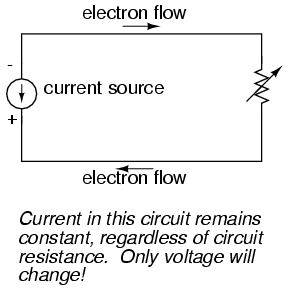
It is possible through the use of electronic amplifiers to design a circuit outputting a constant amount of current rather than a constant amount of voltage. This collection of components is collectively known as a current source, and its symbol looks like this:

A current source generates as much or as little voltage as needed across its leads to produce a constant amount of current through it. This is just the opposite of a voltage source (an ideal battery), which will output as much or as little current as demanded by the external circuit in maintaining its output voltage constant. Following the "conventional flow" symbology typical of electronic devices, the arrow points against the direction of electron motion. Apologies for this confusing notation: another legacy of Benjamin Franklin's false assumption of electron flow!

Current sources can be built as variable devices, just like voltage sources, and they can be designed to produce very precise amounts of current. If a transmitter device were to be constructed with a variable current source instead of a variable voltage source, we could design an instrumentation signal system based on current instead of voltage:

The internal workings of the transmitter's current source need not be a concern at this point, only the fact that its output varies in response to changes in the float position, just like the potentiometer setup in the voltage signal system varied voltage output according to float position.

Notice now how the indicator is an ammeter rather than a voltmeter (the scale calibrated in inches, feet, or meters of water in the tank, as always). Because the circuit is a series configuration (accounting for the cable resistances), current will be precisely equal through all components. With or without cable resistance, the current at the indicator is exactly the same as the current at the transmitter, and therefore there is no error incurred as there might be with a voltage signal system. This assurance of zero signal degradation is a decided advantage of current signal systems over voltage signal systems.

The most common current signal standard in modern use is the 4 to 20 milliamp (4-20 mA) loop, with 4 milliamps representing 0 percent of measurement, 20 milliamps representing 100 percent, 12 milliamps representing 50 percent, and so on. A convenient feature of the 4-20 mA standard is its ease of signal conversion to 1-5 volt indicating instruments. A simple 250 ohm precision resistor connected in series with the circuit will produce 1 volt of drop at 4 milliamps, 5 volts of drop at 20 milliamps, etc:

The current loop scale of 4-20 milliamps has not always been the standard for current instruments: for a while there was also a 10-50 milliamp standard, but that standard has since been obsoleted. One reason for the eventual supremacy of the 4-20 milliamp loop was safety: with lower circuit voltages and lower current levels than in 10-50 mA system designs, there was less chance for personal shock injury and/or the generation of sparks capable of igniting flammable atmospheres in certain industrial environments.

  • REVIEW:
  • A current source is a device (usually constructed of several electronic components) that outputs a constant amount of current through a circuit, much like a voltage source (ideal battery) outputting a constant amount of voltage to a circuit.
  • A current "loop" instrumentation circuit relies on the series circuit principle of current being equal through all components to insure no signal error due to wiring resistance.
  • The most common analog current signal standard in modern use is the "4 to 20 milliamp current loop."
__________________
"Memorize the calculations, you look like a fool searching your notes while teaching class"
Reply
Reply to Forum Thread 3 comments
Copy to Clipboard

Users who posted comments:

dhanesh.koshti (1); jcchiefeng (1); SimpleMind (1)

Previous in Forum: Single shot pulse circuit   Next in Forum: intools training

Advertisement