Previous in Forum: owner of ensenada solar in Baja California   Next in Forum: Starters.
Close
Close
Close
9 comments
Rate Comments: Nested
Commentator

Join Date: Jul 2010
Posts: 92
Good Answers: 1

Pumps and Motor Current Draw

02/23/2012 11:08 PM

Hi,

I'm struggling to understand the relationship between pumps and motor current draw.

For example, with an axial flow pump (assume direct-online 50Hz motor), I know that restricting the flow (ie. shutting a control valve downstream, therefore increasing the pressure head), will result in an increase in motor current draw. Does the impellor slow down with an axial pump when pressure head is increased? As I understand, Motor current draw is directly proportional to motor slip, ie. the slower the rotor spins in relation to the stator, the more current will be drawn by the motor (until you hit a locked rotor scenario). If the impeller stays at the a constant speed regardless of pressure head, how is it the motor drawing more current with an increasing pressure head?

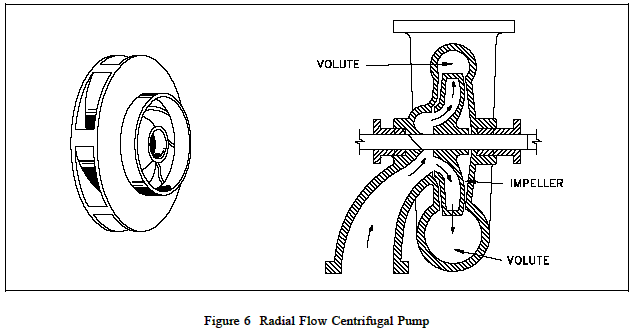
The opposite is true with radial pumps, As I can read from the curves. Restricting flow output actually decreases motor current draw. I've also read that the impeller on a radial pump remains at constant speed for any given pressure head. I'm not sure how more current can be drawn by the motor, if the motor/pump shaft and hence impeller remain at a constant speed?

Look forward to the responses.

__________________
Electrical Engineer
Register to Reply
Interested in this topic? By joining CR4 you can "subscribe" to
this discussion and receive notification when new comments are added.

Good Answers:

These comments received enough positive votes to make them "good answers".

"Almost" Good Answers:

Check out these comments that don't yet have enough votes to be "official" good answers and, if you agree with them, vote them!
Guru
Technical Fields - Technical Writing - New Member Engineering Fields - Piping Design Engineering - New Member

Join Date: May 2009
Location: Richland, WA, USA
Posts: 21017
Good Answers: 795
#1

Re: Pumps and motor current draw

02/23/2012 11:20 PM

I don't know where you are getting your information, but your sources seem to be really, really, really confused. (And your terminology is unclear and/or unusual.)

__________________
In vino veritas; in cervisia carmen; in aqua E. coli.
Register to Reply
Commentator

Join Date: Jul 2010
Posts: 92
Good Answers: 1
#2
In reply to #1

Re: Pumps and motor current draw

02/23/2012 11:33 PM

I'm not sure how I can word it any better, my understanding of fluid mechanics is limitted.

__________________
Electrical Engineer
Register to Reply
Guru

Join Date: Mar 2007
Location: by the beach in Florida
Posts: 33392
Good Answers: 1817
#3

Re: Pumps and motor current draw

02/23/2012 11:41 PM
__________________
All living things seek to control their own destiny....this is the purpose of life
Register to Reply
4
Guru
Technical Fields - Technical Writing - New Member Engineering Fields - Piping Design Engineering - New Member

Join Date: May 2009
Location: Richland, WA, USA
Posts: 21017
Good Answers: 795
#4

Re: Pumps and motor current draw

02/24/2012 12:45 AM

One problem is that "axial pump" is ambiguous. The type shown by Solar Eagle behaves largely like a centrifugal pump (preferred term to "radial"), but progressive cavity pumps such as Moyno are also axial flow.

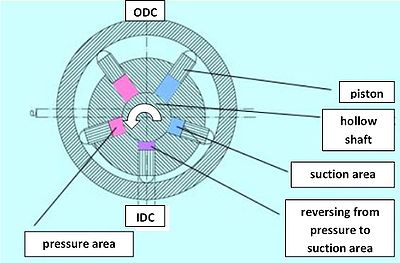
A better terminology is "positive displacement" versus "dynamic" pumps. If their discharge is throttled, positive displacement pumps slow down slightly in rpm and draw more power. When dynamic pump discharges are throttled, the flow goes down substantially and the pressure rises slightly (depending on the specific performance curve). The reduced flow typically dominates over the increased pressure; power draw decreases while rpm increases slightly.

That's a nutshell version; there may be a few exceptions, but not many.

__________________
In vino veritas; in cervisia carmen; in aqua E. coli.
Register to Reply Good Answer (Score 4)
4
Guru
United States - Member - New Member Engineering Fields - Power Engineering - New Member

Join Date: Sep 2006
Location: California, USA, where the Godless live next door to God.
Posts: 4665
Good Answers: 804
#5

Re: Pumps and Motor Current Draw

02/24/2012 8:35 PM

Toronado is right, axial and radial just refers to the direction of flow with regards to the motion of the device. Axial flows along the same AXIS as the work shaft, radial flows by RADIATING away from it. So from that standpoint there is technically insufficient information to make a determination. But I'm going to have some fun with this based on a class I recently taught on understanding the benefits of VFDs.

GENERALLY there are conventional descriptions of (non-positive displacement) pumps that fall into the two (2-1/2) categories of "Axial" vs "Centrifugal" (what you are calling Radial), and the 1/2 category is actually what's called a "Mixed Flow" pump. The effects of flow restriction are different in those types as you have noted.

Maybe think of it in other terms if it will help.

An Axial Flow pump can be thought of like an airplane propeller. The faster the prop spins, more "stuff" (air or water) it displaces and the more thrust it generates. But if you restrict the flow coming into or out of it you create turbulence, so it becomes more difficult for that prop to work against that turbulence.

So when run at the same speed and the same thrust capability, the motor works harder to overcome the restriction even though the net work being performed (defined as flow) is lower.

Now for a Centrifugal pump, think of one of those push type merry-go-round play structures at the playground. Imagine 20 children loaded up on top of it, all the way out to the edges. Now imagine trying to spin it. It's going to be difficult, right? So imagine an endless flow of children dropping into the center while it is spinning, and the children on the outside edges falling off at the same rate. The work you have to do to in order to keep it spinning is constant right?

Now imagine that the number of children dropping into the center is lower than those being flung off of the edge. In a few minutes, you have less total children in the platen right? The effort you have to exert to keep it spinning is going to be less. that is a Centrifugal pump. Less flow = less work. Restriction means less flow.

A Mixed Flow pump is like a merry-go-round on a moving airplane. Bloody mess.

No wait, a Mixed Flow pump is like a ... well, I can't come up with a good analogy. But it combines both characteristics and acts slightly different depending on the flow, but generally the power requirements are along the lines of a Centrifugal in that flow restriction decreases power requirement, just less dramatically. A lot of pumps that are called Centrifugals, such as sewage lift station pumps, are really mixed flow but because they generally follow the same type of power curve, nobody gets excited about the semantics. But it does mean that some of the dramatic energy savings typically thought of by using VFDs are not going to be quite as dramatic

__________________
** All I every really wanted to be, was... A LUMBERJACK!.**
Register to Reply Good Answer (Score 4)
Power-User

Join Date: Nov 2008
Posts: 121
Good Answers: 4
#6

Re: Pumps and Motor Current Draw

02/25/2012 8:28 AM

With axial pumps, with restriction in flow, there is decrease in flow but a proportonately greater increase in pressure. Since , the power consumed=ýQH/75 where ý is the specific weight, Q is discharge and H is developed head. The product of Q and H increases in axial pumps when flow is restricted, which increases power consumed thereby increasing motor current. The reverse is true for radial flow pumps.

Register to Reply
Participant

Join Date: Aug 2011
Posts: 1
#7

Re: Pumps and Motor Current Draw

02/25/2012 8:39 AM

You are closer to the right answer than the previous responses. The change in current is a function of rotor speed and thus change in back emf of the motor. The radial pump that you observed was operating in a range where its flow decreased more quickly than its pressure increased ( a common but not necessary phenomena) so the total power of the pump was reduced and the rotor increased in speed. The axial pump that you observed exhibited a lower reduction in flow as the pressure increased so the power requirement increased and the motor slowed down. This is not unusual in axial flow pumps but will only happen over a narrow range of performance.

Register to Reply
Anonymous Poster #1
#8

Re: Pumps and Motor Current Draw

02/25/2012 10:52 AM

the spinning impellers of the centrifugal pump guide the liquid to be thrown off by

centrifugal action. if the the discharge output valve is shut, the liquid in the pump

is caged in and the impellers just become eggbeaters in action. in fact the friction

of the eggbeater action will heat up the caged liquid, so the drive motor is simply

coasting along so it draws reduced current.

Register to Reply Score 1 for Good Answer
Commentator

Join Date: Jul 2010
Posts: 92
Good Answers: 1
#9

Re: Pumps and Motor Current Draw

02/26/2012 4:37 PM

Thanks guys, that sorts everything out.

__________________
Electrical Engineer
Register to Reply
Register to Reply 9 comments

Good Answers:

These comments received enough positive votes to make them "good answers".

"Almost" Good Answers:

Check out these comments that don't yet have enough votes to be "official" good answers and, if you agree with them, vote them!
Copy to Clipboard

Users who posted comments:

Anonymous Poster (1); IRSHAD (1); JRaef (1); milo friesen (1); polerz (2); SolarEagle (1); Tornado (2)

Previous in Forum: owner of ensenada solar in Baja California   Next in Forum: Starters.

Advertisement