If I say 12:1 is the correct answer, and tomorrow your instructor asks you how you arrived at your answer, will you say, "I got it on CR4, from a total stranger, who is now my personal tutor"?
NOW: What is the mechanical advantage of this pulley system?
Okay, I'll explain how I got the mechanical advantage of 12:1.
The two rightermost pulleys have a mechanical advantage of 3:1. The other four pulleys have a mechanical advantage of 4:1 (we can use the line counting method here). I just want confirmation that this is a compound pulley system.
Re: What is the mechanical advantage of this pulley system?
06/19/2013 7:12 PM
Completely indeterminate, but certainly not 15:1 nor 12:1. The pulley on the right can go any old where compared to the others. The meaning of the red lines is not given, nor whether the leftmost rope end is fixed. What is the black line between the lower right pulleys?
__________________
In vino veritas; in cervisia carmen; in aqua E. coli.
Re: What is the mechanical advantage of this pulley system?
06/20/2013 1:46 AM
SE and Lyn...you guys just got owned by Falcon. He completely blew off your "no homework" yammering and kept coming back with more. He then sucks Tornado into the fray and gets him to participate. This guy's a genius!!
Re: What is the mechanical advantage of this pulley system?
06/20/2013 3:20 AM
<...This guy's a genius!!...>
That allegation is just so difficult to swallow.
__________________
"Did you get my e-mail?" - "The biggest problem in communication is the illusion that it has taken place" - George Bernard Shaw, 1856
Re: What is the mechanical advantage of this pulley system?
06/20/2013 8:32 PM
What I meant was...he's a genius because he got you guys to participate regardless of your views on homework questions!...Geez, it's like having to explain a joke!
Anyway, it's irrelevant because he says it's not homework so...carry on.
Re: What is the mechanical advantage of this pulley system?
06/20/2013 5:53 PM
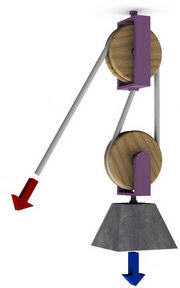
Let me get some things straight. First of all, this is not a homework question. I am just asking this out of curiosity. The image is also made by myself.
The rightmost moving pulley is connected to the main cord with a Prussik knot. We now basically have a Z-rig, with the third pulley labeled with 'A'. These two pulleys have a mechanical advantage of 3:1. The rightmost moving pulley is not directly connected to the load; it is connected to the main cord.
The other four pulleys form a 4:1 system. The moving pulleys are directly connected to the load.
So we have a 3:1 pulley system pulling a 4:1 system. Since the rightmost moving pulley is not directly connected to the load, and moves at a different speed that the other moving pulleys, we have to mulitply the mechanical advantage. This system will have a mechanical advantage of 12:1.
I don't have a book where the theory of this kind of pulley systems is explained. I got the theory from this video: http://youtu.be/O150ASX3Z8g?t=5m29s
The man has constructed a pulley system where a 3:1 Z-rig pulls a 3:1 pulley system, hence giving it a total mechanical advantage of 9:1. I've drawn a pulley system where a 3:1 Z-rig pulls a 4:1 pulley system. According to the theory in the video, the total mechanical advantage is 12:1, and not 7:1.
The reason I'm asking this question here is that I want to know if this theory is correct. I am not cheating, this is not a homework assignment and I don't have an instructor.
If this theory isn't correct, are there other ways to multiply the mechanical advantage with pulleys?
Re: What is the mechanical advantage of this pulley system?
06/20/2013 7:28 PM
They things are tied together here, with several weights/pulleys moving in unison, the configuration is essentially parallel rather than series. That's why it adds rather than multiplies.
__________________
In vino veritas; in cervisia carmen; in aqua E. coli.
Re: What is the mechanical advantage of this pulley system?
04/28/2025 11:08 AM
Good grief...
__________________
"Did you get my e-mail?" - "The biggest problem in communication is the illusion that it has taken place" - George Bernard Shaw, 1856
Good Answers: