|
 Recently, a group of physicists at CERN discovered that neutrinos traveling some 730 km underneath the Alps, (apparently) moved faster than light in vacuum.(a) Recently, a group of physicists at CERN discovered that neutrinos traveling some 730 km underneath the Alps, (apparently) moved faster than light in vacuum.(a)
They could not directly compare the arrival times of neutrinos and light, because unlike neutrinos, photons do not travel through rock. They claim that the distance is known to within 20 cm and the travel time is known to within 10 ns. The latter comes from the fact that transmission and reception times are only available statistically. They claim that the particles arrived 60 ns too early, with a six-sigma significance.
The most obvious 'explanation' for this result is that there is a systematic error in the timing data. A less obvious 'explanation' is that it may not be neutrinos that were detected, but some unknown exotic particles that can travel faster than light, collectively known as 'tachyons'. We must remember that Einstein's theory of relativity forbids anything with mass (real or imaginary) to travel at the speed of light in vacuum; but, it does not say explicitly that nothing can travel faster than that.
Ordinary matter, 'born' at subluminal relative speed, must stay at subliminal relative speed forever. Tachyons, if they exist, must be born at superluminal speed relative to ordinary matter and must stay like that forever. According to relativity theory, the speed of light barrier requires infinite energy to cross from either side. Energy is taken to be always real and hence requires that both the mass and the Lorentz factor must be imaginary for tachyons.(b) Imaginary mass? Hm...
It will be interesting to watch the progress of follow-on experiments and analyses.
Jorrie
PS: On Nov 17, 2011, the Opera team issued this statement:
"Following the OPERA collaboration's presentation at CERN on 23
September, inviting scrutiny of their neutrino time-of-flight
measurement from the broader particle physics community, the
collaboration has rechecked many aspects of its analysis and taken into
account valuable suggestions from a wide range of sources. One key test
was to repeat the measurement with very short beam pulses from CERN.
This allowed the extraction time of the protons that ultimately lead to
the neutrino beam to be measured more precisely.
"The beam sent from CERN consisted of pulses three nanoseconds long
separated by up to 524 nanoseconds. Some 20 clean neutrino events were
measured at the Gran Sasso Laboratory, and precisely associated with the
pulse leaving CERN. This test confirms the accuracy of OPERA's timing
measurement, ruling out one potential source of systematic error. The
new measurements do not change the initial conclusion. Nevertheless, the
observed anomaly in the neutrinos' time of flight from CERN to Gran
Sasso still needs further scrutiny and independent measurement before it
can be refuted or confirmed."
A statistical data analysis error seems to be ruled out. This leaves two reasonable possibilities: (1) the clock synchronization between CERN and Gran Sasso has a systematic error, or (2) those neutrinos went faster through rock than light goes through 'empty space'. An independent experiment is needed.
-J
(a) http://www.wired.com/geekdad/2011/09/neutrinos-and-the-speed-of-light-a-primer-on-the-cern-study
(b) http://en.wikipedia.org/wiki/Tachyon
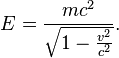
When v > c, both numerator and denominator must have imaginary values.
| 




 Re: Neutrinos Go Superluminal?


