|

Have you been known to say "I
thought I heard…"? Or have been certain you heard something correctly only to
realize your perception was completely incorrect? For those who are getting
older or have been with a partner or spouse long enough, both of these are increasingly
common occurrences. But rest easy, friends: the seemingly infinite Shepard
scale illusion laid out in this post will be misheard by all.
The Shepard scale was
developed by cognitive scientist Roger Shepard, and relies on a combination of
pitch and volume to achieve its never-ending effect. Shepard's effect is quite
simple and begins with two identical pitches an octave apart. While the tones
ascend through the scale, the higher tone gradually diminishes in volume, while
a third tone below the original lower tone begins to sound almost inaudibly and
increases in volume as it ascends. Eventually the original high tone becomes
inaudible and the scale returns to its original position, only to continue
ascending. A crude realization sounds a little like this (complete with helpful spectrogram).
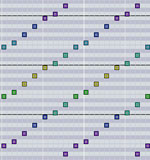
The image below is a little
confusing, but nicely illustrates the Shepard principle. The graphic
representations of pitch below are color coded by volume, with purple
indicating the lowest amplitude and teal / yellow indicated the highest. We can
see that, just as the higher tones fade, a new set below becomes increasingly
strong and takes their place.
 ...Via Wikipedia ...Via Wikipedia
 Jean-Claude Risset, a French
electronic composer, subsequently altered the scale to blur the tones together,
which in my opinion creates an infinitely neater effect. Here's a looped
audio example of the Shepard-Risset
glissando, in which a complete cycle occurs every 30 seconds or so. Jean-Claude Risset, a French
electronic composer, subsequently altered the scale to blur the tones together,
which in my opinion creates an infinitely neater effect. Here's a looped
audio example of the Shepard-Risset
glissando, in which a complete cycle occurs every 30 seconds or so.
The Shepard scale is
sometimes referred to as a "sonic barber's pole" and shares many
characteristics with this classic optical illusion. Both contain seemingly
endless information loops, and both mask information that assists in fooling
our actual perception. Both also share one trait of all sensory illusions:
playing on our brains' ability to assimilate limited amounts of information.
When we listen to a Shepard scale, we are able to compare the current tone with
the previous tone that we've heard, but not all the previous tones in the
scale. This sort of auditory "aperture" is identical to the visual aperture
that makes the barber pole illusion possible: by limiting the candy stripes to
a narrow vertical cylinder, it gives the illusion that they are endlessly
swirling down. If the same visual material was presented in a horizontal
aperture, we would be fooled into thinking it was endlessly swirling sideways.
So, the next time you botch
an important project detail or forget an item on your honey-do list, try
blaming the pitch and amplitude of the instructions - it just may get you off
the hook.
(...Ear trumpet image via Leeds Museum | Barber pole via Vimeo)
| 


 Re: The "Sonic Barber Pole"


"Almost" Good Answers: