|

A few weeks ago I stumbled upon an
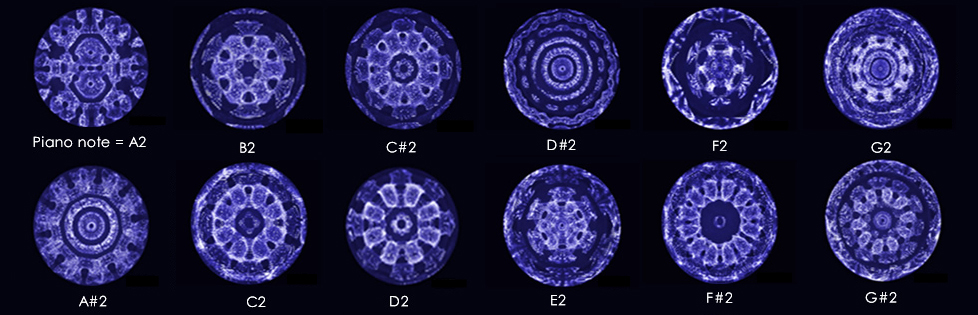
article about Shannon Novak, an artist who commissioned a group of
researchers to produce images representing twelve different musical tones. A
little more research pulled me into the world of the Cymascope and its
inventors, who have lofty and wide-reaching goals for its applications.
Cymatics is the science of making sound visible, which is
dependent on the fact that when sound encounters a membrane, such as human skin
or water, it imprints an invisible pattern of energy on the surface. The field
traces its origins back at least a thousand years, when African tribes used
taut skins sprinkled with grains to divine the future. Later, scientists as
diverse as Da Vinci, Galileo, Robert Hooke, and Faraday commented on and
studied this phenomenon. A Swiss doctor named Hans Jenny dubbed the field
"cymatics" - using the Greek word kyma (waves)
- in the 1970s.
Jumping to the present, John Stuart Reid and Erik Larson
began work on a new cymatics instrument, which they've dubbed the Cymascope, in 2002. While the
inventors first used a thin latex membrane and fine particulate matter to
visualize vibrations, they later switched to ultra-pure water due to this
medium's higher flexibility and better response times. An early prototype -
using a flexible membrane and particulate matter - can be seen here.
Reid and Larson claim that the Cymascope, as the first truly
scientific cymatics instrument, will revolutionize the field in a manner
similar to the telescope's impact on cosmology or the microscope's effect on
biology. They point to applications as diverse as acoustical analysis of the
Great Pyramids, deciphering of dolphin communications, and the more "out there"
practice of sound healing.
Of course, in keeping with the overarching topic of this blog, the Cymascope is
artistically valuable as well. Cymatics enthusiasts have termed each aural
snapshot a "mandala", named after the Tibetan Buddhist sand
mandala art form. Interested parties can purchase a mandala print
of their own voice for the low, low price of $199.
I'm certainly no expert on the subject, but something about
these aural visualizations doesn't add up. When we try the neat interactive
piano scale on this
page, it's clear that the mandala for each tone goes through visually
radical changes as the tone decays. Observing the mandala for the tone A2, it
appears that the water's vibration stops completely for a split-second despite
the fact that the pitch is clearly audible. The creators even state that this
is a phenomenon that "no one expected." So why does it occur? Changes in
ambient conditions or air quality, separate from the actual tone? Increasing
prevalence of other harmonics?
All worrying and dissecting aside, perhaps I would be wise
to just sit back and enjoy some really lovely musical canvases.
(Violin image via Cymatica | Mandalas image via Healers Journal)
| 


