|
One of the biggest problems plaguing electric vehicles (EVs)
on the market today is their limited range between charges - typically only 50 to
150 miles. Add to that the inconvenience of long charge times and limited availability of charging stations, and we
can understand why these vehicles are not yet a truly hot commodity. Researchers at North
Carolina State University (NCSU) have been developing technology which could one
day provide a solution to the range problem - wireless charging via transmitters
under the road.
Wireless charging sounds like something from a science
fiction movie: cars getting power from the road like an electric train, but with
freedom of movement and no track or visible power transfer. In reality, wireless
charging is as real as your electric toothbrush charger, and is in development
on a larger scale for consumer electronics and electric cars alike.
The mechanism for wireless charging is magnetic induction,
where a coil through induction creates an electromagnetic field which can be
picked up by a receiving electrical device to draw power and charge a battery.
In consumer electronics applications (e.g. cell phone charging), the field is generated via
a charging station. In EV charging, it is from a transmitter positioned under the
surface of the car.

Stationary wireless EV
charger - via gizmag.com
NCSU researchers have developed a system that uses a
specialized receiver to induce bursts of power when a vehicle passes over a
wireless transmitter. Compared to typical stationary inductive chargers for
EVs (see image above), this technology is more energy efficient, eliminating
the need for complex sensors or power electronics. Instead of using sensors,
NCSU's charger emits a weak magnetic field which becomes strong when a car
passes over due to electronics in the receiver. The system also incorporates inductors
and capacitors to assist power transfer between the transmitter and receiver, in
the place of more energy sapping power electronics. These cost and efficiency benefits are important when considering the application: hundreds to thousands of these placed underneath roadways.
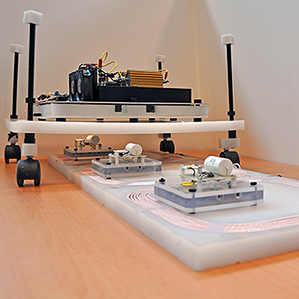
The researchers at NCSU have produced a low-power proof-of-concept of
their charger (seen right), and the intent is to scale up to a rate of 50
kilowatts, which is equivalent to direct-current (DC) fast charging stations. How
this research develops remains to be seen, since scale is a big factor when it
comes to this technology.
NCSU's prototype - via technologyreview.com -->
How much of an affect could these chargers have? According to
an assistant professor at NCSU, adding these chargers to 10% of a roadway would
extend the range of an EV from 60 to 300 miles, closing in on the range of
standard gasoline-fueled cars.
Like many possible technologies for the future, the biggest
hurdles to wireless EV chargers are the infrastructure and maintenance costs.
Implanting coil systems into even 10% of the U.S.'s major roadways seems a like
daunting and unrealistically expensive task.
A more feasible use of this technology might be to place
charging technology in strategic locations, such as bus stops or at traffic
lights. The University of Utah has tested a wireless charging infrastructure
for city buses, and has created a company called Wireless Advanced
Vehicle Electrification to build commercial products. It will be interesting to
see how this technology advances; its fate may be closely tied to the success and evolution of the EV market.
Source Article: Technology
Review
| 

 4
4


 Re: Wireless EV Charging


Good Answers: