|
Twice now I've taken to my CR4 soapbox to proclaim, "This is
the airship of the future!" The first
was back in November 2012;
the second was this past
March.
 Almost certainly, my desire to see new life breathed into an
obsolete mode of transportation is heavily nostalgic and novelty. They
fascinated me as a kid on the rare occasion I glimpsed one. As an adult, they
serve primarily as billboards, but they are also a faint reminder that I once
recognized them as something more than that. Blimps and airships were once the
truest form of airliner; they melded luxurious accommodation with efficient
service and travel. Today, 'airliner' refers to company who charges you per
cracker served mid-flight. Almost certainly, my desire to see new life breathed into an
obsolete mode of transportation is heavily nostalgic and novelty. They
fascinated me as a kid on the rare occasion I glimpsed one. As an adult, they
serve primarily as billboards, but they are also a faint reminder that I once
recognized them as something more than that. Blimps and airships were once the
truest form of airliner; they melded luxurious accommodation with efficient
service and travel. Today, 'airliner' refers to company who charges you per
cracker served mid-flight.
So I won't argue that airships
are coming back or that they have a bright future. Rather, let's examine how
one peculiar type of theoretical airship could push aerospace material science
to new heights.
Enter the vacuum airship. This type of aircraft is considered
the first concept of a flying machine that, if built, could actually fly. It
was devised by the Italian monk  Francesco Lana-Terzi in 1686, who was a
professor of physics and math. He was inspired by the atmospheric pressure work
of Otto von Guericke, developer of the vacuum pump, and utilizing his
scientific knowledge he envisioned an airship whose balloons were completely
empty. Francesco Lana-Terzi in 1686, who was a
professor of physics and math. He was inspired by the atmospheric pressure work
of Otto von Guericke, developer of the vacuum pump, and utilizing his
scientific knowledge he envisioned an airship whose balloons were completely
empty.
Lana theorized that he could construct a boat-like vehicle
tethered to four evacuated spheres, with a sail and rudder for sailing. The
craft would float until the density of the atmosphere counter-balanced the
weight of the ship, and it could be landed by letting small amounts of air into
the spheres.
There were several reasons Lana never built his airship. He
believed God wouldn't let such a device succeed, on account it could grant an
insurmountable advantage to armies. He also pledged himself to a life of poverty
as a monk, so he could never amount the resources required.
Oh yeah, he also had no clue what to make it out of, and
this represents the same problem with vacuum airships today. The vacuum tanks
would need to withstand enormous atmospheric pressure once evacuated. While
modern materials can overcome this structural load, it can't be done without
weighing down the vessel to a non-buoyant density.
Of course, researchers and scientists have had 300 years to
solve this problem, right? Yes, but virtually no attention has been paid to
this reliable concept. Once Portuguese priest Bartolomeu de Gusmao nearly burned down the
royal palace while demonstrating a successful hot air balloon, vacuum-based
atmospheric buoyancy lost all interest.
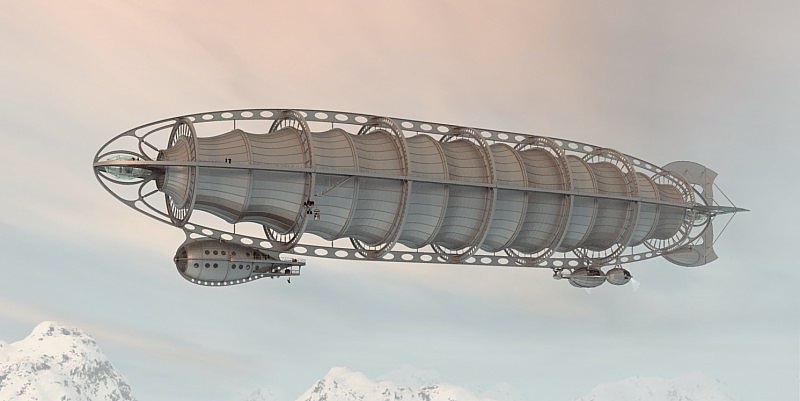 As sustainable engineering and resource management become
integral routines, not just chores, many ideas once considered impractical are
revisited if they can be efficient. Obviously, blimps need large amounts of
helium or hydrogen to remain buoyant, but helium is in
low supply and expensive while hydrogen goes boom. But a vacuumed structure
would create static lift which can be drawn upon to fly almost anything. And this is 2014, the age of supermaterials--graphene,
aerographite, buckminsterfullerene--something has to be able to support this
extreme pressure, right? And even if such an invention isn't used for a vacuum
airship, it could be practical for thousands of other applications. Entire
floating cities could be a reality and flying cars would require minimal energy
resources. As sustainable engineering and resource management become
integral routines, not just chores, many ideas once considered impractical are
revisited if they can be efficient. Obviously, blimps need large amounts of
helium or hydrogen to remain buoyant, but helium is in
low supply and expensive while hydrogen goes boom. But a vacuumed structure
would create static lift which can be drawn upon to fly almost anything. And this is 2014, the age of supermaterials--graphene,
aerographite, buckminsterfullerene--something has to be able to support this
extreme pressure, right? And even if such an invention isn't used for a vacuum
airship, it could be practical for thousands of other applications. Entire
floating cities could be a reality and flying cars would require minimal energy
resources.
So far, the closest we've gotten is a three-layer shell with
a low-density core of aluminum honeycomb or ceramic foam that is between two
ceramic sheets of boron carbide or silicon carbide. The initial
research suggests that thousands of 10 cm or smaller balloons could be
constructed and harnessed to deliver lift to a vehicle or platform. While not
useful quite yet, there are developments being made. Perhaps the most
interesting case is for carbon nanotubes that have buckminsterfullerene caps.
If they could be manufactured in a vacuum and produced on a large enough scale,
they could provide captured static lift.
Even though vacuum airships were obsolete before they were
even realized, they continue to forge presence in the aerospace industry. Just
because it wasn't built, doesn't mean potential real engineering solutions are
valueless.
| 


 Re: HUSH Loves Airships, Part 3


