|
 Quantum Tunnelling Quantum Tunnelling
The uncertainty principle, loosely stated, says that you can't observe both the position and the momentum of a particle precisely. The more precisely you know its position, the less precisely you know its momentum and vice versa. Thus if you cool an atom to a very low temperature, it has an increased chance of appearing on the other side of a potential barrier (due to uncertainty), which is known as Quantum Tunnelling.
Quantum Zeno Effect
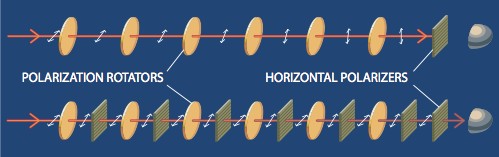
The quantum Zeno effect (also known as the Turing paradox) is a situation in which an unstable particle, if observed continuously, will never decay. One can "freeze" the evolution of the system by measuring it frequently
enough in its known initial state. As an outgrowth of study of the quantum Zeno effect, it has become
clear that applying a series of sufficiently strong and fast pulses with
appropriate symmetry can also decouple a system from its decohering environment
Quantum Zeno Effect Observed
The above definitions above should help you understand the interesting article below. Experiments such as these really help further define the nature of quantum mechanics and are very interesting. They also have lots of practical applications.
'Zeno effect' verified: Atoms won't move while you watch
One of the oddest predictions of quantum theory - that a system can't change while you're watching it - has been confirmed in an experiment by Cornell physicists. Their work opens the door to a fundamentally new method to control and manipulate the quantum states of atoms and could lead to new kinds of sensors. The experiments were performed in the Utracold Lab of Mukund Vengalattore, assistant professor of physics, who has established Cornell's first program to study the physics of materials cooled to temperatures as low as .000000001 degree above absolute zero. The work is described in the Oct. 2 issue of the journal Physical Review Letters.
Graduate students Yogesh Patil and Srivatsan K. Chakram created and cooled a gas of about a billion Rubidium atoms inside a vacuum chamber and suspended the mass between laser beams. In that state the atoms arrange in an orderly lattice just as they would in a crystalline solid.,But at such low temperatures, the atoms can "tunnel" from place to place in the lattice. The famous Heisenberg uncertainty principle says that the position and velocity of a particle interact. Temperature is a measure of a particle's motion. Under extreme cold velocity is almost zero, so there is a lot of flexibility in position; when you observe them, atoms are as likely to be in one place in the lattice as another. The researchers demonstrated that they were able to suppress quantum tunneling merely by observing the atoms. This so-called "Quantum Zeno effect", named for a Greek philosopher, derives from a proposal in 1977 by E. C. George Sudarshan and Baidyanath Misra at the University of Texas, Austin,, who pointed out that the weird nature of quantum measurements allows, in principle, for a quantum system to be "frozen" by repeated measurements.
Article Continues Here
| 




 Re: Quantum Zeno Effect: Observing Atoms to Prevent Quantum Tunnelling




"Almost" Good Answers: