|
Mars is getting more and more appealing. First as a planet studies project: last week it was reported the atmosphere is subject to intense, planet-wide auroras due to the interaction between solar storms and remnant magnetism in the planet's crust. Expedia can help you plan your trip there.
It's also garnering interest as a new workplace. Beginning December 21, NASA will begin fielding open applications for a new generation of astronauts, and in that group of hirings will likely be the first individual to set foot on the red planet. (joeymac has some info on NASA's future Mars mission.)
Clearly space technology needs to develop considerably if NASA is going to land humans on Mars in the 2030s. But one of the most overlooked pieces of equipment is the space suit. There are three types of space suits, but obviously the ones to be most concerned with are extravehicular suits-the ones that keep people in the extreme environments of space. The truth is that space suits are practically wearable space crafts.
The first notable space suit would be the A7L, the type Neil Armstrong used to walk on the moon. After a fire on the Apollo 1 mission burned through the suits, NASA required all suits to be rated up to 1,000° F. NASA contracted International Latex Corporation to make the suit, as they had significant experience making garments that withstood considerable internal pressure (namely bras and girdles). ILC made the A7L exterior out of Beta-cloth, a fabric of Teflon-coated glass microfibers. ILC also innovated the convolute joint from nylon tricot-reinforced neoprene to allow freedom of movement. Steel aircraft cables in the suit absorbed tension forces and helped maintain suit shape. The cost was $100,000; equal to $670,000 USD today. Looking back, Armstrong praised the suit's functionality and aesthetic-and the latter part has influenced many subsequent designs.
Today, crew members on the International Space Station utilize either the U.S.-made Extravehicular Mobility Unit or the Russian-made Orlan. Both are white, with domed helmets, convolute joints and backpack-based breathing and propulsion systems. The EMU has been in use since 1982, and the Orlan since 1977, though there have been obvious upgrades. Yet NASA has identified the need for a completely new suit if/when explorers are sent to Mars.
There are notable differences about Mars' atmosphere? that makes current space suit technology obsolescent. Old suits are designed for microgravity environments, with the EMA and Orlan weighing in at 275 lb. and 265 lb., respectively. On Mars, where gravity is about 1/3 that of Earth, but still three times that of the Moon, old, heavy suits will restrict mobility and limit the science that astronauts can accomplish. Yet the suits must still provide stability in wind gusts up to 94 km/h. Providing astronauts more lower body mobility is also a priority, so wearers can bend, twist, and maneuver tools and samples. More tactility in gloves and footwear, and integrating cameras to eliminate blind spots, can help improve sensory collection. A mission on Mars will likely last longer than mission on the Moon, meaning suit durability is more important as well.
 Enter the Z-2, NASA's most current prototype and predecessor to the Z-3 suit that NASA hope to send to the ISS in 2020. (For the record, the Z-1 was a straight-up Buzz Lightyear knockoff.) Enter the Z-2, NASA's most current prototype and predecessor to the Z-3 suit that NASA hope to send to the ISS in 2020. (For the record, the Z-1 was a straight-up Buzz Lightyear knockoff.) 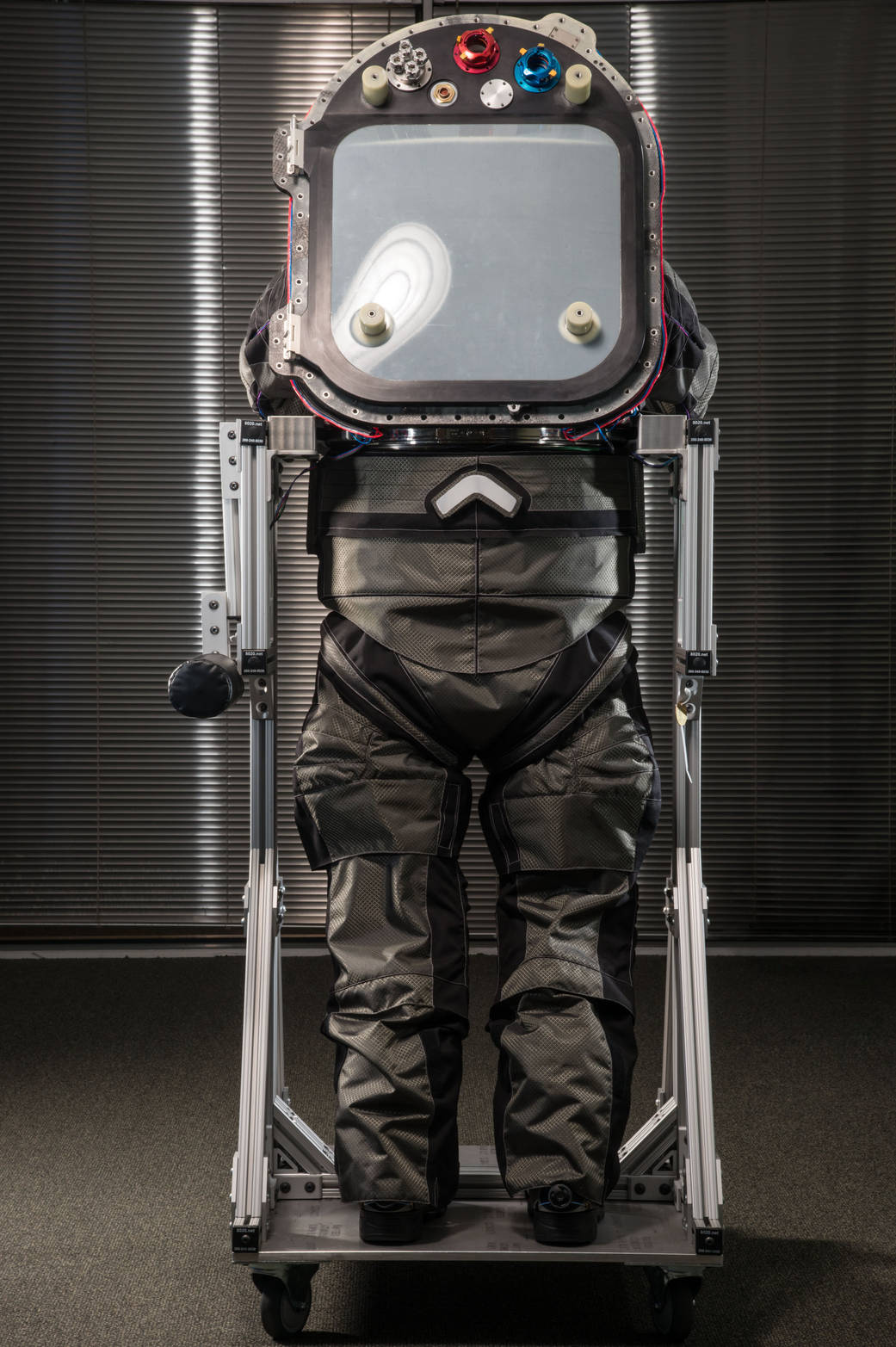 The Z series eliminates convolute joints for bearing joints, making knees and elbows more easily flexed. The Z-2 can also be entered from a hatch, instead of worn and attached. This makes it quicker and easier to enter and exit, and suits could be mounted externally on the ship and entered solely via suitports. A hands-free display is also a necessity to help keep track of time and suit performance. NASA also credits 3D printing and scanning as essential components to its current prototyping, but also as a way to ensure a perfect fit for space scientists. To improve hand tactility and reduce stresses, the Z-2 currently has 62 glove configurations. There are still many years of testing and development ahead, but for a piece of equipment so important it's never too early to product design. The Z series eliminates convolute joints for bearing joints, making knees and elbows more easily flexed. The Z-2 can also be entered from a hatch, instead of worn and attached. This makes it quicker and easier to enter and exit, and suits could be mounted externally on the ship and entered solely via suitports. A hands-free display is also a necessity to help keep track of time and suit performance. NASA also credits 3D printing and scanning as essential components to its current prototyping, but also as a way to ensure a perfect fit for space scientists. To improve hand tactility and reduce stresses, the Z-2 currently has 62 glove configurations. There are still many years of testing and development ahead, but for a piece of equipment so important it's never too early to product design.
The Z-2, just as with all the space suits of the past 50 years, will be manufactured by ILC. As long as it gets the job done, I don't think many people are going to be checking the label.
| 


 Re: Building a Better Space Suit


