The Building & Design Blog is the place for conversation and discussion about building projects, tools and equipment, materials and hardware, and environment & energy. Here, you'll find everything from application ideas, to news and industry trends, to hot topics and cutting edge innovations.
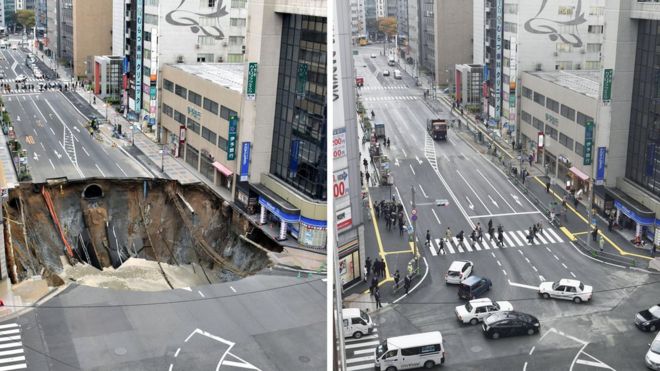
Earlier this month the Japanese city of Fukuoka made news when a very large sinkhole, almost 100 ft. wide and 50 ft. deep, devoured the roadway and utilities of a downtown business neighborhood. It hampered transportation and commerce, but the city’s mayor promised a swift repair to the vital infrastructure.
Sinkholes happen—all the time, actually. So the news wasn’t the occurrence of a sinkhole, but more so that Japanese officials, engineers and workers had the massive chasm repaired, filled and like-new within a week. After the fix, Fukuoka’s mayor issued an apology for the inconvenience, promised the street was now 30 times stronger than the original, and launched in investigation into why it happened. Consider this excellent repair and response a testament to Japanese efficiency and organization (and a type of concrete-filled soil designed for mining that hardens when wet).
Sinkholes are quite common, but in most other countries they would take weeks, months or even longer to fix. The United States has many sinkholes each year but no state suffers sinkholes quite like the state of Florida, where they are a leading infrastructure nuisance due to the state’s landscape composition.
Sinkholes typically develop in one of two ways. Sinkholes that occur naturally are typically found in karst topographies. These are locations where water primarily drains away via deep underground caverns and rivers. The bedrock is composed of carbonate or evaporite rocks, or contains salt beds, all of which erode in the presence of water. Florida’s bedrock is primarily limestone and dolostone, which support a soil type that is sandier than many other state’s. Eventually the underground voids cave in.
Other sinkholes, especially those found in cities, are typically man-made. The one in Japan is believed to be the result of underground excavation in the area, although it is too soon to tell for sure. Most sinkholes that are the result of humans occur in locations where underground utilities, such as sewers and water mains have degraded to the point of collapse. Yet these sinkholes tend to be smaller. Large man-made ones are the result of abandoned mines that have finally caved in, such as The Grandfather sinkhole, located in Berezniki, Russia, which measures more than 1,000 ft. wide, 1,300 ft. long, and nearly 800 ft. deep.
Ultimately, there is little that can be done to predict sinkholes. Since the entire state of Florida is located on soluble bedrock, there is hope that eventually technology can help detect sinkholes sites before they hurt anyone or damage property. For a few years NASA has been testing interferometric synthetic aperture radar (InSAR), a type of airborne radar that can detect small deformations in the Earth’s surface from miles above. By observing an area for a period of time, scientists are able to determine how the Earth’s surface changes over time.
Incredible video of the Bayou Corne sinkhole:
In 2011 and 2012, the InSAR program measured the surface of the Earth around Bayou Corne, La. When a 25-acre large sinkhole formed at the site in August 2012, scientists noticed the ground had shifted months in advance, in some spots up to 10 inches, towards the eventual site of the sinkhole. InSAR hasn’t been used heavily for sinkhole prediction, but shows promise. Last summer InSAR predicted that two sinkholes in rural Texas were growing and expected to merge.
It seems the sinkholes are yet another trade-off for Florida’s beautiful weather. All that sun also brings rain, which ultimately contributes to the sinkhole problem. Will there ever be a way to predict and stop sinkholes? It seems unlikely in our lifetimes, but at least the Japanese have learned how to streamline the repair.




 Re: Sinkholes Happen


