Roger's Equations Blog

Roger's Equations

This blog is all about science and technology (with occasional math thrown in for fun). The goal of this blog is to try and pass on the sense of excitement and wonder I feel when I read about these topics. I hope you enjoy the posts.

Previous in Blog: Deriving the Speed of Light   Next in Blog: Euler Formula
Close
Close
Close
7 comments
Rating: Comments: Nested

Quadratic Formula and Cubic Formula

Posted September 19, 2006 12:51 PM by Bayes

Often times we use formulas without any idea where they came from. Today I'm going to show where the general solution to the Quadratic Equation comes from.

A quadratic equation is an equation of the form:

ax2+bx+c=0

This equation has solutions in the form of:

A Cubic equation is an equation of the form:

ax3+bx2+cx+d=0

This Equation has solutions in the form of:
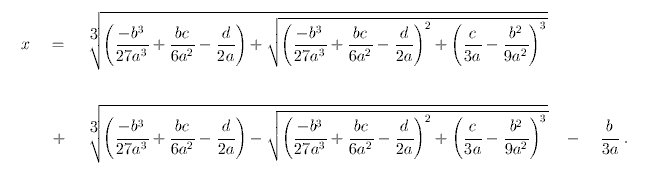
There is also a Quartic Equation that can be solved, the solutions are complicated to say the least and beyond the scope of this blog. The Quintic Equation and Higher Equations don't have a nice formula for the solutions.

Today I'm just interested in showing where the solution for the Quadratic Equation comes from. You may find remembering the derivation for the formula is easier then the formula itself.

So, we start with the Quadratic Equation:

ax2+bx+c=0

The first step is to multiply both sides of the above equation by 1/a
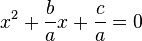
Next we subtract c/a from both sides

Next we want to complete the square so we add b2/4a2 to both sides

Which is equal to

Next we take the square root of each side

Finally we subract b/2a from both sides

So our final solution is

Notice that there are two solutions to the Quadratic equation. The + solution and the - solution from the formula above. A Cubic equation will have three solutions, a Quartic equation will have four solutions, etc.

If you're interested, here is some of the history of the Quadratic Equation.

Reply

Interested in this topic? By joining CR4 you can "subscribe" to
this discussion and receive notification when new comments are added.

"Almost" Good Answers:

Check out these comments that don't yet have enough votes to be "official" good answers and, if you agree with them, vote them!
Guru
Engineering Fields - Aerospace Engineering - Retired South Africa - Member - The Rainbow-nation Engineering Fields - Engineering Physics - Relativity & Cosmology Popular Science - Cosmology - The Big Picture!

Join Date: May 2006
Location: Pretoria, South Africa
Posts: 3804
Good Answers: 69
#1

Re: Quadratic Formula and Cubic Formula

09/20/2006 6:47 AM

This brought back memories of my engineering-school days, where were shown how to calculate the quadratic equation's roots on a slide-rule with the minimum number of 'slides' of the rule.

First write the equation so that the coefficient of x equals 1 (actually dividing both sides by a), i.e.,

x^2 + px + q = 0, where p = b/a and q = c/a.

The two roots are then:

x = -(p/2) ± √[(p/2)^2-q]

The √[…] means square root - sorry, did not have an equation editor handy.

The trick lies in having (p/2) twice and q on its own.

__________________
"Perplexity is the beginning of knowledge." -- Kahlil Gibran
Reply
Anonymous Poster
#2
In reply to #1

Re: Quadratic Formula and Cubic Formula

09/20/2006 9:23 AM

Cool point, I like simple disscusions that could have complicated answers. Another question is which equation suits which data set "best". These may not be the standard forms accepted by the respective science field for publication and are therefore overlooked. I havent bothered with the science of arithmetic since I discovered TK Solver, MathCad and , CurvExpert. I quess it is because that far beyond being curious about arithmetic, I jealously gaurd my time so that family and football can be important to me. Arithmetic for the sake of arithmetic is as consuming and productive as playing games on the internet. This is a handy tool for pump calibration and is best solved using TK Solver.

GPM=

(A*(RPM/RD))-((B*L^C)*((RD/RPM)^((2*C)-1)))

RD= Design RPM

RPM= Actual Pump RPM L= Static Head ("Lift")

Reply
The Engineer
Engineering Fields - Engineering Physics - Physics... United States - Member - NY Popular Science - Genetics - Organic Chemistry... Popular Science - Cosmology - New Member Ingeniería en Español - Nuevo Miembro - New Member

Join Date: Feb 2005
Location: Albany, New York
Posts: 5060
Good Answers: 129
#3
In reply to #2

Re: Quadratic Formula and Cubic Formula

09/20/2006 10:18 AM

You wrote:

"Arithmetic for the sake of arithmetic is as consuming and productive as playing games on the internet."

I'm not sure what you mean by Arithmetic for the sake of arithmetic, but I'm with you on Football. The reason I learn derivations is so I know what I"m talking about. It's been my experience that it takes the real world about 5 minutes present a problem your software can't handle. If you understand where the formula came from in the first place, or the math behind a computer program, you can more often than not figure out a work around.

Reply Score 1 for Good Answer
Guru
Engineering Fields - Control Engineering - New Member China - Member - New Member

Join Date: Sep 2006
Location: CHINA
Posts: 2945
Good Answers: 14
#6
In reply to #1

Re: Quadratic Formula and Cubic Formula

09/18/2007 10:29 PM

Its algbra of first grade in middle school. you hve several solutions method except above mehod.

if you want to solve it with slide rule. it will use Weda therom. the roots can be read easily on the rule scale.

My slide rule still sleeps in somewhere of my room.

Reply
Guru
Engineering Fields - Aerospace Engineering - Retired South Africa - Member - The Rainbow-nation Engineering Fields - Engineering Physics - Relativity & Cosmology Popular Science - Cosmology - The Big Picture!

Join Date: May 2006
Location: Pretoria, South Africa
Posts: 3804
Good Answers: 69
#4

Re: Quadratic Formula and Cubic Formula

09/26/2006 2:01 PM

Hi Roger

As a curiosity, here is a variant of the cubic equation solution you gave. I've used this algorithm to solve a cubic equation for the turning points of an elliptical orbit around a black hole.

This is a box in a chapter named "Orbital equations" on my website and eBook Relativity 4 Engineers.

__________________
"Perplexity is the beginning of knowledge." -- Kahlil Gibran
Reply
Anonymous Poster
#5

Re: Quadratic Formula and Cubic Formula

03/24/2007 4:01 AM

Cubic Equations.

I was taught a solution using trig identities which worked fine for my purpose (and had the bonus that I could follow its derivation ).However it fell down (at least for me !) with (-1)0.5. I later found another method which worked well in all case (I don't think it was a re-arrangement of the method you quote) , though no derivation was given. Are ther any neat tricks to get around the 'nasty' roots with i ?

Reply
Guru

Join Date: Mar 2012
Posts: 2189
Good Answers: 84
#7
In reply to #5

Re: Quadratic Formula and Cubic Formula

09/29/2012 3:33 AM

I found it far more useful to get comfortable with complex numbers. They're so useful in so many ways (such as reducing long and cumbersome trig problems to simple algebra) that I don't know how I got on without them.

The 'i' in the root(s) is simply telling you that the solution is a perfectly ordinary complex number, ie, the root does not lie on the Real axis but is above or below it.

Reply
Reply to Blog Entry 7 comments

"Almost" Good Answers:

Check out these comments that don't yet have enough votes to be "official" good answers and, if you agree with them, vote them!
Copy to Clipboard

Users who posted comments:

Anonymous Poster (2); Bayes (1); cnpower (1); europium (1); Jorrie (2)

Previous in Blog: Deriving the Speed of Light   Next in Blog: Euler Formula

Advertisement
