|
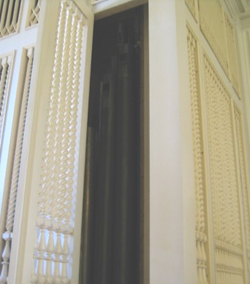
Let's complete our tour of Hildene by taking a look upstairs and then going outside to visit Robert Todd Lincoln's observatory. When you finish the first flight of stairs, stop on the landing and take a look around. The center hall is magnificent, of course, but did you notice the open panel with the pipes inside (see the photo at left)? In 1908, Robert Todd Lincoln purchased this massive 1,000-pipe organ for his wife Mary, who, incidentally, had the same first name as Mr. Lincoln's mother, Mary Todd, the wife of slain President Abraham Lincoln.
The Aeolian Pipe Organ
Enough genealogy, you say? Well, you might like to know that this Aeolian pipe organ is, according to hildene.org, "the oldest residential pipe organ with a player attachment still in its original location and still in working order in the United States." Once the largest music company in America, Aeolian built organs, pianos, and other instruments during a time without radio or television - or MP3 players, for that matter.
The reed pipe-organ at Hildene has 242 scrolls, most of which are still in good condition. These rolls, which are placed in a spool box above a console, help "play" the organ. Until Aeolian began selling fully-automatic pipe organs in 1915, a user set the controls and pressed various "stops" to activate individual reeds. The pipe organ at Hildene was retrofitted for automatic operation, however, and still greets visitors with early twentieth-century sounds.The Sitting Room
The tall case clock in the center hall just chimed, so it's almost time for TechnoTourist to go! But first, let's finish our ascent of the staircase and ake a look at the sitting room. Mary Harlan Lincoln would sometimes retreat to this place to play her 1876 Steinway upright piano (image below), or admire the formal gardens in the backyard. A birthday gift from her daughter, this parterre garden featured a French design. When the garden was in bloom, each section of privit represents a different panel of a stained glass window. TechnoTourist neglected to take a picture here, but our trip to the observatory will make up for this omission.
The Observatory
A lifelong astronomer, Robert Todd Lincoln sited his observatory on a high point of land just 80 yards from his Hildene home. Perched atop a base made of concrete and brick, the light-colored observation dome is 14-ft. in diameter and 6-in. thick. Originally covered in canvas, it was delivered by horse and wagon over dirt roads.

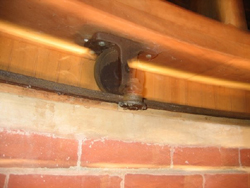
Inside the observatory, an iron rail runs around the base of the dome and mates with casters. By using a metal rod, an astronomer can rotate the heavy but well-balanced dome a full 360 degrees. The observatory dome, built by the Eagle Square Company in nearby Shaftsbury, Vermont, cost $182.16 (USD) in June 1908.
After deeming the original telescope too small, Robert Todd Lincoln ordered a larger, six-inch refracting telescope from the Warner and Swasey Company of Cleveland, Ohio. The lens was ground by the John A. Brashear Company of Pittsburgh, Pennsylvania. Bought at a cost of $19,200, the telescope was installed in the Hildene observatory in the summer of 1909. Several layers of brick were then added to the structures' walls to accommodate the larger instrument.

Today, members of the Hildene Astronomy Club care for and use the observatory at Hildene.
Editor's Note: Part 1, Part 2, and Part 3 of this series are already on CR4.
Additional Resources:
http://members.socket.net/~rtaylor/aeolian_pipe_organ.html
| 


 Re: TechnoTourist Visits Hildene (Part 4)


