Previous in Forum: Transient Analysis - Need Help For Transformer Model   Next in Forum: Linear Actuator 50mm~75mm Displacement
Close
Close
Close
35 comments
Rating: Comments: Nested
Anonymous Poster #1

Power and Ohm's Law

04/14/2016 6:50 AM

If Power = V * I, why as per Ohm's law it V=IR.

Where V is voltage, I is Current and R is resistance.

why In power equation voltage is inversely proportional to current and in Ohm's law voltage is directly proportional to current ?

Reply
User-tagged by 1 user
Interested in this topic? By joining CR4 you can "subscribe" to
this discussion and receive notification when new comments are added.

Good Answers:

These comments received enough positive votes to make them "good answers".

"Almost" Good Answers:

Check out these comments that don't yet have enough votes to be "official" good answers and, if you agree with them, vote them!
Guru
United Kingdom - Member - Not a New Member Hobbies - Musician - New Member Hobbies - Fishing - New Member

Join Date: May 2006
Location: Reading, Berkshire, UK. Going under cover.
Posts: 9684
Good Answers: 468
#1

Re: Power and Ohm's Law.

04/14/2016 7:09 AM

Oh, dear.

__________________
"Love justice, you who rule the world" - Dante Alighieri
Reply Score 1 for Off Topic
Anonymous Poster #2
#5
In reply to #1

Re: Power and Ohm's Law.

04/14/2016 7:33 AM

back to the books......... you have em screwed up

Reply Off Topic (Score 7)
Guru
Engineering Fields - Electrical Engineering - Been there, done that. Engineering Fields - Control Engineering - New Member

Join Date: Dec 2008
Location: Long Island NY
Posts: 15600
Good Answers: 981
#2

Re: Power and Ohm's Law.

04/14/2016 7:30 AM

For power to be constant then voltage and current are inversely proportional to each other. You are forgetting which attribute, if any, is a constant and which are variables.

__________________
"Don't disturb my circles." translation of Archimedes last words
Reply Score 1 for Good Answer
5
Guru
Popular Science - Weaponology - New Member United Kingdom - Member - New Member

Join Date: May 2007
Location: Harlow England
Posts: 16512
Good Answers: 670
#3

Re: Power and Ohm's Law.

04/14/2016 7:30 AM

You are completely overthinking this.
It is simple algebraic manipulation of equations.
Your statement:-
"In power equation voltage is inversely proportional to current"
Is nonsensical.... the power equation is about power which is pretty obviously directly proportional to both voltage and current.
More volts= more power.
More current=more power.
Don't try and draw conclusions about the Voltage from the power equation as power is rarely a constant... it is more often a result of the other variables.
If you want to talk about voltage, then rearrange the equation to give voltage on the left of the "=" sign and the relevant variables that interest you on the right.
E.G
V=IR which is fair enough and pretty self explanatory.
Or
V=P/I which is again fairly self explanatory... If P increases then V increases (assuming constant I).
If I increases then V decreases (assuming constant P which is an unlikely situation).
BUT
You can't start messing with 3 variables at once. One is always dependent on the other 2.
I'd suggest you ignore power. Just work with V I and R... once you have your values, you can then calculate power.

Del

__________________
health warning: These posts may contain traces of nut.
Reply Good Answer (Score 5)
Anonymous Poster #3
#9
In reply to #3

Re: Power and Ohm's Law.

04/14/2016 8:15 AM

Taking copyrighted material (without permission) from one of the textbooks published by the Kris-Del Institute for Electrical Engineering:

for voltage think of how fast an arrow is traveling
for current think of how heavy an arrow is
for resistance think of how dense the straw is packed behind the target
for power think of how far the arrow goes into the target and straw pack

Reply
Power-User

Join Date: Nov 2015
Posts: 133
#4

Re: Power and Ohm's Law.

04/14/2016 7:32 AM

I'm pretty sure you done a "typo error", don't you think?

Both equation, displays direct proportionality between Current "I" and voltage "V"

__________________
formerly Legolaz
Reply Off Topic (Score 3)
Guru

Join Date: Jul 2005
Location: Stoke-on-Trent, UK
Posts: 4496
Good Answers: 137
#10
In reply to #4

Re: Power and Ohm's Law.

04/14/2016 9:21 AM

No, in his Power = V * I, V is inversely proportional to I if power is constant. Whether power is constant is another matter, covered in various posts.

__________________
Give masochists a fair crack of the whip
Reply
Guru

Join Date: Feb 2011
Posts: 7025
Good Answers: 207
#6

Re: Power and Ohm's Law.

04/14/2016 7:36 AM

do you see R anywhere?

Reply Score 1 for Off Topic
Guru

Join Date: Mar 2007
Location: by the beach in Florida
Posts: 33392
Good Answers: 1817
#12
In reply to #6

Re: Power and Ohm's Law.

04/14/2016 11:21 AM

The "R" is resisting

__________________
All living things seek to control their own destiny....this is the purpose of life
Reply
Guru
Popular Science - Weaponology - New Member United Kingdom - Member - New Member

Join Date: May 2007
Location: Harlow England
Posts: 16512
Good Answers: 670
#7

Re: Power and Ohm's Law.

04/14/2016 7:43 AM

Another way of looking at it:-
"In power equation voltage is inversely proportional to current"
This isn't really right because you are looking at the equation:-
V=P/I and in the real world if you increase I then P would increase as well and thus V would remain constant!

You can' independently adjust all the variables.
Del

__________________
health warning: These posts may contain traces of nut.
Reply
Anonymous Poster #2
#8

Re: Power and Ohm's Law.

04/14/2016 7:49 AM

Ohm's law equation (formula): V = I × R and the power law equation (formula): P = I × V. P= power, I or J = Latin: influare, international ampere, or intensity and R = resistance. V = voltage, electric potential difference Δ V or E = electromotive force (emf = voltage).

Reply Score 1 for Good Answer
Guru

Join Date: Apr 2010
Location: About 4000 miles from the center of the earth (+/-100 mi)
Posts: 9910
Good Answers: 1141
#11

Re: Power and Ohm's Law.
04/14/2016 11:07 AM

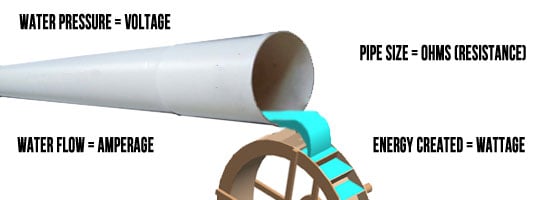
Think of it in hydraulic terms: Voltage=pressure, Current=flow. Resistance impedes current flow. With more resistance, you have more pressure but less flow.

Power is pressure x flow. You have to have both pressure and flow to get any power.

That's as simple as I can make it.

Reply
Guru

Join Date: Oct 2008
Posts: 42355
Good Answers: 1693
#13

Re: Power and Ohm's Law.

04/14/2016 7:52 PM

Somewhere is going:

Reply Score 1 for Good Answer
Power-User

Join Date: Jul 2008
Location: Adelaide, Australia
Posts: 403
Good Answers: 14
#14

Re: Power and Ohm's Law.

04/15/2016 12:28 AM

Has anyone mentioned that Power is in Watts, is that what is confusing you?

Tony

__________________
The nice thing about Standards is there are so many to choose from.
Reply
Guru

Join Date: Feb 2012
Posts: 595
#15

Re: Power and Ohm's Law.

04/15/2016 4:28 AM

P = U·I = (∂A1/∂q1)·(∂q2/∂t1) = ... = ∂A / ∂t = Fi·∂s / ∂t = m·a · ∂s / ∂t = m·(∂s / ∂²t) · ∂s / ∂t = ... = m · ∂²s / ∂³t

R = U/I = (∂A2/∂q3) / (∂q4/∂t2) = ... = ∂A·∂t / ∂²q = !!! = k·(F·∂s·∂t) / (F·∂²s) = !!! = k · ∂t / ∂s

the same "mistake" again :

P = m · ∂²s / ∂³t , I = ∂q / ∂t

R = k · ∂t / ∂s , I = ∂q / ∂t

Shortly put - it´s because the P and R represent different statistical factors

__________________
ci139
Reply Score 2 for Off Topic
Guru

Join Date: Jul 2005
Location: Stoke-on-Trent, UK
Posts: 4496
Good Answers: 137
#17
In reply to #15

Re: Power and Ohm's Law.

04/15/2016 4:53 AM

I suppose this is a joke?

__________________
Give masochists a fair crack of the whip
Reply
Guru

Join Date: Oct 2009
Location: sometimes Wales,UK.. was Libya, now Oman!
Posts: 1715
Good Answers: 117
#16

Re: Power and Ohm's Law

04/15/2016 4:38 AM

Many years ago, teaching a group of fresh graduates the fundamentals of electrically powered centrifugal pumps for the oil industry, one of my bright sparks of a student then decided that Ohms Law did not and could not be applied to a submersible pump and its operation, despite the whole pumping system being powered by a rather large HP motor.

When asked how he had come up with this and pointing out that Ohms Law applied to all thing electrical (the motor) he was still steadfast in his statement.

In return to rebuke him I then told him the following....

"Son, the laws of physics have been about the dawn of time and Ohms Law is one such law. If it now doesn't work or cannot be applied then you will have to find an alternative or rewrite Ohms Law.

If you decide to rewrite Ohms Law as you will not find an alternative, then you better think of rewriting the others too, as they will also be wrong."

"BUT.... before you lock yourself away in a darken room for the next thirty years, rewriting the Laws of Physics in an attempt to get a Noble Peace prize, I would like you to remember one thing.... and that is what Scott would always say to Captain Kirk on the bridge of the Starship Enterprise....

"Ye canna change the Laws of Physics Cap't!!"

Our OP is that bright spark..... there is one in every generation!!

__________________
The square root of nothing is what you make it!
Reply
Guru

Join Date: Oct 2009
Posts: 1460
Good Answers: 30
#18
In reply to #16

Re: Power and Ohm's Law

04/15/2016 5:36 AM

I have a certain sympathy with your student. Ohm's law, strictly speaking, relates only to DC voltage, DC current and resistance. As soon as you discuss an AC-driven pump you introduce further complications, including magnetic effects (back EMF) and frequency-dependent impedance rather than straight resistance.
I also have to point out that your assertion that the laws of physics have been around since the dawn of time is a logical postulate which itself requires verification:)

Reply
Guru

Join Date: Oct 2009
Location: sometimes Wales,UK.. was Libya, now Oman!
Posts: 1715
Good Answers: 117
#21
In reply to #18

Re: Power and Ohm's Law

04/15/2016 2:17 PM

Ohms law may be relative to DC when discovered, but the students today(including mine) are not taught that.

And while you may introduce back EMF and all the other lovely other things we know and associate with AC supplies, for simple power and other calculations, Ohms Law works.

Lets not try to over think it, says me... KISS!

As for the Laws of Physics being around since the dawn of time.. of course they have!

They were not invented, only discovered!

Take Newton, an apple and gravity! Always there, but never discovered.. need I go on?

__________________
The square root of nothing is what you make it!
Reply
Guru

Join Date: Oct 2009
Posts: 1460
Good Answers: 30
#22
In reply to #21

Re: Power and Ohm's Law

04/16/2016 5:41 AM

I now have even more sympathy with your student, as you appear unwilling to listen. Allow me to repeat my message: it is an article of faith among scientists that the laws of physics have existed since the dawn of time, but there is no proof that this is so. The evidence may be excellent within our observable range, but our observable range is limited in both time and space.

Reply
Guru

Join Date: Oct 2009
Location: sometimes Wales,UK.. was Libya, now Oman!
Posts: 1715
Good Answers: 117
#24
In reply to #22

Re: Power and Ohm's Law

04/17/2016 4:26 AM

Listen to what?

Physics.. it is all around us, governs EVERYTHING we do, from the internal combustion engine to your refrigerator.

You can't change them only use them... so you might have sympathy for a numpty student that doesn't know is arse from his elbow, I wonder if you fall into the same box as him.

If you can prove to me that the laws of physics were not around at the dawn of time, then I am happy to hear you out! Until then.. I wait!

__________________
The square root of nothing is what you make it!
Reply
Guru

Join Date: Oct 2009
Posts: 1460
Good Answers: 30
#26
In reply to #24

Re: Power and Ohm's Law

04/17/2016 8:48 AM

If you can prove to me that the laws of physics were not around at the dawn of time, then I am happy to hear you out! Until then.. I wait!
Sorry, you are still not listening hard enough. You make the assertion. I query the assertion as unprovable. It is up to you to prove the truth of the assertion. It is up to me to continue to query it.

Reply
Guru

Join Date: Oct 2009
Location: sometimes Wales,UK.. was Libya, now Oman!
Posts: 1715
Good Answers: 117
#27
In reply to #26

Re: Power and Ohm's Law

04/17/2016 9:27 AM

Then Sir.. you are a fool!!

__________________
The square root of nothing is what you make it!
Reply Score 1 for Off Topic
Guru

Join Date: Oct 2009
Posts: 1460
Good Answers: 30
#30
In reply to #27

Re: Power and Ohm's Law

04/17/2016 5:52 PM

Thank you. Clearly what you are lacking in logic you more than make up for with abuse.

Reply
Guru

Join Date: Jul 2005
Location: Stoke-on-Trent, UK
Posts: 4496
Good Answers: 137
#23
In reply to #21

Re: Power and Ohm's Law

04/16/2016 7:36 AM

I too have some sympathy with your student.

There aren't many physical laws that are universally applicable. Conservation of mass and energy are pretty good, but following E = m.c2 it's only the total that's conserved. Newton's laws of motion and gravity are fine for most purposes and once thought of as universal, but now known to have limits.

Ohm's law is no exception. It applies to (most) metallic conductors at constant temperature, but there are many situations where it doesn't, especially if the system considered is viewed as a "black box". Eg an incandescent lamp bulb, where at low voltage (hence low power and temperature, the resistance is low, but higher at design voltage. Giving rise to a high inrush current. Then there's diodes (solid state) including Zener diodes, LEDs, electrolytic cells etc.

With AC motors, within allowable voltage limits eg 380 - 420 volt 3-phase, at constant power higher volts means lower amps, as can be seen in manufacturers' data. When driving eg a centrifugal pump, increased volts causes a slight increase in speed, hence power drawn, but not enough to negate the reduced amps required (and as a thought experiment power could be kept unchanged, by adjusting the pump discharge throttling, and anyway the data is at fixed rated output). I don't know much about DC motors, it's probably similar, but needing more twiddling to maintain constant shaft power with changed voltage. Taking account of back-EMF, I'd guess Ohm's law applies to the windings, but it's different looking at the motor as a whole. That's maybe what your student had in mind.

__________________
Give masochists a fair crack of the whip
Reply
Guru

Join Date: Oct 2009
Location: sometimes Wales,UK.. was Libya, now Oman!
Posts: 1715
Good Answers: 117
#25
In reply to #23

Re: Power and Ohm's Law

04/17/2016 4:42 AM

Codemaster...

Fresh out of their protective shell of college, the students I had, while bright, had no practical experience in engineering, no skill sets to speak of and no common sense and no idea on how to apply what they had had been taught in college.

My job and that of the other instructors was to teach them baby steps in learning the practical side of some of the theory they had learnt in college, which was extremely difficult. These guys had been programmed in college, and if what we taught them did not fit in with that they thought they knew (taught in college) we ended up taking them back to Basics 101.

As to what was in my students mind at the time?.. who knows, as he didn't.

As for all the lovely stuff like back EMF, changing loads, frequency variants, power factor, torque output, AC theory etc, etc.... before anyone can understand that, they MUST have a firm grip of the basics.
These students did not understand the basics, so a comment like "ohms law doesn't apply" is so left field, and based on nothing, it's plain stupidity!

__________________
The square root of nothing is what you make it!
Reply
Guru

Join Date: Jul 2005
Location: Stoke-on-Trent, UK
Posts: 4496
Good Answers: 137
#28
In reply to #25

Re: Power and Ohm's Law

04/17/2016 10:13 AM

Brich

I don't think you read my post. Your student may have been somewhat bumptious, but he was right in thinking you cannot directly apply Ohm's law to the pump motor, submersible or otherwise, or any other motor. Ohm's law would imply current proportional to voltage, and power to volts2. If you measure the static resistance with a multimeter, and calculate current from supply voltage, it would be much higher than actual FLA. Motors don't behave like that. There's no option but to bring back-EMF into it, and inductance etc if it's AC. If that's too advanced for the class, better IMHO to stick to ordinary resistors for the time being. But let's not fall out about it, we've had an interesting chat .

I still say Ohm's is not a universal law (though it probably applies near enough to DC motor windings if used correctly). Plenty of other scientific laws are in the same category eg the ideal gas laws - OK for most everyday purposes, but not for any old pressure and temperature.

__________________
Give masochists a fair crack of the whip
Reply
Guru
Engineering Fields - Electrical Engineering - Been there, done that. Engineering Fields - Control Engineering - New Member

Join Date: Dec 2008
Location: Long Island NY
Posts: 15600
Good Answers: 981
#29
In reply to #28

Re: Power and Ohm's Law

04/17/2016 10:29 AM

There is a phasor form of Ohms Law that handles AC very accurately. This is still considered to be Ohm's Law. The power, current and voltage do still have the same proportionality relationships. With one of these variables set to a constant, the other two will have the same proportional relationship (inverse or not) as when one works with a simple DC source. The difference between these two will just be that a complex, frequency dependent impedance (Z) sets the ratio and that the current and voltage wave forms will likely not be in phase.

I know both of you know this. Now you and brich should shake hands and agree that you were both just failing to communicate.

What surprises many students is how quickly this seemingly simple relationship gets very complicated when a non-linear device in the load produces multiple frequencies (harmonics) in a circuit.

__________________
"Don't disturb my circles." translation of Archimedes last words
Reply
Guru

Join Date: Aug 2005
Location: Hemel Hempstead, UK
Posts: 5826
Good Answers: 322
#19

Re: Power and Ohm's Law

04/15/2016 6:49 AM

In general the diameter of a tree trunk is proportional to the height of the tree.

Where the volume of wood in the trunk is proportional to the diameter squared x the height.

why In the volume equation height is inversely proportional............?

I really wish I hadn't started this, at first it seemed like a really simple way of pointing out the mistake in the OP's thinking. I still hold that it makes about as much sense, but when I realised that the volume is a function of the square of the diameter I began to wonder if the height would normally be directly related to diameter or cross sectional area or somewhere in between. I started trying to look it up and found that most measures of tree diameter girth are done "at breast height": which immediately begs the question whose breast?.....

__________________
If you spend all your time looking for people and things to complain about: trust me, you will find plenty to complain about.
Reply
Guru
United States - Member - New Member Engineering Fields - Power Engineering - New Member

Join Date: Sep 2006
Location: California, USA, where the Godless live next door to God.
Posts: 4665
Good Answers: 804
#20

Re: Power and Ohm's Law

04/15/2016 1:57 PM

__________________
** All I every really wanted to be, was... A LUMBERJACK!.**
Reply Score 1 for Good Answer
Associate
Engineering Fields - Power Engineering - New Member

Join Date: Oct 2015
Posts: 33
Good Answers: 2
#31

Re: Power and Ohm's Law

04/18/2016 4:11 AM

Energy can neither be created nor destroyed; rather, it transforms from one form to another.
As an Electrical Engineer i always consider the above statement whenever i am crossing other discipline this way i do not encounter difficulties in relating electrical parameters to other discipline. I hope this helps

Reply
Participant

Join Date: Oct 2011
Posts: 3
#32

Re: Power and Ohm's Law

04/18/2016 8:30 AM

Hello,

P=U*I watt

W =Joule/sec

U =Joule/Coulomb

I= Coulomb/sec

Then U*I =Joule/sec (watt)

P=I^2 * R

if you using the just dimensions for I and R then the answer is in Watts

Reply
Guru

Join Date: Jul 2005
Location: Stoke-on-Trent, UK
Posts: 4496
Good Answers: 137
#33
In reply to #32

Re: Power and Ohm's Law

04/18/2016 9:28 AM

Not sure what that's meant add to it, but you left off P = U2/R

__________________
Give masochists a fair crack of the whip
Reply
Guru
Popular Science - Weaponology - New Member Fans of Old Computers - PDP 11 - New Member Technical Fields - Architecture - New Member Hobbies - HAM Radio - New Member

Join Date: Oct 2009
Location: Maine, USA
Posts: 2168
Good Answers: 71
#34

Re: Power and Ohm's Law

04/18/2016 3:25 PM
__________________
Tom - "Hoping my ship will come in before the dock rots!"
Reply
Guru
Engineering Fields - Electrical Engineering - Been there, done that. Engineering Fields - Control Engineering - New Member

Join Date: Dec 2008
Location: Long Island NY
Posts: 15600
Good Answers: 981
#35
In reply to #34

Re: Power and Ohm's Law

04/18/2016 3:41 PM

That reminds me of reply #20. You left out the water wheel that explains power, too.

__________________
"Don't disturb my circles." translation of Archimedes last words
Reply
Reply to Forum Thread 35 comments

Good Answers:

These comments received enough positive votes to make them "good answers".

"Almost" Good Answers:

Check out these comments that don't yet have enough votes to be "official" good answers and, if you agree with them, vote them!
Copy to Clipboard

Users who posted comments:

Anonymous Poster (3); brich (5); ci139 (1); Codemaster (5); edelangh (1); Fredski (1); JohnDG (1); JRaef (1); lyn (1); mrbrightside (1); Peterpipper (1); phph001 (4); Randall (1); redfred (3); Rixter (1); SolarEagle (1); Tom_Consulting (1); Tonymech (1); user-deleted-1105 (2)

Previous in Forum: Transient Analysis - Need Help For Transformer Model   Next in Forum: Linear Actuator 50mm~75mm Displacement

Advertisement