Previous in Forum: Operate Power Plants in Remote Areas   Next in Forum: LED Technology COB vs. SMD
Close
Close
Close
17 comments
Rating: Comments: Nested
Commentator

Join Date: Feb 2009
Posts: 60
Good Answers: 3

Series Heating Effect vs. PF...

12/22/2016 4:14 PM

Greetings. Real simple one today ;o)

I'm having a bit of a "meltdown" trying to nail down a concise answer to the following hypothetical question:

Will a series resistance placed inline with a power-consuming item which is nominally rated at, say, 180W/400VA experience heating based solely upon the expressly-stipulated 180 watt rating of the consumer; or will power factor enter into the equation to increase the total heating effect in the aforementioned series resistance?

(lots of conflicting info out there in these matters)

Thanks a bunch!

Register to Reply
Interested in this topic? By joining CR4 you can "subscribe" to
this discussion and receive notification when new comments are added.

Good Answers:

These comments received enough positive votes to make them "good answers".

"Almost" Good Answers:

Check out these comments that don't yet have enough votes to be "official" good answers and, if you agree with them, vote them!
3
Guru
Engineering Fields - Power Engineering - New Member

Join Date: May 2007
Location: NYC metropolitan area.
Posts: 3230
Good Answers: 444
#1

Re: Series Heating Effect vs. PF . . .

12/22/2016 4:35 PM

It's a common question, and the stream of conflicting answers that is sure to follow will only add to the confusion!

That said, your series resistance only "sees" the current passing through it, and since that current is is the vector sum of the real current and the reactive current, it's "heating effect" will be equal to the (magnitude of the current)2 times the resistance, whether the PF is zero, leading, lagging, unity, or anything in between.

__________________
“Tell me and I forget. Teach me and I remember. Involve me and I learn.” Ben Franklin.
Register to Reply Good Answer (Score 3)
Guru

Join Date: Oct 2008
Posts: 42355
Good Answers: 1693
#3
In reply to #1

Re: Series Heating Effect vs. PF . . .

12/22/2016 6:29 PM

Oh come now.

"It's a common question, and the stream of conflicting answers that is sure to follow will only add to the confusion!"

"220 VAC Electric Baseboard Heater Without A Ground" seemed like a simple yes or no question too.

We are up to 112 "answers" and counting on that one.

Nothing's ever simple.

Register to Reply Score 1 for Good Answer
Guru
Engineering Fields - Power Engineering - New Member

Join Date: May 2007
Location: NYC metropolitan area.
Posts: 3230
Good Answers: 444
#5
In reply to #3

Re: Series Heating Effect vs. PF . . .

12/22/2016 8:34 PM

Agreed, but with one caveat; i.e., "Not on CR4" where opinion trumps over-rides fact more often than not! I'm sure that you get an occasional chuckle watching how "engineering facts" can get so easily confused with "engineering opinion".

__________________
“Tell me and I forget. Teach me and I remember. Involve me and I learn.” Ben Franklin.
Register to Reply Score 1 for Good Answer
Guru

Join Date: Oct 2008
Posts: 42355
Good Answers: 1693
#6
In reply to #5

Re: Series Heating Effect vs. PF . . .

12/22/2016 9:12 PM

Chuckle and guffaw!

Hey, we all have our moments.

Register to Reply
Guru

Join Date: Oct 2014
Location: Hemet, Land of milk and honey.
Posts: 2365
Good Answers: 36
#9
In reply to #3

Re: Series Heating Effect vs. PF . . .
12/23/2016 12:08 AM

Lyn, that was a " fun" question.

Did you see how many in the group came out to play :)

Register to Reply
Power-User

Join Date: Sep 2016
Location: SPAIN
Posts: 233
Good Answers: 13
#10
In reply to #1

Re: Series Heating Effect vs. PF . . .
12/23/2016 12:59 AM

All that leading and lagging theory sounds very old school for us, power electronics guys. Since nowadays there are plenty of modulated Power Supplies, the definition of PF changed a long time ago.

That being said, your argument is true taking into account the frequency response of the element in question.

__________________
Building the future!
Register to Reply
Guru

Join Date: Apr 2011
Posts: 8006
Good Answers: 286
#2

Re: Series Heating Effect vs. PF . . .
12/22/2016 5:08 PM

The power factor won't come into play for the series resistance, but can the other choice be correct, either?

Is the first answer the only other option to the second answer?

Does nominal rating usually/ever determine actual power/current/losses/heat?

If you have a power consuming item in a circuit consuming close to its 180 watt nominal rating and then you add a nonnegligible series resistance what conditions would be needed to keep the power consuming item consuming the same power? Wouldn't that have an effect on the heating of the series resistance and doesn't that depend not solely on the power consumption of the power consuming items, but in large part on the size of the series resistance added?

Looks like a trick question.

__________________
Eternal vigilance is the price of knowledge. - George Santayana
Register to Reply
Guru

Join Date: Apr 2010
Location: About 4000 miles from the center of the earth (+/-100 mi)
Posts: 9910
Good Answers: 1141
#4

Re: Series Heating Effect vs. PF . . .
12/22/2016 8:27 PM

What is constant is the applied voltage. Power equals voltage squared divided by impedance. Power will have a real and imaginary part. If your heater has resistance plus inductance then the impedance will be R + jX. Let's set the voltage to 1 to make calculations simpler.

P = 1 / (R + jX).

multiply by (R-jX)/(R-jX) to make the denominator real

P = (R-jX)/(R2+X2)

the real part (which generates heat) is R/(R2+X2)

Adding series resistance increases R. As R becomes larger, the denominator increases faster than the numerator, so the total real power becomes less.

Register to Reply Score 1 for Good Answer
Guru

Join Date: Apr 2010
Location: About 4000 miles from the center of the earth (+/-100 mi)
Posts: 9910
Good Answers: 1141
#7
In reply to #4

Re: Series Heating Effect vs. PF . . .

12/22/2016 10:15 PM

OK, thought about it some more and ran some numbers. Here is a simpler explanation. The same current goes through the heater and added resistance. So the power (current x voltage) is proportional to the impedance V = I (R + jX).

Total power = 400 VA and real power = 180 W for heater alone.

Power = 180*R + 357j *X [ sqrt(1802+3572)=400.]

The total power and real power will be proportional to the resistance R and inductive reactance X.

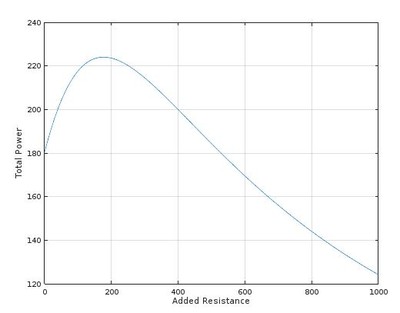
It turns out that as you add series resistance, the total power increases to a point and then decreases. Using the formula for power:

P = (R-jX)/(R2+X2) and plotting the real power

Register to Reply Score 1 for Good Answer
Guru

Join Date: Apr 2010
Location: About 4000 miles from the center of the earth (+/-100 mi)
Posts: 9910
Good Answers: 1141
#8

Re: Series Heating Effect vs. PF . . .

12/23/2016 12:04 AM

I've been trying to find a simple answer.

If voltage is constant, power is inversely proportional to Impedance: P = V2/Z

If impedance is real (resistance only), if resistance increases, power decreases.

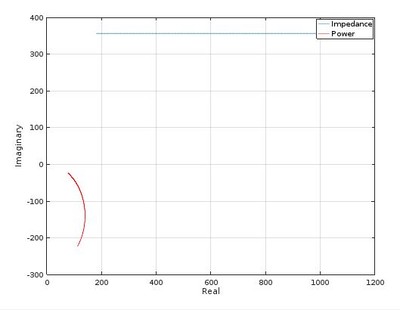
If impedance is complex (resistance + reactance), then if resistance increases (real part of impedance) then it does not mean that real power increases. Here's an example (Complex plot of Z in blue and Power in Red)

Register to Reply
Guru
Engineering Fields - Power Engineering - New Member

Join Date: May 2007
Location: NYC metropolitan area.
Posts: 3230
Good Answers: 444
#11
In reply to #8

Re: Series Heating Effect vs. PF . . .

12/23/2016 12:21 PM

You're way overthinking this, the OP's question was whether the current from the real power, or the current from the apparent power, causes the the resistor to heat up.

The answer is the current from the apparent power (S). Surely you don't think that if the load were purely inductive (or capacitive for that matter) then there wouldn't be any heating.

__________________
“Tell me and I forget. Teach me and I remember. Involve me and I learn.” Ben Franklin.
Register to Reply Score 1 for Good Answer
Guru

Join Date: Apr 2010
Location: About 4000 miles from the center of the earth (+/-100 mi)
Posts: 9910
Good Answers: 1141
#12
In reply to #11

Re: Series Heating Effect vs. PF . . .

12/23/2016 10:41 PM

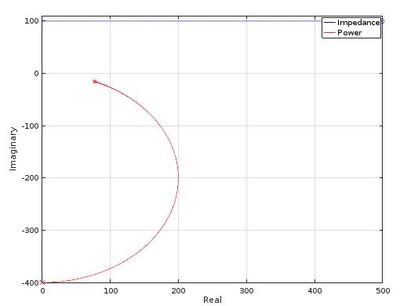
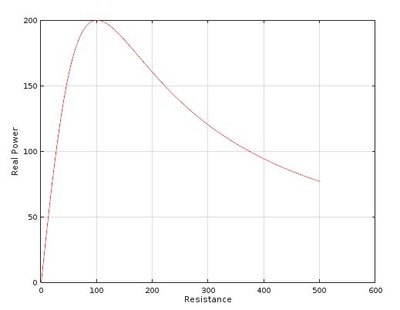
If you start with a pure inductor and add resistance, the total power dissipation (real power) will rise to a maximum when the resistance equals the inductive reactance. After that point, it will decline.

The OP had a heater which had resistance and inductive reactance, and in his case, the inductive reactance was greater than the resistance. (400 VA and 180W equates to 180 real power and 353 reactive power.) So adding more resistance caused the total (real) power to increase.

If there had been more resistance than inductive reactance in the heater, adding external series resistance would have resulted in a decrease in real power as it would have been on the downward slope of the power curve.

Impedance and Power on the complex plane:

Impedance = 100j + Resistance

Resistance = 0 - 500

Real Power as a function of Resistance:

Register to Reply
Guru

Join Date: Apr 2011
Posts: 8006
Good Answers: 286
#13
In reply to #11

Re: Series Heating Effect vs. PF . . .

12/23/2016 11:07 PM

Wait, if the load is purely inductive (or purely capacitive), so no resistance, what mechanism is responsible for the heating?

__________________
Eternal vigilance is the price of knowledge. - George Santayana
Register to Reply
Guru

Join Date: Apr 2010
Location: About 4000 miles from the center of the earth (+/-100 mi)
Posts: 9910
Good Answers: 1141
#15
In reply to #13

Re: Series Heating Effect vs. PF . . .

12/24/2016 11:21 AM

Power is a complex quantity if inductance or capacitance are present in the circuit. You are correct. If the load is pure inductance, power is purely imaginary and there is no heat. (See first plot in #12, at zero resistance power is 0 - 400j)

Register to Reply
Guru
Engineering Fields - Power Engineering - New Member

Join Date: May 2007
Location: NYC metropolitan area.
Posts: 3230
Good Answers: 444
#17
In reply to #15

Re: Series Heating Effect vs. PF . . .

12/25/2016 12:35 AM

"...power is purely imaginary and there is no heat..." in the inductor, of course, but real power (Watts) are dissipated in the series resistor that has the reactive current passing through it to reach the inductor, regardless of the angle of the current relative to the voltage.

__________________
“Tell me and I forget. Teach me and I remember. Involve me and I learn.” Ben Franklin.
Register to Reply
Guru

Join Date: Oct 2012
Location: 100 miles North from the World Center
Posts: 879
Good Answers: 42
#14

Re: Series Heating Effect vs. PF...

12/23/2016 11:48 PM

If we continue with the philosophy around the power losses in the inserted resistance we have to take the power factor into consideration.

If you intend to keep Srat and Prat you have to keep V2=V2rat [and I=Irat] and then you have

to rise the supply voltage V1.

In this case since the I=Irat [constant] the power factor does not matter indeed.

However, if you cannot do it, that means the supply voltage V1=Vrated the voltage V2 will be

less and the current will be less [and so S,P and Q] and then the losses in R1 will be less.

If Q=SQRT(S^2-P^2)=SQRT(400^2-180^2)=357.2 VAr

P=V2^2*R2/SQRT(R2^2+X2^2)

Q=-V2^2*X2/SQRT(R2^2+X2^2)

Q/P=X2/R2

P=V2^2/R2/SQRT(1+(Q/P)^2) R2=V2^2/P/SQRT(1+(Q/P)^2)

X2=R2*Q/P

V1=SQRT((V2+R1*I*COS(Fi2))^2+(R1*I*SIN(Fi2))^2) if you know V2

V2=sqrt(V1^2-(R*I*SIN(Fi2))^2)-R*I*COS(Fi2) if you know V1

Nevertheless V2<V2rat R2 and X2 remain the same[usually].

In this case I=V1/SQRT((R1+R2)^2+X2^2)

S=I*V2 P=S*cos(Fi2)

__________________
Julius
Register to Reply
Guru

Join Date: Sep 2016
Posts: 973
Good Answers: 9
#16

Re: Series Heating Effect vs. PF...

12/24/2016 11:45 PM

Dude, you need to wake up!!!

See the wattage of your resistors. Simple series circuitry will tell you half the voltage, Amperage goes twice. That's the source of your thingy heat up.

Example, rewire all your house wiring and make it in series. What do you think will happen to your appliances?

Register to Reply Score 2 for Off Topic
Register to Reply 17 comments

Good Answers:

These comments received enough positive votes to make them "good answers".

"Almost" Good Answers:

Check out these comments that don't yet have enough votes to be "official" good answers and, if you agree with them, vote them!
Copy to Clipboard

Users who posted comments:

7anoter4 (1); gutmonarch (1); Ivanov327950 (1); lyn (2); RAMConsult (4); Rixter (5); tonyhemet (1); truth is not a compromise (2)

Previous in Forum: Operate Power Plants in Remote Areas   Next in Forum: LED Technology COB vs. SMD

Advertisement