I understand that, in a given rest frame, standard clocks & rulers always span a constant metric interval. Adopting the MTW sign convention (-+++):
clocks from cycle to cycle span ds2 = -1
rulers from end to end span ds2 = +1
Particularly, when viewed from a valid embedding hyper-space, clocks always span the same hyper-spatial metric distance of one normalized unit. Even when the fabric of space-time warps, stretches, or shrinks, around them.
So, please ponder the usual FRW coordinate mesh (t,r) mapped into our ever-so-slightly closed space-time fabric. The *spatial* curvature requires:
ds2 = grr dr2 = dr2 / (1-r2) > dr2
because you can fit more standard rulers into one unit of differential *coordinate* distance dr, due to the curvature of the *spatial* slices of the space-time fabric.
But, by like logic, the *temporal* slices of space-time are also curved. For constant r, the time-like world-lines of rest-frame clocks move both "forward" in the direction of increasing *coordinate* time t, and also "outward" in the direction of increasing radius-of-curvature scale factor a(t). That requires:
ds2 = gtt dt2 = dt2 + da2 = (1 + (da/dt)2) dt2 > dt2
because you can fit more standard clock cycles into one unit of differential *coordinate* time dt, due to the rest-frame world-line moving "hyper-spatially outward" with the expansion of space-like slices of space-time, whose radius-of-curvature a(t) is inexorably increasing.
For all of those reasons, I tried modifying the FRW metric:
gtt = 1 → 1 + (da/dt)2
The equations resulting from the Einstein tensor equation, namely the (tt) & (rr) components thereof, remain tractable & elegant, and the resulting curve of a(t) vs. t is qualitatively similar to the standard result. However, when integrating the resulting equation:
f(a) da = dt
one finds that f(a) → 0 when a=0.2-0.3 for reasonable choices of curvature, matter, and radiation densities. f(a) becomes imaginary for small scale factors, and so I found it impossible to construct a solution which squeezes all the way down to a singular Big Bang at a=0.
Even if not particularly popular, I still hope that this suggested modification of the FRW metric's time-time component stimulates valuable discussion, one capable of explaining why it is not (or perhaps really actually is???) valid.
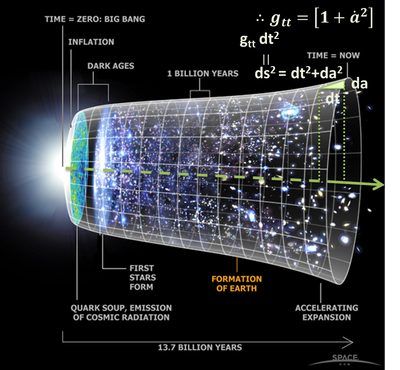


 Time-Time Component of FRW Metric

 Re: Time-Time component of FRW metric


