Previous in Forum: Simple (?) Excel 2016 Question   Next in Forum: Erosion and Corrosion
Close
Close
Close
16 comments
Rating: Comments: Nested
Member

Join Date: Feb 2019
Posts: 5

Parts Detection in High Temperatures

02/20/2019 7:40 AM

I have a continuous feed annealing oven I need to know when parts are leaving the heat zone so a proper quench can be made. My oven belt is 48" wide, the oven heat zone in 30' long. Overall width of the oven is 9'. My parts vary in height on the belt so I need to look across the top of the belt near the exit end. 1100` f is my target temperature. Physical contact sensors do not last in these harsh conditions so I need to break a beam of some type.

Does anyone have experience with anything like this? I am open to discussion.

Register to Reply
Interested in this topic? By joining CR4 you can "subscribe" to
this discussion and receive notification when new comments are added.

"Almost" Good Answers:

Check out these comments that don't yet have enough votes to be "official" good answers and, if you agree with them, vote them!
Guru

Join Date: Apr 2010
Location: About 4000 miles from the center of the earth (+/-100 mi)
Posts: 9910
Good Answers: 1141
#1

Re: Parts Detection in High Temperatures
02/20/2019 9:26 AM

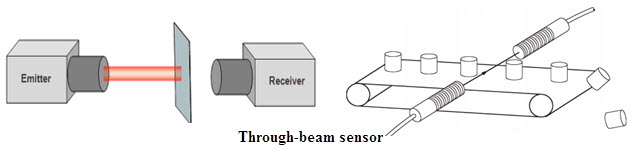
Possibly a laser beam and sensor. Or, if the parts are a different temperature from the belt, a thermal sensor.

https://www.elprocus.com/optical-sensors-types-basics-and-applications/

Register to Reply
Member

Join Date: Feb 2019
Posts: 5
#4
In reply to #1

Re: Parts Detection in High Temperatures

02/20/2019 1:48 PM

This is nice but do you have recommendations as far as which or what brand to use? I think a combination of laser and thermal imaging would greatly improve the process we are currently using.

Register to Reply
Guru

Join Date: Apr 2010
Location: About 4000 miles from the center of the earth (+/-100 mi)
Posts: 9910
Good Answers: 1141
#5
In reply to #4

Re: Parts Detection in High Temperatures

02/20/2019 4:43 PM

I don't know what you are using now. What I had in mind are the sensor pairs sold as safety devices for garage doors. They are cheap enough that you could try one out.

https://www.northshorecommercialdoor.com/dimocrunbese.html#video-tab

I don't know if the far infrared (heat) from your parts would affect the sensors, but a piece of glass in front of each sensor would block the heat while letting the near infrared beam through,

I hope this helps.

Register to Reply
Participant

Join Date: Mar 2018
Posts: 3
#14
In reply to #4

Re: Parts Detection in High Temperatures

02/22/2019 9:59 AM

Hi Craig,

Thanks for your reply.,You can try Ametek Land Instruments or several others. Go google Infra Red Temperature measurement and you will have very good comparison.

Register to Reply
Guru
Engineering Fields - Electrical Engineering - Been there, done that. Engineering Fields - Control Engineering - New Member

Join Date: Dec 2008
Location: Long Island NY
Posts: 15600
Good Answers: 981
#2

Re: Parts Detection in High Temperatures

02/20/2019 11:43 AM

With a 9 foot wide opening for the beam to travel you might run into some alignment difficulties. So the transmitter and receiver should be firmly locked in place after adjustments have been made. The size of the objects leaving the oven should be larger than the transmitted light beam to assure a complete occultation of light. However, the smaller the light beam is the more critical will be the alignment of transmitter and receiver.

__________________
"Don't disturb my circles." translation of Archimedes last words
Register to Reply
Guru

Join Date: Mar 2007
Location: by the beach in Florida
Posts: 33392
Good Answers: 1817
#3

Re: Parts Detection in High Temperatures

02/20/2019 11:51 AM

I would go with a thermal imaging system....precise temperature control is key to quality products...

https://www.lumasenseinc.com/EN/solutions/industrial-materials/steels-metals/making/annealing-furnace/annealing-furnaces.html

__________________
All living things seek to control their own destiny....this is the purpose of life
Register to Reply Score 1 for Good Answer
Guru

Join Date: Jul 2016
Posts: 1367
Good Answers: 105
#6

Re: Parts Detection in High Temperatures

02/20/2019 10:43 PM

Williamson IR is used on hot rolling mills, to measure speed & temperature of ingots. They have the technology to filter intense IR energy to perhaps discriminate between the conveyor and your product. I've seen their equipment installed in aluminum hot rolling mills, to confirm ingot position and temperature, so their application engineers have developed the instruments to stand up in your environment.

These sensors have a wide enough field of vision so you can probably detect the parts from above, by temperature and/or alloy IR signature, rather than height

https://www.williamsonir.com/

Register to Reply Score 1 for Good Answer
Guru

Join Date: Oct 2006
Location: 44.56024"N 15.307971E
Posts: 8277
Good Answers: 270
#7

Re: Parts Detection in High Temperatures

02/21/2019 6:18 AM

Check out this link:

http://entherm.com/Williamson-twowire.pdf

The output is standard 4-20 Milliamp and may be used by a controller,such as speed,temp,etc.

__________________
"A man never stands so tall as when he stoops to help a child." "Never argue with a stupid person.They will drag you down to their level and beat you with experience" "To create an apple pie from scratch, first you must create a universe"
Register to Reply
Member

Join Date: Feb 2019
Posts: 5
#8

Re: Parts Detection in High Temperatures

02/21/2019 7:15 AM

These comments are a welcome sight first thing in the morning. I will investigate and evaluate. Thanks.

Register to Reply
Power-User
United States - Member - Member

Join Date: Dec 2006
Location: La Grande, Oregon U.S.A.
Posts: 468
Good Answers: 23
#9

Re: Parts Detection in High Temperatures

02/21/2019 8:23 PM

Load cells on the conveyor idlers would eliminate the wavelength and alignment problems. Is the idler arrangement such that this would be possible?

__________________
Don't hit at all if it is honorably possible to avoid hitting; but never hit soft! - Theodore Roosevelt
Register to Reply
Member

Join Date: Mar 2011
Posts: 6
#10

Re: Parts Detection in High Temperatures

02/21/2019 11:25 PM

Yes I do. Use a reflective sensor across the belt.

Email me for more info.

mike@andersoncontrol.com

Register to Reply
Participant

Join Date: Mar 2018
Posts: 3
#11

Re: Parts Detection in High Temperatures

02/22/2019 3:48 AM

Hi, the best possible solution for this is the Thermal Infra-Red Temperature Sensor. There are many reputable suppliers in the market.

It is a fairly accurate device and does not have any physical sensors protruding into your oven unlike traditional bi-metal temperature sensors such as RTD or Thermocouples.

Register to Reply
Member

Join Date: Feb 2019
Posts: 5
#12

Re: Parts Detection in High Temperatures

02/22/2019 8:09 AM

I am looking at two coincidental controls. A beam at the end of the heat zone will be a signal initially to let the operator know a part is ready to quench. A 10 second window exists to go from heating to quench for correct properties to be achieved.

The thermal imaging is desired for ISO standards so we can log each part's characteristics as each piece moves through our process. Exact placement and utilization of the IR has yet to be finalized. We are in development which is why I'm asking questions.

I appreciate your feedback.

Register to Reply
Guru

Join Date: Jul 2017
Posts: 520
Good Answers: 14
#15
In reply to #12

Re: Parts Detection in High Temperatures. Boredom relief.

02/22/2019 10:17 AM

Cool. Leave music on the transmit coil. When the volume fluctuates, the part is ready to quench. Let the operator choose the music and optimal loudness. With multiple operators, use headphones if that is not a safety issue. This leaves the two controls decoupled and you will not ruin one adjusting the other. It also gives the operator some boredom relief.

__________

thewildotter

Register to Reply
Guru

Join Date: Jul 2017
Posts: 520
Good Answers: 14
#13

Re: Parts Detection in High Temperatures..... HumbuckerTheraminTRMD

02/22/2019 9:58 AM

Inverted "T" Humbucker TR Metal Detector Search Coil

I would use a TR (transmit receive) metal detector with a humbucker wound double receive coil in a plane parallel to, and above, your belt. I would use a rectangular coil shape for all three coils. The coil would be a long rectangle (48" long for this belt) with (say 4" diameter) rounded ends. A single loop for each of the three coils would probably work but some designs might use spirally wound coils depending on the characteristics of your part. The transmit coil would sit perpendicular to the humbucker coils and centered between them with the bottom at the level of the humbucker. The humbucker coil pair might be printed or wound on a temperature indifferent(aluminum oxide ?) board. The transmit coil should probably use identical form factor and materials to half of the humbucker and be solidly mounted to the humbucker. One could consider stretching six thin stainless steel cables across the top of the belt up in the air if convenient endpoint mounts can be implemented. Creating the TR coils with stretched cables would be a minimalist approach. The downside to stretched cables is that they may be too sensitive to vibration.

A metal detector signal higher than that due to the belt and surrounding stuff would indicate a part passing under the humbucker. A level threshold could be used to adjust sensitivity for actuating a timed relay for your quench. Just think of the 4" high, 8" wide, inverted "T" assembly crossing your belt as the TR metal detector search coil. The mechanism should be quite adaptable in terms of part geometry but will work better if all the parts are at least tall enough to get near the humbucker inverted "T" search coils and if the belt itself is reasonably uniform and moves smoothly.

If you use stretched cables implementing only one turn in each of the three coils, you may want to run the TR metal detector at a higher frequency than normal TR and it might be possible to implement it with an extremely cheap commodity FM radio transmitter such as an RF link between your IPOD and your car FM radio I have seen advertised. These devices are low power FM transmitters that can be received on a normal cheapo radio receiver placed close to your humbucker wire and otherwise isolated from your transmitter with an Altoids box containing the receiver and an insulated metal plate electrically connected to your humbucker conductor. The headphone jack output could be rectified and compared in the Altoids box to some desired threshold of signal intensity higher than that generated by the belt alone. Drive your transmitter with your favorite music to tune your setup then switch to a constant audio tone for normal use.

Call the rig your "Part Detector Theramin". It is very much like the volume control section generally used in Theramins hybridized with the humbucker pickup coil on an electric guitar.

Humbucker is electric guitar jargon which means that distant (or balanced) signals such as mains power 120 cycle hum null out in the coil but geometrically complex nearby (vibrating string) signals are not cancelled.

I do not know if anyone has already done this and offers it commercially. I would do it myself to gain complete flexibility but YMMV. The RF is kind of like a beam vertically into the belt and vertically back rather than across it. Part geometries and positioning are likely to be important. You may even be able to characterize and perhaps even identify dramatically different parts by their signal strengths and timing. I have been assuming conductive parts or at least parts which affect near field RF.

_________________
thewildotter

Register to Reply
Member

Join Date: Feb 2019
Posts: 5
#16

Re: Parts Detection in High Temperatures

02/25/2019 1:02 PM

I hadn't thought of that.

Register to Reply
Register to Reply 16 comments

"Almost" Good Answers:

Check out these comments that don't yet have enough votes to be "official" good answers and, if you agree with them, vote them!
Copy to Clipboard

Users who posted comments:

Brian Teo (2); Craig Spicer (4); HiTekRedNek (1); LG_Dave (1); Mike Ellis (1); redfred (1); Rixter (2); rwilliams (1); SolarEagle (1); thewildotter (2)

Previous in Forum: Simple (?) Excel 2016 Question   Next in Forum: Erosion and Corrosion

Advertisement