Previous in Forum: hybride vehicle   Next in Forum: Vertical Storage tank shell erection
Close
Close
Close
35 comments
Rate Comments: Nested
Anonymous Poster

Coefficient of Thermal Expansion

03/11/2008 1:56 PM

Hello everyone. I have a question on thermal expansion. I want to press fit a hypodermic tube (316 SS) into a metal rod(304 SS) that has a hole in the middle. Less than half of the hypodermic tube will be inserted into the metal hub.

Dimensions:

Hypo Tube: .022" OD .014" ID 1/2" Long

Metal Hub: .125" OD .200" Long

Hole in middle of Metal Hub: .020" OD Through All

I am trying to machine the metal hub to fit the hypodermic tubing by heating the hub and inserting the hypo tube. The hypo tube may also need to be cooled.

My question is at what temperature will the metal hub expand enough for the hypo tube to be inserted, or what hole size should the hub be so I can insert the hypo tube.

Using Coefficient of Thermal Expansion, I should be able to find out at what temperature the hub needs to be heated to so the hypo tube can be inserted. I am not sure which form the the thermal expansion formula to use (length, area, volume). Can anyone give me any help with this? Thank you.

Reply
Interested in this topic? By joining CR4 you can "subscribe" to
this discussion and receive notification when new comments are added.

Good Answers:

These comments received enough positive votes to make them "good answers".

"Almost" Good Answers:

Check out these comments that don't yet have enough votes to be "official" good answers and, if you agree with them, vote them!
Guru
Canada - Member - Our strength is our diversity

Join Date: Jan 2007
Location: Canada
Posts: 1024
Good Answers: 40
#1

Re: Coefficient of Thermal Expansion

03/11/2008 2:46 PM

You are concerned about the cross sectional area of the Hub. You want the OD to increase by at least .004" The inside diameter will also increase this amount from .020" to .024" this will give you .002" clearance to insert the tube. If you cannot increase it that much, you will have to do both, Heat the Hub and cool the tube to split the difference.

Insertion must be quick (about 1 second max) as heat from the hub will transfer to the tube and it will expand and be permanently press fitted in place.

No machining needs to be done, unless you need to remove it later. for the tube OD to be .002" larger then the inside diameter of a hub is normal for a permanent press fit.

As a machinist I have never dealt with something this small, however, our standard for all sizes of metals was .002" oversize for a permanent press fit. If the Hub splits, (I doubt it) you may have to machine .001" off OD of tube, but no more.

__________________
Perfection is a subjective and abstract concept.
Reply
Guru

Join Date: Jul 2007
Posts: 4448
Good Answers: 143
#2

Re: Coefficient of Thermal Expansion
03/11/2008 3:56 PM

You're looking at about a 9% increase in the hole diameter. In round numbers I think that works out to 5000°C unless I dropped a zero.

__________________
"Well, I've wrestled with reality for 35 years, Doctor, and I'm happy to state I finally won out over it." Elwood P. Dowd
Reply Score 1 for Good Answer
Anonymous Poster
#3
In reply to #2

Re: Coefficient of Thermal Expansion

03/11/2008 4:12 PM

How did you come to that conclusion? Which formula were u using?

Reply
Guru
Canada - Member - Our strength is our diversity

Join Date: Jan 2007
Location: Canada
Posts: 1024
Good Answers: 40
#7
In reply to #3

Re: Coefficient of Thermal Expansion

03/11/2008 4:57 PM

Try this site http://www.engineeringtoolbox.com/thermal-expansion-pipes-d_283.html

and substitute your diameter into

Lo = length of pipe (m, inch)

When metal is heated it expands equally in all directions. The effect in length seems more since the amount of expansion is additive with the amount of material heated

Using the coefficient of 12.8 X 10-6 X .125" X 2500 degrees F you get an expansion of .004"

This is very close to the melting point of Stainless steel. It must be "white" hot

At 1250 degrees F the expansion is .002" so this would be your lower limit

__________________
Perfection is a subjective and abstract concept.
Reply
Guru

Join Date: Jul 2007
Posts: 4448
Good Answers: 143
#8
In reply to #3

Re: Coefficient of Thermal Expansion

03/11/2008 6:27 PM

ΔT = ΔD/(Dα) where ΔD is the increase in diameter in inches, D is the diameter in inches, and α is the Coefficient of Thermal Expansion in inches/inch/°F. I have 10.4 X 10⁻⁶ for α. My answer is then 8740°F. Maybe I used the wrong CTE for SS304?

__________________
"Well, I've wrestled with reality for 35 years, Doctor, and I'm happy to state I finally won out over it." Elwood P. Dowd
Reply
Guru
Canada - Member - Our strength is our diversity

Join Date: Jan 2007
Location: Canada
Posts: 1024
Good Answers: 40
#4
In reply to #2

Re: Coefficient of Thermal Expansion

03/11/2008 4:19 PM

I don't think so .129" (goal) / .125 (original)" is a 3.2% increase in diameter not 9%

It is the material that is expanding not the hole

__________________
Perfection is a subjective and abstract concept.
Reply
Guru

Join Date: Jul 2007
Posts: 4448
Good Answers: 143
#10
In reply to #4

Re: Coefficient of Thermal Expansion

03/11/2008 7:39 PM

Well, OK .002/.020 is only 9% if you round off to the nearest 9%. It should be 10% - slight brain fog there.

But anyway, it is the hole that has to expand. Just imagine having a 0.020" dia shaft in there during expansion.

__________________
"Well, I've wrestled with reality for 35 years, Doctor, and I'm happy to state I finally won out over it." Elwood P. Dowd
Reply
Guru
Canada - Member - Our strength is our diversity

Join Date: Jan 2007
Location: Canada
Posts: 1024
Good Answers: 40
#16
In reply to #10

Re: Coefficient of Thermal Expansion

03/12/2008 9:52 AM

You are not heating up the mass of the hole (which has a different Heat coefficient). you are heating up the metal of the Hub around the hole which has much greater mass . Your calculations may be close if you were heating up the tube and not the hub.

__________________
Perfection is a subjective and abstract concept.
Reply Score 1 for Off Topic
Guru

Join Date: Aug 2006
Posts: 4484
Good Answers: 246
#17
In reply to #16

Re: Coefficient of Thermal Expansion

03/12/2008 12:02 PM

TVP is correct. This post and your earlier one suggest that you may hold a common misconception about how hole dimensions change when a body is heated.

If you have a CAD system, you can make an essentiall perfect model of thermal expansion by scaling up a piece in all three dimensions. The hole dimensions, outer dimensions, lengths, thicknesses, all increase by the same percentage.

Here's an explanation that both makes sense in theory, and corresponds perfectly with my experience in assembling things with shrink fits.

Thermal expansion : expanding holes

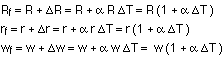
Consider a donut, a flat, two-dimensional donut, just to make things a little easier. The donut has a hole, with radius r, and an outer radius R. It has a width w which is simply w = R - r.

What happens when the donut is heated? It expands, but what happens to the hole? Does it get larger or smaller? If you apply the thermal expansion equation to all three lengths in this problem, do you get consistent results? The three lengths would change as follows:

The final width should also be equal to the difference between the outer and inner radii. This gives:

This is exactly what we got by applying the linear thermal expansion equation to the width of the donut above. So, with something like a donut, an increase in temperature causes the width to increase, the outer radius to increase, and the inner radius to increase, with all dimensions obeying linear thermal expansion. The hole expands just as if it's made as the same material as the hole.

The above is from here: http://physics.bu.edu/~duffy/py105/Temperature.html

__________________
There is more to life than just eating mice.
Reply
Guru
Canada - Member - Our strength is our diversity

Join Date: Jan 2007
Location: Canada
Posts: 1024
Good Answers: 40
#19
In reply to #17

Re: Coefficient of Thermal Expansion

03/12/2008 12:36 PM

Wrong TVP is not correct. The rest is right.

You said "What happens when the donut is heated? It expands"

You are heating the donut! Your calculations must be based on the Area or Volume of what is heated - the donut.

Yes the hole expands at the same rate as the donut, however, the Area and Volume of the hole is much smaller then the donut. You cannot base your calculations on the area of the hole. The area heated and expanding is the Area and Volume of the material of the donut.

The area being heated expands equally, therefore, the larger quantity of material being heated, the more the total expansion.

Example

  • 10 X 1.2 = 12 (difference of 2)
  • 100 X 1.2 = 120 ( difference of 20)
  • The expansion percent is same (20%), however, the total expansion is very different.
  • So if I want an expansion of 4 in my 100 foot pipe it would be 1.4% expansion based on the 10 foot pipe and only 1.04% for the 100 foot pipe an error of 36%

If however I was heating a rod that fit inside the pipe I would use the area or volume of the rod.

In virtual reality you may not see the difference, take a step back into the real world.

__________________
Perfection is a subjective and abstract concept.
Reply
Guru

Join Date: Aug 2006
Posts: 4484
Good Answers: 246
#24
In reply to #19

Re: Coefficient of Thermal Expansion

03/12/2008 6:43 PM

You are heating the donut!

Yes, of course. Per your earlier post, the outside of this donut would expand 3.2%, to .129. The inside would expand from .020 to .0206 (also 3.2%). The calculations are linear, not by squares or cubes, as your Area and Volume would suggest.

In writing the following you seem to be arguing at cross purposes:

  • 10 X 1.2 = 12 (difference of 2)
  • 100 X 1.2 = 120 ( difference of 20)
  • The expansion percent is same (20%), however, the total expansion is very different.
  • So if I want an expansion of 4 in my 100 foot pipe it would be 1.4% expansion based on the 10 foot pipe and only 1.04% for the 100 foot pipe an error of 36%

This supports my contention, that of Boston University, and that of TVP. It does not support your contention that expanding the outside of the hub by .004" causes the hole diameter to expand by .004"

I used to have mechanics students make a thumb press fit 1" nominal rod to fit a 1" nominal hole (both aluminum). Then they would heat both parts in an oven, to see that the fit was retained at elevated temperature. This proved the BU contention:

So, with something like a donut, an increase in temperature causes the width to increase, the outer radius to increase, and the inner radius to increase, with all dimensions obeying linear thermal expansion. The hole expands just as if it's made as the same material as the hole.

BTW, your practice of applying a .002" interference to all press fits would get you fired at most machine shops. Machinery's Handbook lists the correct interferences, which do indeed vary with the size of the part. As I said before 10% interference is far too much for a part .022" in diameter.

__________________
There is more to life than just eating mice.
Reply
Guru
Canada - Member - Our strength is our diversity

Join Date: Jan 2007
Location: Canada
Posts: 1024
Good Answers: 40
#26
In reply to #24

Re: Coefficient of Thermal Expansion

03/13/2008 10:26 AM

I stand corrected.

So the result is, due to the ridiculous temperature that would melt the hub, the hub should be reamed to about .0005" larger then the OD of the needle.

I think It would have been faster to just try it, than get confused with all the calculations!

__________________
Perfection is a subjective and abstract concept.
Reply
Guru

Join Date: Mar 2007
Location: City of Light
Posts: 3943
Good Answers: 183
#25
In reply to #19

Re: Coefficient of Thermal Expansion

03/13/2008 9:16 AM

I have the feeling that you misunderstand the way a tube expands under temperature changes. The material will expand in ALL directions ie radial, longitudinal and TANGENTIAL with same expansion coefficient if it is homogeneous.

If you look in a book for mechanical design you will find an equation to determine the STRAINS in tubes due to the thermal expansion (or the opposite).

Due to the wall thickness the expansion of the outer layers are constrained and the inner layers are pulled so that outside a compression strain appears and to the inner side a tension is noticed. Those strains will modify slightly the deformations but if their effect is neglected the HOLE will expand (relatively) as much as the outer diameter.

Your computations based on the outer diameter for the inside are totally wrong.

Assuming that the strains i mentioned are not active then the equation for the inside diameter is d(Θ)=d(Θo)*(1+α(Θ-Θo)). from this one could compute back Θ to obtain the wished diameter increase.

Θ=Θo+[d(Θ)/d(Θo)-1]/α

Let us assume zero clearance after heating d(Θ)=0.022" d(Θo)=0.02" Θo=20°C

α ≈ 11 E-6 the result is Θ=20+(0.022/0.02-1)/(11E-6)=9111 °C which is according to my humble opinion too much.

Reply
Guru
Spain - Member - New Member Engineering Fields - Nuclear Engineering - New Member

Join Date: Oct 2007
Location: Madrid, Spain
Posts: 716
Good Answers: 25
#18
In reply to #16

Re: Coefficient of Thermal Expansion

03/12/2008 12:24 PM

Oh, yes! you're right: the CTE of the hole (if we could call it so) is different from that of the surrounding metal.

But I don't completely understand what do you mean with "the metal of the Hub around the hole which has much greater mass".

The Coefficient of Thermal Expansion doesn't depends on the mass quantity but rather with the initial length (perhaps because of that it's expressed in m/m.ºC or inch/inch.ºF).

Do you really think that two bars of the same material and the same length but one of them with double diameter (4 times mass) when heated or cooled from the same initial temperature up to the same final temperature will have different length?

Before making some comments it's recommendable to refresh some basic principles.

Cheers

__________________
It's stupid to discuss about AI: We´ve reached by the "B" way. We' ve producing men as clever as machines.
Reply Off Topic (Score 5)
Guru
Canada - Member - Our strength is our diversity

Join Date: Jan 2007
Location: Canada
Posts: 1024
Good Answers: 40
#20
In reply to #18

Re: Coefficient of Thermal Expansion

03/12/2008 12:49 PM

Sorry you misunderstood me

If I take my Length measurement and substitute the into the "Diameter" of the pipe, the diameter will expand by the same coefficient.

So in your example, the two pipes would expand longitudinally the same, however the thicker pipe will expand in diameter more then the thinner pipe.

__________________
Perfection is a subjective and abstract concept.
Reply Off Topic (Score 5)
Commentator

Join Date: Jul 2007
Location: KY
Posts: 82
#21
In reply to #2

Re: Coefficient of Thermal Expansion

03/12/2008 1:48 PM

at that temp. your SS will be a puddle

Reply Score 1 for Good Answer
Guru

Join Date: Jul 2007
Posts: 4448
Good Answers: 143
#23
In reply to #21

Re: Coefficient of Thermal Expansion

03/12/2008 6:09 PM

Yep, but then the hypodermic would fit in it.

This is the second time this question has been asked, with about the same answers. I'm not sure what he's looking for, but us hillbillies only give straight answers once.

__________________
"Well, I've wrestled with reality for 35 years, Doctor, and I'm happy to state I finally won out over it." Elwood P. Dowd
Reply
2
Guru
Popular Science - Evolution - New Member Popular Science - Weaponology - New Member

Join Date: May 2006
Location: The 'Space Coast', USA
Posts: 11119
Good Answers: 918
#5

Re: Coefficient of Thermal Expansion

03/11/2008 4:38 PM

0.020" is much too small a hole for that needle! Even if you could heat it to that size it would either crush the needle or crack the tube when it cools.

What I would do is search for a miniature reamer. If the OD is 0.022, then you want to drill and then ream a hole 0.0215". You will need to search around for a tool to do this. Here is an example I found quickly, but the smallest size they have is 0.0236". However, it is but an example.

Reamers

There are so many tricks to doing this that I would employ a skilled machinist to help you. I only dabble in the subject, but I know there are many ways to skin the goat.

Heating and cooling only go so far with expansion and contraction of stainless steel. You can look up the coefficient of expansion for those metals on line yourself.

Then, you have to ask yourself how you are going to put the hole in the larger tube. How you do that will dictate the level of repeatability you get in the process and how many holes a tool can make before it is trash (assuming you are making more than one). You are dealing with tolerances in the tenths of a thousands of an inch.

You can also select a larger gauge size on the needle to match a tool or reamer that can be had.

You can also have a reamer or tool made to your own specification, too.

Finally, stainless steel is a bugger to work with, so the task is a bit harder and requires more finesse to do. Shop around for a competent machinist.

Reply Good Answer (Score 2)
Guru
Popular Science - Evolution - New Member Popular Science - Weaponology - New Member

Join Date: May 2006
Location: The 'Space Coast', USA
Posts: 11119
Good Answers: 918
#6

Re: Coefficient of Thermal Expansion

03/11/2008 4:43 PM

You could also make the tube hole 0.022" and use a Locktite (look it up) product to cement them together.

Reply Score 1 for Good Answer
Anonymous Poster
#9

Re: Coefficient of Thermal Expansion

03/11/2008 7:10 PM

my best guess is volume!

Reply
Guru

Join Date: Aug 2006
Posts: 4484
Good Answers: 246
#11

Re: Coefficient of Thermal Expansion

03/12/2008 12:18 AM

This previous thread deals with this subject precisely.

In short, that is far too much interference for a shrink fit. Shrink fit calculations are based on hole size, not the size of the piece of material around the hole. In heating the receiving piece (no matter how large) you are effectively scaling up the piece. If the piece had multiple holes, each hole would increase by 10%, and the overall size of the piece would increase by 10%. If you check the melting point of stainless, you'll find it is lower than the temperature required for 10% expansion.

__________________
There is more to life than just eating mice.
Reply
Guru
Spain - Member - New Member Engineering Fields - Nuclear Engineering - New Member

Join Date: Oct 2007
Location: Madrid, Spain
Posts: 716
Good Answers: 25
#12

Re: Coefficient of Thermal Expansion

03/12/2008 7:52 AM

Hi all,

I haven't made any calculation about tolerances (there are many previous posts about it) and I never worked with such a small components, but anybody thought about heating problems in 304SS?

When we've made this type of press fitting on austenitic SS, we've cooled the inner piece in LN, not heating the outer one!

Cheers

__________________
It's stupid to discuss about AI: We´ve reached by the "B" way. We' ve producing men as clever as machines.
Reply
Guru

Join Date: Jul 2007
Posts: 4448
Good Answers: 143
#13
In reply to #12

Re: Coefficient of Thermal Expansion

03/12/2008 7:58 AM

It's the same problem. You wind up at about -4500K. In the past, I've used heat shrink fits for small bearings. In aluminum, which has a much bigger CTE, I could get about 0.0005" for a 0.7500" hole.

__________________
"Well, I've wrestled with reality for 35 years, Doctor, and I'm happy to state I finally won out over it." Elwood P. Dowd
Reply
Guru
Spain - Member - New Member Engineering Fields - Nuclear Engineering - New Member

Join Date: Oct 2007
Location: Madrid, Spain
Posts: 716
Good Answers: 25
#14
In reply to #13

Re: Coefficient of Thermal Expansion

03/12/2008 8:14 AM

Hi, TVP45

I told I do not make any calculation. I think it is a simple thing anybody who call himself an engineer can do it.

I was talking just about the problems of sensitization of 304SS if heated and not solution heat treated. For this type of material, to shrink the inner piece is a better solution because austenitic SS doesn't fragilize at very low temperatures.

__________________
It's stupid to discuss about AI: We´ve reached by the "B" way. We' ve producing men as clever as machines.
Reply
Anonymous Poster
#15

Re: Coefficient of Thermal Expansion

03/12/2008 9:19 AM

Change your hole size to .0215", with the use of a reamer. The hole size is too small to be practical, for a press fit, with the use of heating and cooling.

Reply
Guru
Engineering Fields - Piping Design Engineering - New Member Egypt - Member - Member since 02/18/2007

Join Date: Feb 2007
Location: Cairo, Egypt
Posts: 1733
Good Answers: 248
#22

Re: Coefficient of Thermal Expansion

03/12/2008 6:08 PM

THERMAL EXPANSION DATA

In going from 70 oF to indicated temperatures.

A = Mean Coefficient of Thermal Expansion x 106, in./in. per oF & B = Linear Thermal Expansion, in./100 ft.

Material

Coefficient

Temperature Range 70 oF to 1400 oF

..7020030040050060070080090010001100120013001400
Carbon steel, carbon-moly steel, low-chrome steels (thru 30% Cr)A

B

. .

0

6.38

0.99

6.60

1.82

6.82

2.70

7.02

3.62

7.23

4.60

7.41

5.63

7.65

6.70

7.84

7.81

7.97

8.89

8.12

10.04

8.19

11.10

8.28

12.22

8.36

13.34

Intermediate alloy steels,

5 Cr - Mo thru 9 Cr - M.

A

B

. .

0

6.04

0.94

6.19

1.71

6.34

2.50

6.50

3.35

6.66

4.24

6.80

5.14

6.96

6.10

7.10

7.07

7.22

8.06

7.32

9.05

7.41

10.00

7.49

11.06

7.55

12.05

Austenitic stainless steels,

18 Cr - 8 Ni

A

B

. .

0

9.34

1.46

9.47

2.61

9.59

3.80

9.70

5.01

9.82

6.24

9.92

7.50

10.05

8.80

10.16

10.12

10.29

11.48

10.39

12.84

10.48

14.20

10.54

15.56

10.60

16.92

Straight chromium stainless steels,

12 Cr, 17 Cr and 27 Cr

A

B

. .

0

5.50

0.86

5.66

1.56

5.81

2.30

5.96

3.08

6.13

3.90

6.20

4.73

6.39

5.60

6.52

6.49

6.63

7.40

6.72

8.31

6.78

9.20

6.85

10.11

6.90

11.01

25 Cr - 20 Ni A

B

. .

0

7.76

1.21

7.92

2.18

8.08

3.20

8.22

4.24

8.38

5.33

8.52

6.44

8.68

7.60

8.81

8.78

8.92

9.95

9.00

11.12

9.08

12.31

9.12

13.46

9.18

14.65

Monel

67 Ni - 30 Cu

A

B

. .

0

7.84

1.22

8.02

2.21

8.20

3.25

8.40

4.33

8.58

5.46

8.78

6.64

8.96

7.85

9.16

9.12

9.34

10.42

9.52

11.77

9.70

13.15

9.88

14.58

10.04

16.02

Monel

66 Ni - 29 Cu - Al

A

B

. .

0

7.48

1.17

7.68

2.12

7.90

3.13

8.09

4.17

8.30

5.28

8.50

6.43

8.70

7.62

8.90

8.86

9.10

10.16

9.30

11.50

9.50

13.00

9.70

14.32

9.89

15.78

Aluminum A

B

. .

0

12.95

2.00

13.28

3.66

13.60

5.39

13.90

7.17

14.20

9.03

. . . . . . . .
Gray cast iron A

B

. .

0

5.75

0.90

5.93

1.64

6.10

2.42

6.28

3.24

6.74

4.11

6.65

5.03

6.83

5.98

7.00

6.97

7.19

8.02

. . . .
Bronze A

B

. .

0

10.03

1.56

10.12

2.79

10.23

4.05

10.32

5.33

10.44

6.64

10.52

7.95

10.62

9.30

10.72

10.68

10.80

12.05

10.90

13.47

11.00

14.92

. .
Brass A

B

. .

0

9.76

1.52

10.00

2.76

10.23

4.05

10.47

5.40

10.69

6.80

10.92

8.26

11.16

9.78

11.40

11.35

11.63

12.98

11.85

14.65

12.09

16.39

. .
Wrought iron A

B

. .

0

7.32

1.14

7.48

2.06

7.61

3.01

7.73

3.99

7.88

5.01

8.01

6.06

8.13

7.12

8.20

8.26

8.39

9.36

. . . .
Copper - Nickel

70 Cu - 30 Ni

A

B

. .

0

8.54

1.33

8.71

2.40

8.90

3.52

. . . .

.

.

.

.

.

.

By simple math calculation, you can calculate how much the expansion required and how much the required degree of temperature by using A & B for Austenitic stainless steels (18 Cr - 8 Ni) .

__________________
It is better to be defeated on principles, than to win on lies!
Reply
Participant

Join Date: Oct 2009
Posts: 1
#30
In reply to #22

Re: Coefficient of Thermal Expansion

10/30/2009 9:57 AM

Guru; please advise on the following,

I have got 3-1/2" 9.7 lb/ft 13% Chrome tubing in a well at Bottom hole Temperature 299 deg F. I am to spike the well with nitrogen. The expected change in temperature is from 300 to 70 at botom hole. What coefficient of thermal expansion is tobe used and what is the expected elongation at 10648 ft.

Reply
Anonymous Poster
#31
In reply to #30

Re: Coefficient of Thermal Expansion

10/30/2009 12:17 PM

About 12' in length.

Reply
Guru
Engineering Fields - Piping Design Engineering - New Member Egypt - Member - Member since 02/18/2007

Join Date: Feb 2007
Location: Cairo, Egypt
Posts: 1733
Good Answers: 248
#32
In reply to #30

Re: Coefficient of Thermal Expansion

10/30/2009 1:01 PM

Dear Fauzan,

1st. I'd like you to know that the thermal expansion and/or contraction is dependent mainly on type of material, difference in temperature, and length of coupon under study. At the same time, the thermal expansion not depends on the configuration of the coupon under study and is its section a circular or square, ... etc.

2nd. For your material 13% Cr Stainless steel, the nearest material to it from the Table at my Post #22 is Straight Chromium Stainless Steels 12 Cr, 17 Cr and 27 Cr.

3rd. From the Table at my Post #22 : For 300 oF, the Coefficient B of Linear Thermal Expansion is 1.56 in./100 ft. This means that the expansion (if heated from ambient temp. to higher temp.) or contraction (if cooled from higher temp. to ambient temp.) is 1.56 in. per every 100 ft. of length due to changing in temp. between 70 oF and 300 oF.

4th. The total thermal expansion (or contraction) between 70 oF and 300 oF is a result of multiplying the coefficient B by the total length of tube.

Total expansion (or contraction) = (1.56 in./100 ft) (10 648 ft) = 166.109 in. (13.842 ft. ≈ 14 ft.)

__________________
It is better to be defeated on principles, than to win on lies!
Reply
Guru
Engineering Fields - Piping Design Engineering - New Member Egypt - Member - Member since 02/18/2007

Join Date: Feb 2007
Location: Cairo, Egypt
Posts: 1733
Good Answers: 248
#33
In reply to #32

Re: Coefficient of Thermal Expansion

10/30/2009 2:25 PM
__________________
It is better to be defeated on principles, than to win on lies!
Reply
Power-User

Join Date: Dec 2007
Posts: 142
Good Answers: 1
#34
In reply to #32

Re: Coefficient of Thermal Expansion

06/30/2011 4:37 PM

Abdel,

I have read your charts on expansion and I have been using a value of .0000067/ft x Delta Temp x total linear distance in feet, for carbon steel pipe and its came pretty close. I am wondering if I am off with that value as I compare to your chart. Your value per your chart would be about .0099 for a per foot number.

Please advise. Thanks

Reply
Power-User

Join Date: Dec 2007
Posts: 142
Good Answers: 1
#35
In reply to #32

Re: Coefficient of Thermal Expansion

07/01/2011 2:26 PM

http://www.inspectapedia.com/exterior/Coefficients_of_Expansion.htm

This has a material chart confirming the value I have been using.

Reply
Commentator

Join Date: Jul 2007
Location: KY
Posts: 82
#27

Re: Coefficient of Thermal Expansion

03/13/2008 11:04 AM

If you heat the cylinder with the intent of inserting the cool needle, I beleive you will have issues with the thin wall of the needle conducting the heat very quickly. This will make any idea of expansion differences moot.

you will need some binder material and a slight taper to the ID of the cylinder. This will give you some friction sit tightness, and the binder material will help hold the part in place.

Else you are gong to need some mechanical means of joining the two parts. Perhaps There is a way to spin weld the parts. You may yet again run into issues with the small needle diameter.

Reply
Guru

Join Date: Jul 2007
Posts: 4448
Good Answers: 143
#28

Re: Coefficient of Thermal Expansion

03/13/2008 12:37 PM

AMBJ, I'll give a numeric estimate of why this doesn't (won't) work. The maximum interference allowed for a solid needle inserted in the block is about 0.0001" (Machinery's Handbook); of course, a hollow needle will be worse but this is quicker. So, a reasonable set of required dimensions would be:

needle = 0.01998 +/- 0.00002"

hole = 0.01992 +/- 0.00002"

You could easily do the heat/cold bit with a few hundred degrees, but where will you find somebody to machine stainless to 20 µin?

__________________
"Well, I've wrestled with reality for 35 years, Doctor, and I'm happy to state I finally won out over it." Elwood P. Dowd
Reply
Power-User
Hobbies - CNC - New Member United States - Member - New Member

Join Date: Feb 2008
Location: Mid-West USA
Posts: 498
Good Answers: 28
#29

Re: Coefficient of Thermal Expansion

03/14/2008 8:23 AM

Is this a prototype or production scenario? I would shoot for .0005" to .001" press or shrink fit. If press fitting omit the heating sequence in the text below.

For a prototype or one-off I would use a milling machine as a press for assembling the parts. Start with a rod that is about 2-3 inches longer than needed so you have something to clamp on without it crushing when machined. The end of the rod should extend just far enough above the vise jaws to make the part. Much more than that and vibration could become a problem when drilling. Mount the rod in the machine vise vertically. Use an indicator to sweep the rod and center it below the spindle. Also check it for vertical alignment with the indicator. Or simply place the rod in a collet and lower the quill so the rod is in the mill vise. Position the mill table so that the rod touches the stationary jaw and close the vise. It all depends on how concentric the set-up needs to be. Center drill the rod end so your drill bit does not wander off location. Drill, counter sink, and ream the hole in that order. When drilling the hole, plunge 1/4" deeper than needed to provide a place for shavings to fall during the reaming process. Now place your hypo in a good drill chuck. A collet would be best if you have one that size. Move the quill down until the hypo touches the top of the rod. Set the quill stop for the depth of insertion you wish. Raise the quill and use a torch to heat the end of the rod in the vise. Heat evenly to reduce distortion. When the rod is hot enough you should be able to quickly press the hypo into place very accurately. Remove the assembly and saw it off. Take it to a lathe and face it to length. While in the lathe you can clean up the ID of the hole in the rod with a counter sink and a reamer. This may take some tweaking but it should get you in the right direction.

Not knowing the application I do not know if Loc-Tite would be seen as a contaminate. But since other posts have suggested it, I too would opt for it over using heat and drill/ream the hole larger to provide for a sliding / slip fit. There are several grades of holding strength available. I use the bearing locker strength on a regular basis. It only comes apart when enough heat is applied.

If this is a production run I would purchase or cannibalize a press and make a jig for doing this to keep the mill freed up.

Reply
Reply to Forum Thread 35 comments

Good Answers:

These comments received enough positive votes to make them "good answers".

"Almost" Good Answers:

Check out these comments that don't yet have enough votes to be "official" good answers and, if you agree with them, vote them!
Copy to Clipboard

Users who posted comments:

Abdel Halim Galala (3); Anonymous Hero (2); Anonymous Poster (4); Blink (3); Fauzan (1); Kwetz (3); nick name (1); pipeit (2); SGQ (2); techno (7); The Mechanic (1); TVP45 (6)

Previous in Forum: hybride vehicle   Next in Forum: Vertical Storage tank shell erection

Advertisement