Previous in Forum: Design of coupling   Next in Forum: Lawn Mower Speed Record
Close
Close
Close
48 comments
Rate Comments: Nested
Guru

Join Date: Feb 2006
Posts: 757
Good Answers: 12

Water Heater Multiplicity

07/11/2006 10:15 PM

I was considering adding a second, gas-fired water heater in parallel, at the end of the too-long line, in order to boost pressure and flow to the last consumer (a shower nozzle) on the line. Certain buddies warn that the two tanks must be exactly matched (i.e., balanced) in size and pipe connections...or one might dominate/shut-out the other. I would contend, on the the other hand, that, so long as tank heights (or stored water surface elevations) are equal--and all other things being equal--that multiple tanks will self-balance, irrespective of relative tank size. Neither tank will be "locked out." Who's correct? and why?

PS: Please disregard that the second tank's input would be connected to the outdoor supply line in a closed loop configuration of both tanks. Just think: two tanks in parallel; Will both flow (at all) on demand? Or won't they?

Thank you.

Register to Reply
Pathfinder Tags: Water heater
Interested in this topic? By joining CR4 you can "subscribe" to
this discussion and receive notification when new comments are added.
Member

Join Date: May 2006
Posts: 6
#1

parallel or series?

07/12/2006 9:14 AM

I would think that you would need a proportioning valve with its output to the shower and two inputs from the two heaters. That way the proportion device would maintain the temperature of the output based on the supply temp from the two heaters. A more common aproach is to install a small heater inline near the point of use to raise the temperature of the supply that is lost in the transmission process.

__________________
Matt
Register to Reply
Guru

Join Date: Apr 2006
Location: Cincinnati, Ohio, USA
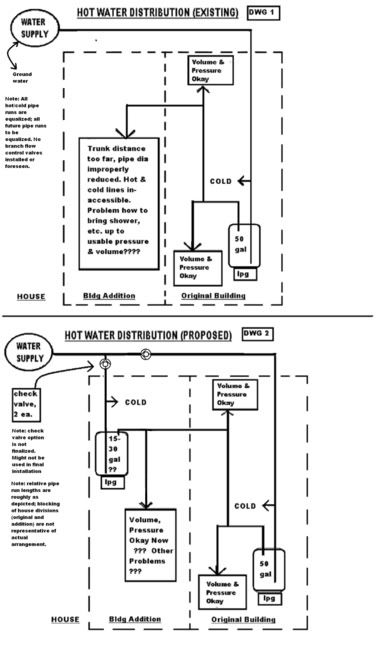
Posts: 662
Good Answers: 49
#2
In reply to #1

Re:parallel or series?

07/12/2006 1:09 PM

The question states that planned supplement heater would be "parallel", at end of line- Sounds like a "series" installation actually. Assuming that the HW line rises from the top of both heaters, the size and height of parallel heaters does not matter. The pressure drop of the total line will be much higher than through the heaters and the flow through the heaters will self-balance (parallel resisters electrically). If parallel installation, the only pressure savings is flow through heaters- which will likely be offset by added fittings. Heat issue is determined by temperature setting of the heaters and will be flow-based average of each. If inadequate temp is the issue, a series heater installation is better (the added small pressure drop and corresponding reduced flow would be offset by hotter water to mix with cold for final temp at shower. Another (lower cost) option is to use just the original heater and set outlet temp to "maximum" condition (140F for residential unit, or 190F for a commercial style) and still rely on CW blending- at a higher risk of scalding.

__________________
NO MATTER HOW WELL YOU HAVE DONE SO FAR, ALWAYS TRY TO BE BETTER TOMORROW.
Register to Reply
Guru

Join Date: Feb 2006
Posts: 757
Good Answers: 12
#19
In reply to #2

Re:parallel or series?

08/30/2006 4:29 AM

No, it will actually be a parallel installation, with the "new" heater tied in (along with the cold circuit) at the other side of the house…at the extreme end of the present hot water trunk (and cold water trunk), with the supplemental heater supplied from a new, tee'd-off line from the outside, UG main water supply line. (That line is fed from a well/reserve tank, by the way).

So the UG water supply line will divide, with one branch (still) going to the existing heater (about 50 ft away) and the other (tie-in) branch going to the new heater—it's to be situated in a walk-in closest next to a wall that separates it from the "terminal" bathroom, the same wall which will give access to pipes serving the terminal bathroom—about 12 or so feet away. (I am also considering the closet for mounting of a buffer tank…but let's not go into that just yet.)

Although augmented heat to that "rear" bathroom shower will be a side benefit, that is not the primary purpose of installing the secondary water heater and branch from the main supply line; rather, its purpose is to alleviate a practical nuisance that has arisen as a result of a prior addition to the house which includes two bathrooms, namely: that as the flow rate impelled from the reserve tank builds and ebbs, the shower faucet flow rate at that last bathroom can drop (too) significantly. This situation (otherwise a minor inconvenience) is especially intolerable when one is standing in that shower, already lathered up, waiting an indefinite time for the well pump (with cut-on/cut-off settings already at optimal) to cycle on and re-build system head pressure.

But…as your post suggests, it is not sufficient to consider only one aspect of the problem; both pressure & flow volume, and heat factors must be taken into account.

As was the initial impetus behind this discussion, I agree—up to a point--with your assertion (in principle) that size and shape of tanks does not matter so long as the outlet elbows (or an above-tank manifold) is at the same elevation (and precisely mutually equi-leveled), albeit that achieving such leveling at extreme ends of the house might be troublesome (but I think that water tube leveling would suffice).

But I am not convinced, yet, that the (apparent) dominance or locking out of one tank—as suggested in other posts—could be reliably avoided without additional modifications. I will address these considerations in another post further down.

I also agree with your electrical circuit analogy…but, again, up to a point. Whereas with an electronic circuit a load would be presumed, (and possibly also branch pull-up resistors) the outflow from the HW tank or tank gang would go through the faucet (the switch analogy) and directly down the drain—which, as I see it, would be tantamount to a short (or switch-able return) to ground in the electrical circuitry (so there would need to be the analogy for a load and/or (possibly) for the pull-up resistors as well. I will address these considerations as well in the posting farther below.

Register to Reply
Guru

Join Date: Feb 2006
Posts: 757
Good Answers: 12
#18
In reply to #1

Re:parallel or series?

08/30/2006 4:25 AM

Matt, as I see it thus far—and I might just be "disputating" around the margins here—the extra heater (of the two heaters) would supply the already-installed, below-subfloor HW service branch (which is supplied at its opposite end by the HW trunk from the original heater (it's on the other side of the building), and the existing risers (including those in the problem bathroom) would remain as they are. Since the existing plumbing network is balanced (by which I mean, hot and cold pipe runs are equal in length), and since care would be taken to balance any new piping as well, it is to be expected that proportioning might be unnecessary; but it could be accomplished by resetting the proportioning adjustments in the shower faucet (and other faucets as well).

Given a "floor space of residence" for an inline (electric) heater, and convenient AC hookup facility, that would be an expedient solution…if quick hot water service was the paramount problem seeking solution…which, as you will see in my reply to energygod, it is not.

Register to Reply
Guru
Popular Science - Evolution - New Member Popular Science - Weaponology - New Member

Join Date: May 2006
Location: The 'Space Coast', USA
Posts: 11119
Good Answers: 918
#3

Simple

07/12/2006 4:50 PM

Buy an On-Demand water heater (also known as a tankless heater) and install that.

Your cost to operate will go down and if you live in the USA, Uncle Sam will give you something like a $100 or more rebate.

Register to Reply
Power-User
Safety - ESD - RF Manufacturing ESD Installer

Join Date: Nov 2005
Location: Princess Anne, Maryland USA
Posts: 184
#7
In reply to #3

Re:Simple

07/13/2006 8:38 AM

I (Being an electrician) would have to agree with this route. It would be much simpler and provide you with the finished prodiuct you are looking for. Installation would be less expensive and operating cost would be lower in the long run.

__________________
“The problems we face cannot be solved with the same level of thinking we had when they were created” Albert Einstein
Register to Reply
Guru

Join Date: Feb 2006
Posts: 757
Good Answers: 12
#21
In reply to #7

Re:Simple

08/30/2006 4:36 AM

As suggested to Anonymous…

it will be necessary to reserve judgment before deciding whether or not it might be part of a solution.

Register to Reply
Member

Join Date: May 2006
Posts: 6
#12
In reply to #3

Re:Simple

07/13/2006 2:10 PM

exactly my point. thanks for the simpler statement.

__________________
Matt
Register to Reply
Guru

Join Date: Feb 2006
Posts: 757
Good Answers: 12
#22
In reply to #12

Re:Simple

08/30/2006 4:38 AM

Ditto, Matt.

Register to Reply
Guru

Join Date: Feb 2006
Posts: 757
Good Answers: 12
#20
In reply to #3

Re:Simple

08/30/2006 4:32 AM

As stated before, this might be a good solution…but a solution in search of the wrong (or the less important) problem. Which is to say, it could not, of itself, increase flow volume.

Register to Reply
Power-User

Join Date: Jul 2006
Location: Springfield, Tennessee U.S.A.
Posts: 231
Good Answers: 16
#4

Water Heater Multiplicity

07/12/2006 11:48 PM

Of course one could do what is often done in large facilities that have one (1) source of hot water, and that is to install a return circuit and heavily insulate all of the plumbing. Afterwards, a vane pump that is carefully matched to the water flow characteristics is installed in order to keep the hot water in constant circulation. The pro-hot water is available all of the time. The con-the expense due to the cost of pump operation and heat loss. I like the other post that suggests a point-of-use (on demand) type of water heater. I went through this in a previous dwelling, and it solved the problem. But, the caveat is that the manufacturers of these units strongly advise against using these as a booster, and demand that they be supplied by the cold water circuit.

__________________
"Yeah, but will it fit?"
Register to Reply
Guru

Join Date: Feb 2006
Posts: 757
Good Answers: 12
#23
In reply to #4

Re:Water Heater Multiplicity

08/30/2006 4:42 AM

…and for good reason in that, anything that boosts (and supplying from hot water would amount to boosting) must also be supplied…and it is supply—constant supply—or lack thereof—that is at the heart of my problem.

In addition to what has been said in responses above, and despite possible inappropriateness for a single family dwelling, another impediment arises as to any return line or closed loop circulating system: the prohibitive prospect of installing the needed piping. The house addition in which the problem bathroom is located has no attic space for piping; to access the subfloor space (of inches rather than feet) would entail removing flooring and subflooring across the extent of the house, and across four walls, not to mention damaging walls and flooring that were only recently redone. And, if too-slow hot water access were the primary problem, a perhaps even better solution would be another, fairly recent innovation.

It is a pump & diverter device which is fitted, near the point of service demand, into and between the hot water and cold water service lines. It operates under control of a temp sensor which, when the temp drops below a set threshold, causes actuation of a pump which actually forces cooled-down "hot" water, backward (or upstream) through the cold water line towards the cold water source—in essence, back towards the hot water heater intake…a quasi-circulating loop, you might say. Then—as such cooled "hot" water is vacated from the hot water line near the point of service—"freshly heated" hot water from the water heater tank is able to move forward quickly to take its place. At that point the pump disconnects, the hot line is decoupled from the cold line, and hot water flow continues normally. One only needs to activate the system, say, before showering, in order to have "hot" hot water available (then and thereafter) within a few seconds.

The benefit of such a system is that no return piping is needed…only a tee-in fitting at a convenient location, such as under the BthRm lavatory sink. However, in my situation I would be unwilling to use such a system…for the reason that, since some of my piping and pipe jointery is rather old, I would not want to impose on it the "double & more" pressure that would attain when water was forced backward against supply pressure.

Register to Reply
Power-User

Join Date: Jul 2006
Location: Springfield, Tennessee U.S.A.
Posts: 231
Good Answers: 16
#41
In reply to #23

Re:Water Heater Multiplicity

08/31/2006 9:31 PM

Interesting application. I agree with your analogy that hydraulic pressure is a major concern for an older plumbing system. Especially since one cannot determine the present quality of the installed plumbing. Perhaps a point-of-use water heater is then the best solution, if sufficient electrical current and physical space is available. Ing. Robert Forbus

__________________
"Yeah, but will it fit?"
Register to Reply
Guru

Join Date: Feb 2006
Posts: 757
Good Answers: 12
#46
In reply to #41

Re:Water Heater Multiplicity

09/06/2006 1:50 AM

So it seems we agree that precaution is indicated before using a device that might overpressurize older plumbing. In my case, however, it now seems that using such a device might not entail such a risk as was initially perceived. Referring to the drawing (link below in first message of "Ganged water heater concept--one more time" thread), note that two distribution branches arise from the outlet near the original HW heater. The older one goes southward; the one going northward (towards top of drawings) towards the "problem" bathroom comprises relatively new piping. So if the new-type hotwater expediter device was used in that north branch the piping would probably be strong enough to hold up. However, after additional thought about the device itself, it occurs to me that the perception that greatly increased pressure would occur in the cold line was probably mistaken. Here's why....

Recall that the device functions by pumping "degraded" hot water backwards (ostensibly) against system head pressure through the cold water line. So it seems plausible that, to drive that water back, the pump output pressure must be equal to system head pressure and more. Right? But wait! This would be the case (that pressure increases) only if there was not water flowing from the hot water heater--if the device was not opening flow in the hot water line! However, since the hot water flows forward to replace cooled-hot water in the hot water line that is being evacuated to the cold water line by the pump, then the returned cold water will return immediately to the HW tank input--because the pressure is lowest there--and not towards the water source. Therefore, although there might be a small surge as the pump starts up, there is no appreciable pressure increase in the system. What you have is an actual hot water circulating system: one that runs only as long as it is needed (rather than continuously); one that requires no additional plumbing; one that, for providing hot water on demand, is cheaper by far to install and operate.

Unfortunately, in my case, getting hot water immediately on demand, is not the primary concern; and the device will do nothing to remedy low flow to that one bathroon when the well's reserve tank head goes low. And by comparison, the intial idea of using an extra tank should not only alleviate the low flow problem just where it is needed, it will also provide almost immediate hot water on demand in the problem bathroom (and probably to the nearby, the NW, bathroom as well).

Register to Reply
Power-User

Join Date: Jul 2006
Location: Springfield, Tennessee U.S.A.
Posts: 231
Good Answers: 16
#47
In reply to #46

Re:Water Heater Multiplicity

09/06/2006 11:52 AM

The plumbing may not be an issue if the original water pressure is not very high. Of course pressure is one (1) issue, and water hammer is a different issue. I just moved from an area that had very high residential water pressure (140 psig believe it or not) so one always had to be very careful about the type of plumbing apparatus chosen and the point of installation of these items. If your pressure is relatively low (normal), then a true pressure regulator would definitely be overkill and would further impede water flow. A simple shock damper can be purchased or made by oneself, and is an expansion chamber that is merely filled with air, and is placed near the end of the run. Any shock from a water hammer is absorbed by the air space and it is minimalized. I have made these from a single piece of large-diameter copper tubing that is capped at one (1) end and connected to the water supply at the other end. There must be two (2) valves installed-one (1) to isolate the chamber from the water supply and the other to "bleed" the water from it. Over a period of time the water will absorb the air inside the chamber and render it useless. It's just an idea to reduce/eliminate severe shock to a plumbing system. It's seldom ever the constant pressure that causes component failure, but it is nearly always the repeated shock of a water hammer. And if you have any concern about a shock (since it will come from a pump starting or stopping it will be a very soft shock) the shock damper is the easy and cheap way to go.

__________________
"Yeah, but will it fit?"
Register to Reply
Member

Join Date: Mar 2006
Posts: 9
#5

In a perfect world ...

07/13/2006 12:58 AM

We are talking water Heaters right? The chances of getting both heaters to flow the same amount (balance out) through a single outlet is hardly likely even at the same input pressures and restictions. You must take the temputure of the water in to account (higher temp = higher pressure) so the efficency of the heater is a factor. If both are supposedly equal (fat chance even for identical models), one will 'over power' the other until the flow brings it's temp down and then the other will take over in a (probably) never ending cycle. Look at the cylinder head cooling cycle of any old American V-8.

Register to Reply
Power-User

Join Date: Jun 2005
Posts: 104
#9
In reply to #5

Re:In a perfect world ...

07/13/2006 10:53 AM

For those of us not familiar with cooling cycles of old american V-8's, do you care to elaborate your analogy?

Register to Reply
Guru

Join Date: Feb 2006
Posts: 757
Good Answers: 12
#25
In reply to #9

Re:In a perfect world ...

08/30/2006 4:48 AM

Be nice…

Register to Reply
Guru

Join Date: Feb 2006
Posts: 757
Good Answers: 12
#24
In reply to #5

Re:In a perfect world ...

08/30/2006 4:45 AM

Right…. May I start by saying that it is Smokie's response that really gave me "food for thought" about this matter…and which, I hesitate to say, has led me to conclude as follows: (1) that equal (i.e., no appreciable change in) faucet flow, under specific conditions, from ganged standard water heaters of any shape and size is a theoretical, if not practical, certainty; (2) that the temperature or temperature settings among parallel ganged heaters will have no appreciable effect (derogatory or otherwise) on outflow at the faucets…only on faucet output temperature; (3) that, in principle, only source pressure will govern output flow; and (I would maintain), (4) that the notion of "overpowering" or "locking out" is one of perception only, and does not reflect what might actually be going on, unseen, within the heater tanks or piping. In that vein, Smokie, I would invite your review of and responses to my posting below in which I have attempted to explain the "why" of these assertions, (1) through (4).

That said, I am also not yet prepared to say that fluctuations and apparent overpowerings that you mention are not a potential problem to be overcome…just that they might not be for the reasons that have been suggested.

I, too, am having difficulty envisaging the cylinder head cooling cycles you allude to—perhaps your example is in reference to the thermostat? or to the cab heater control valve? In any event, it would seem to me that such an analogy might be misplaced…in the sense that, whereas a building's hot water service system is a closed system part of the time (under static conditions) and an open system under dynamic conditions (when faucets are opened), a water-cooled IC engine's cooling system (V8 or otherwise), to my knowledge, is (typically) always a closed system—but I stand to be corrected on that issue.

Register to Reply
Power-User
Popular Science - Weaponology - New Member Popular Science - Cosmology - New Member

Join Date: Apr 2006
Posts: 261
#6

Shower Pipe/ Heaters

07/13/2006 1:57 AM

If your problem is flow, you would be better advised to
compensate for the poor design of the system by installing
a pressure pump/tank combo, instead of an additional heater
to serve the 'end of line` shower.
Your description of the system is a bit unclear, so the best guidance I can offer is:
The flow at any outlet on the system through both of the proposed heaters
would be in inverse proportion to the total resistance in the path from the cold water source.

Register to Reply
Guru

Join Date: Feb 2006
Posts: 757
Good Answers: 12
#26
In reply to #6

Re:Shower Pipe/ Heaters

08/30/2006 4:51 AM

A pressure pump/tank combo….. I'm trying to picture it. But it's worth mentioning that if you're talking about boosting, the pump would still need to be supplied…and at the very time during which water supply is in short supply. (But perhaps you have a clearer mental picture you could provide to help me understand better.)

As you probably have surmised by now, the flow will not necessarily be (equally drawn) from both heaters. By that I mean that my upgrade design is intended to exploit the fact that under dynamic, faucet-open condition, flow will be foremost from the nearest heater—remember, that the heaters will be at opposite ends of the house's plumbing system—and will be fed separately from widely spaced points on the outside water supply line. Said another way, all else being equal, faucets closer to a particular HW tank will tend to "consume" stored hot water at a faster rate than faucets more distant—not only for the reasons of (upstream and downstream) resistance you implied, but also because each faucet in turn reduces the pressure available to supply more distant faucets. Said yet another way, both tanks would drained more or less equally only…at a (theoretically calculated) point of discharge that was equidistant in both directions from the point of branching of the outside main water supply line. At least this is my perception…which is further elucidated in the already mentioned post that I will be appending at the bottom.

Register to Reply
Power-User
Popular Science - Weaponology - New Member Popular Science - Cosmology - New Member

Join Date: Apr 2006
Posts: 261
#43
In reply to #26

Re:Shower Pipe/ Heaters

09/04/2006 8:31 PM

My prime concern with what you seem to be proposing:
two separate feeds to two heaters, connected 'in series`,
is that you might wind up providing a path, through
your hot water system to equalize a pressure difference between
the two sources.
This could prove very expensive as backflow through
the 'low pressure side` heater to the main could cause you to be
attempting the heating of the local water supply.
(Remember that pressures on the two mains will vary with flow on the
entire supply system.)
This would probably violate local codes, which generally
take a very dim view of any backfeed to a water supply.
(I don't know if backflow preventers, (check valves), would be acceptible to your inspector).
If you are allowed two feeds in your area, you might do best
to just split the hot water system and feed part from the new heater.
The pressure tank/ pump combination that I suggested
was concieved as a hot water storage system, designed to fill slowly, and provide
enought water for the occaisional draw at the bitter end of your present system.

Register to Reply
Guru

Join Date: Feb 2006
Posts: 757
Good Answers: 12
#44
In reply to #43

Re:Shower Pipe/ Heaters

09/05/2006 2:40 AM

Thank you. A couple definitions, if you will, to ensure were on the same page. By parallel I mean that the input (from the water source--whether it's a single source or composite source) line is split (tee'd or wye'd) into two or more lines, each feeding into (filling and refilling) one of a gang of (two or more) HW heaters, each of which outputs to either a separate output-piping connection to faucets (thence to drain), or (in the case at hand) to a common output piping system to the household faucets--i.e., in which the HW heater outputs are tee's back together. A series setup, on the other hand would involve a supply connection to one heater, with that heater outputting to the input of a successive heater...and so forth...with the "last heater" outputting to the hot water distribution plumbing.

That said, it appears you might not as yet have gotten the "big" picture: perhaps you are only tracking this one thread that you initiated? So, if it's inconvenient to glance over the other threads, I would suggest going down to the thread entitled,
"Ganged water heater concept--one more time"--first indenture--and click on the link so you can see the existing and proposed setups. Possibly seeing the setups will allay your concerns? Please post here to let me know if the drawing answers you questions, or any new concerns. Okay?

Thanks again.
Han...

Register to Reply
Guru

Join Date: Feb 2006
Posts: 757
Good Answers: 12
#45
In reply to #43

Re:Shower Pipe/ Heaters

09/05/2006 3:03 AM

Oh, another thing. As to your points about "backfeeds" to a public (or private-vendor) water main--I'll restrict my comments to metered systems although unmetered systems would be much the same--while water sellers would no doubt be delighted to bill twice for the same water, I would be very surprised to learn of any situation in which a water supplier, public or private, does not provide a mechanism at the main tie-in to prevent back feed--whether it's in conjunction with the meter or otherwise. So it seem more likely--to me at least--that the onus of any code inspection process would fall on the water supplier (the owner of the meter &or check valve) moreso than on the water customer. But, we digress....

Register to Reply
Participant

Join Date: May 2006
Posts: 3
#8

Multiple water heaters

07/13/2006 9:12 AM

Why not just use the new heater for the showers at the end of the line and essentially separate the two hot water circuits? If the problem is water pressure, there are many other factors that affect that - height of the shower nozzle and the size of the pipe feeding it in particular. If the problem is one of temperature, does the problem occur when the last shower is the only one used - even when the water heater is fully heated? If so, it is a heat loss problem - and the second heater closer to the shower will help. If there is not enough hot water to supply the demand you'll need a larger hot water system. Your solution (although I would still disconnect the circuits) would work - but you could also put another heater in series with the one you currently have (which works better than one really big one anyway... but thats a discussion for another time).

Register to Reply
Guru

Join Date: Feb 2006
Posts: 757
Good Answers: 12
#27
In reply to #8

Re:Multiple water heaters

08/30/2006 4:53 AM

Madmech, by responding to your first point, perhaps we can avoid or defer a response to the rest at this time…because there is reason to think that your idea—isolating the hot water tanks' outputs, might turn out to be the best or only viable solution.

Register to Reply
Power-User

Join Date: Jun 2005
Posts: 104
#10

Just have them feed separate outputs.

07/13/2006 10:57 AM

My big question: are the outputs of both water heaters connected at any point? I know the inputs are the same utility source, but if one were to use separate outputs, like one for the aforementioned shower, and keeping the original heater for the remainder of household use, then there's no problem with circular currents or overpowering. In electronics, we call this a single point ground. In this case, it would be a single-point-source. It just so happens you have two loads, but they should not interfere with each other in this configuration.

Register to Reply
Guru

Join Date: Feb 2006
Posts: 757
Good Answers: 12
#28
In reply to #10

Re:Just have them feed separate outputs.

08/30/2006 4:55 AM

Building on the response to Madmech, your points are well taken.

Register to Reply
Power-User
Popular Science - Weaponology - New Member

Join Date: Feb 2006
Posts: 139
#11

What happens when there is no flow/demand?

07/13/2006 11:04 AM

The liklihood of both units having the exact same temperature setpoint is remote. So...In the condition of no flow; when the hot water has just been turned off, might you create a self sustaining convection cell?

Register to Reply
Guru

Join Date: Feb 2006
Posts: 757
Good Answers: 12
#29
In reply to #11

Re:What happens when there is no flow/demand?

08/30/2006 4:58 AM

A most interesting point…I think. But I'm at a loss to picture it in my head. I guess that might be because I keep trying to picture something that could be exploited to achieve a passively-induced circulating hot water system…and the possible patent that might "flow" therefrom! LOL?

For curiosity's sake, could you clarify your idea for me?

Register to Reply
Power-User
Popular Science - Weaponology - New Member

Join Date: Feb 2006
Posts: 139
#35
In reply to #29

Re:What happens when there is no flow/demand?

08/30/2006 8:02 PM

I guess I was thinking that when flow was shut off, both units would heat back up to their respective set point and shut off. If one unit is hotter than the other, a convection cell could develop and cause reverse circulation through the cooler unit. Wouldn't the circulation act as a heat sink and waste energy?

Register to Reply
Guru

Join Date: Feb 2006
Posts: 757
Good Answers: 12
#36
In reply to #35

Re:What happens when there is no flow/demand?

08/31/2006 7:08 AM

Bob,

Forgive me if I've had some difficulty with the terminology...for me a "cell" would be a space bounded by something like a membrane or walls; and I would picture "convection" as a heating-cooling/rising-falling phenomenon (or mechanism).

So I would infer your "cell" to mean (only) the pipe (the manifold assy if you will) between the heater tank outlets--albeit that the contained space would be bounded by both metal and water under pressure; and convection to mean...well, some mechanism by which heat would be transferred (would be conducted) from one tank to the other, and/or be carried by fluid??

However, it seems that your proposition might include a fallacy....in setting the condition that the system is static--"there is no flow/demand"--then drawing a conclusion that water will circulate? (Perhaps you mean something like...how shall I say?...an eddy of circulation in the midst of a stagnant, and pressurized reservoir of water?)

But (I'm trying to think this through), let us suppose that water (itself) in the hotter tank could expand or be forced upward into the outlet manifold (where it would begin to cool as the containing pipe conducted heat away, by the way), and that it could do so against static system pressure (back pressure), and could do so without first overpressuring the tank's pressure-relief safety valve, and would be more disposed to move (or yield its heat) upstream towards the cooler hot water (heater) rather than downstream towards the even cooler water stored in the water service trunk & branches. If that could happen, it (even so) seems to me that no substantive disadvantage would be incurred--in fact, there might even be an advantage: (1) the cooler tank's water would be heated (above its "set point"), keeping its "burner" off longer; (2) the only "circulation" would be reciprocal--as each tank's reservoir (conceivably) alternated between expansion (water donor) and contraction (water recipient) modes; (3)...with the average result that the tanks became temperature balanced despite different heat inputs.

You might find it useful to review the thread about just this subject (about mismatch between heater heat levels) further down towards the end of the discussion.

You might also find it useful to consider: that in my setup both the tank inlets and the tank outlets would be connected (or should I say separated?) by not less than, oh, about 25 feet of pressurized-water-filled pipe, at a minimum.

Hope this answers your concern. Let us know.

Han...

Register to Reply
Power-User
Popular Science - Weaponology - New Member

Join Date: Feb 2006
Posts: 139
#39
In reply to #36

Re:What happens when there is no flow/demand?

08/31/2006 2:09 PM

I see your point - review the thread.

Register to Reply
Guru

Join Date: Feb 2006
Posts: 757
Good Answers: 12
#40
In reply to #36

Re:What happens when there is no flow/demand?

08/31/2006 8:21 PM

Bob,

Thanks for the acknowldgment. --"review the thread"(?). Please explain...is there something I'm missing?

Han...

Register to Reply
Guru

Join Date: Feb 2006
Posts: 757
Good Answers: 12
#13

Oops!

07/24/2006 5:39 PM

To all responders:

I want to apologize for letting this discussion hang unanswered. I had thought I would be getting notifications, so I did not realize that discussion comments were being posted. (By the way, is there any way to request notification by email when comments are posted? How?)

There are many interesting responses; and I would like to address them. And to clarify the proposed "system upgrade" that motivated my initial question. I will also try to post a drawing link to better describe the "scenario." Since there are so many responses, it will take me some time to formulate responses, off-line, before posting them. This will take some time to finish so I appreciate your patience. Suffice it right now to say, it appears that the heaters' output would "balance" (distribute) (as was succinctly expressed in one comment) just like current in an electical circuit.

So please stand by.

PS: If anyone has the answer to the "how to request notifications?" question, and you don't want to clutter this discussion, you could just click my name link and send an email. Thanks

Register to Reply
Friend of CR4

Join Date: Dec 2004
Posts: 1776
Good Answers: 35
#14
In reply to #13

Re:Oops!

07/28/2006 9:09 AM

Cowanon, the current system does not allow for tracking of stories posted. We're nearly finished with our complete overhaul of the site (should be released at the end of August). One of the many upgrades we've added is that you can indeed subscribe to any post on the site.

__________________
Off to take on other challenges. Good luck everybody! See you around the Interwebs.
Register to Reply
Guru

Join Date: Feb 2006
Posts: 757
Good Answers: 12
#15
In reply to #14

Re:Oops!

07/28/2006 9:55 AM

Chris, Thank you for the information. I'll be looking forward to the new and improved site. Cordially, Cowanon

Register to Reply
Active Contributor
Engineering Fields - Piping Design Engineering - Engineering

Join Date: Aug 2006
Location: Beirut, Lebanon
Posts: 13
#16
In reply to #15

Re:Oops!

08/04/2006 7:01 PM

Do you have a schematic in pdf format to send? If so, I can be of help to you, otherwise try one master flow meter on the main line and a slave flow meter on the other line whereby you can exactly split your flows accordingly by cascading. Will try helping you once you send me the sketch of the system set-up.

__________________
Hady V. Kik
Register to Reply
Guru

Join Date: Feb 2006
Posts: 757
Good Answers: 12
#17
In reply to #16

Re:Oops!

08/05/2006 8:24 AM

There will be a drawing link provided...but it will still be a little while before I can get back with the reply to the above. Then you can let me know if you still need a .pdf schematic. Thanks for your, and everyone's patience.

Register to Reply
Guru

Join Date: Feb 2006
Posts: 757
Good Answers: 12
#38
In reply to #16

Re:Oops!

08/31/2006 7:29 AM

Kikster,

Just want you to know I didn't overlook you suggestion. Did you see the drawings I've now provided? Let me know....

Han...

Register to Reply
Guru

Join Date: Feb 2006
Posts: 757
Good Answers: 12
#42
In reply to #16

Re:Oops!

09/01/2006 1:38 AM

To Kikster on behalf of CowAnon:

He has the .pdf drawing on file. He doesn't have the location where you want it sent. What did you have in mind?

CowAnon's cousin, CowArd

Register to Reply
Guru

Join Date: Feb 2006
Posts: 757
Good Answers: 12
#30

More Ganged HW heaters—theoretical conjecture

08/30/2006 5:22 AM

First, I'd want to thank all responders for some very interesting insights. I also want to thank our moderator, Chris Leonard, for posting this discussion in my behalf….apparently he was able to perceived its complexities long before me…and that I have posited a scenario—granted that it was unwitting on my part—in which there are both valid reasons why a design concept ought to work, as well as valid reasons that it will not.

Many responses (above) have anticipated, correctly, that my initial question—it was: would the combined, dynamic outflow pressure be affected when (standard) water heaters of non-uniform physical tank size & capacity are connected in parallel across a supply line?—was in connection with planning an actual modification of a building's (in fact, my own house's) water distribution network; and that the intent of such modification is to correct a system design flaw—or, more accurately, to correct a system-utilization "nuisance" brought about by bathroom additions to the house. (Thus, your responses have spared me the trouble of posting follow-on questions that might have been asked…for which I am thankful.)

As to my primary question, your insights suggest a simple answer (to my formerly-mentioned, "helpful antagonists") as to why it is that (standard, fill-and-feed-from-the-top) water heater tanks of differing (height/diameter) sizes and elevations can be "ganged" with no appreciable effect on downstream faucet output flow (i.e., as to why supposed head variation due to water column height differences associated with the tanks has no effect on supply-, or final-output, pressure—and also as to why it's important to consider static and dynamic properties of water system function separately), namely: that "what goes up [under dynamic condition from water supply line to heater tank inlets] must come down at the same rate [from tank outlets to building's single HW trunk line]."

As to any effect of variations in (burner or element) heat input, or in quantity of water (i.e., heat) stored, it seems to me—and I invite your corrections—that, under dynamic condition (especially), the above-supposed principle (that common input pressure prevails) would govern even still, and that the only appreciable effect would be realized (sooner or later, as plumbing system layout dictates) as a change in water temperature (to an intermediate value) at the downstream faucet(s).

First, it would seem...that the notion (right or wrong) that heat intensity or storage capacity could cause any tank's flow to dominate or "lock out" other tanks must be predicated on the assumption (of the possibility) that (non-entrained) free air—heated air—is entrapped beneath the top(s) of one or more of the ganged heater tanks…this predication owing to the incompressibility of the liquid water itself. In that regard it might be postulated (in one instance) that a larger tank (of greater diameter) would contain more heated gas (more potential energy) that could expand….but I would counter that that larger quantity of gas bears over a proportionately greater water surface, thus nullifying any pressure "advantage" in the larger tank.

So, how could it then be explained that input water pressure (i.e., source pressure) will govern at the output faucets in spite of differences in inputted heat or stored water temperatures among the ganged tanks? Consider two like tanks, in parallel, each set at different thermostat settings: one at hot (the "hot tank"), the other at medium-hot (the "warm tank"). Now, before opening any faucet, I would offer that (within the limit set by the "slower" tank-pressure-relief safety valve) the static pressure in either tank will not exceed that in the other….because "excess" pressure in the hot tank will be transferred, via that tank's input line, to the warm tank…moreover, that forward-directed, static head at the water source will constrain the two tanks to "pressure equalize." Then, what about the dynamic condition when a faucet is opened?

To explain that, let us take as a given that the hot tank (for any reason or no reason) holds higher static pressure than the warm tank, and, furthermore, that when a faucet is opened the hot tank's (hypothetical) static pressure will impel outflow (against more or less equally-distributed plumbing system inertia) at a higher rate than that which is possible in the warm tank. It would seem to this writer that as soon as the hot tank's pressure was converted to flow—its pressure being immediately dissipated—any tank pressure "advantage" would be immediately conferred upon the warm tank…which would then attain "flow dominance," if only momentarily… (and so on)…until neither tank dominates…and faucet flow assumes a "stable" dynamic relation to the water source head pressure—and only to the source head pressure. Not only that…a further dynamic should abet the warm tank (and, in turn, any succeeding, non-dominant tank) in "catching up." At the point (in the "hot" tee fitting) where "dominant" tank effluent crossed paths with the "non-dominant" tank outlet, the induced pressure differential (i.e., of static vs. running water) should "draw out" water and initiate (rather than impede!) outflow from the warm tank.

Thus concludes my "theoretical" explanation of my views—so far—regarding the perceived properties of parallel-ganged water heaters. Corrections and rejoinders are invited…and, to make it a bit easier to manage thread count and content redundancy, it is asked that responses of a "theoretical nature" be appended to this thread.

I shall now attempt to post a drawing and further explanation of the system modification about which we have been talking.

Han…

PS But wait… On the other hand I can conceive a way in which ganging in parallel could be problematical…perhaps even to the extent that the concept would be infeasible.

[please continue at next message, same indenture]

Register to Reply
Guru

Join Date: Feb 2006
Posts: 757
Good Answers: 12
#31

Ganged HW heaters—theoretical conjecture--Cont'd

08/30/2006 5:28 AM

Cont'd from above… ...On the other hand I can conceive a way in which ganging in parallel could be problematical…perhaps even to the extent that the concept would be infeasible.

It would seem to me that in order for the above "dissertation" to apply, it would be necessary that the tops of each tank (by that I mean the bottoms of the inner dimension of the outflow elbows) must be at precisely the same elevation. Or, alternatively, the tank gang outflow "manifold" would have to be placed higher than (rather than below) the tank tops, and it would have to be precisely (and permanently) level. Why? Because, if we conceive of water heater dynamic operation, not as a continuous process but, as (first) an initial filling of the tank, followed thereafter by a series of (drain and) refill cycles of increasingly small duration (for you calculus wizards: asymptotically small to the point of virtual continuity), then it becomes apparent that it is possible for a (even so slightly) lower-elevated tank to drain before a higher elevated tank has even filled—because water seeks only the lowest—the highest "possible"—level! And if conditions are such, that one of the tanks never quite fills (to the exact same degree as its companion under dynamic conditions), then you could have a situation where that "never quite full all the time" (or sometimes not quite filled) tank would be perceived as having been "locked out." (So the lockout hypothesis is thereby resuscitated as a practical possibility.)

But suppose that the ganged tanks could be and were elevated to the "precise" elevations required. To me it still seems uncertain that "lockout" or "partial lockout" could be reliably avoided—because there still might not be sufficient (i.e., practical design) margin to prevent a tank from assuming "dominant" outflow as a result of system (flow and backpressure, etc.) fluctuations. So it would seem that what would be required is some kind of resistance (a load, to use the electrical analogy) in the downstream outflow lines…something to impede any incipient dominance in one tank to ensure the continuing and sustained complete filling of all companion tank(s). (I believe that the appropriate electronic analogy would consist in the common use of "pull-up" resistors in parallel branches.) Such a "pull-up" resistance in a hot-water distribution system might consist of line constrictions; or it could perhaps consist of inverted U's (inverted goosenecks) of sufficient height. (?) But the burden of adding such modifications (at each service branch in the building) might be enough to defeat one original purpose—of containing costs—that use of an extra water heater was supposed to achieve! And, where could the inverted U's go, but up through the floor? But then where? But, before giving up, I will want to go back and evaluate whether or not the outdoor check valves in the drawing (below) could achieve the same (tank pull-up) result. Suggestions and further thought process enlightenments are welcome.

[Drawing link follows]

Register to Reply
Guru

Join Date: Feb 2006
Posts: 757
Good Answers: 12
#32

Ganged HW heater concept

08/30/2006 5:45 AM

http://i51.photobucket.com/albums/f391/mantidontow el/2d411a79.jpg Drawing notes: 1. Old and new sections of bldg are depicted schematically. Actual wall division is across (E-W) house and two upper bath facilities are in new addition. 2. Respecting inside and outside plumbing, all pipe runs show are equi-level; N-S (vertically depicted) water line runs should not be construed as vertical pipe elements in actual system. (I.e., risers are left to imagination.) 3. Depicted relative lengths of pipe runs is approximately representative of actual installation.

Register to Reply
Guru

Join Date: Feb 2006
Posts: 757
Good Answers: 12
#33
In reply to #32

Re:Ganged HW heater concept

08/30/2006 6:02 AM
Register to Reply
Guru

Join Date: Feb 2006
Posts: 757
Good Answers: 12
#34
In reply to #33

Re:Ganged HW heater concept

08/30/2006 6:04 AM
Register to Reply
Guru

Join Date: Feb 2006
Posts: 757
Good Answers: 12
#37

Ganged water heater concept--one more time

08/31/2006 7:18 AM

I'll post this as coward...so as not to "steal" any more points for screwups. Let's see if I can get you a link to a better concept drawing. Wait. I better not be a coward...in case the site will not allow coward URL postings? (Can you help me with that one, Chris?)Here goes.

http://i51.photobucket.com/albums/f391/mantidontow el/02d54a89.jpg

Register to Reply
Guru

Join Date: Feb 2006
Posts: 757
Good Answers: 12
#48
In reply to #37

Re: Ganged water heater concept--one more time

09/19/2006 6:07 PM

Register to Reply
Register to Reply 48 comments
Copy to Clipboard

Users who posted comments:

Anonymous Hero (1); Bob B. (3); Chris Leonard (1); CowAnon (29); energygod (1); halcyon_m (2); Ing. Robert Forbus (3); jowens (1); Kikster (1); madmech (1); mcgoffinet (2); Pragmatist (2); SmokieDobe (1)

Previous in Forum: Design of coupling   Next in Forum: Lawn Mower Speed Record

Advertisement