Previous in Forum: calibration of horizontal tank   Next in Forum: Pipe Sizing
Close
Close
Close
3 comments
Rate Comments: Nested
Participant

Join Date: Mar 2009
Posts: 2

Building a Shaker for Fatigue Testing of Electrical Components

03/05/2009 2:25 PM

This is probably a very simple question to a vibration expert, but I haven't worked with this in many years...

I have been asked to build a shaker for a product we make for fatigue testing of internal (electrical) components. We basically have a budget for buying a couple vibrators off the shelf and welding a frame of some sorts. The product is Ø1.875" x ~9'L (tube shape) and weighs a total of about 68 lbs. The target vibration level is 5-10G shock.

I want to buy a shaker from McMaster (maybe several) and build a bracket to connect it to the tool. The vibrators are qualified by force in lbs and vibrations per minute. How do you size the vibrator and how heavy does the mounting block need to be to get 5-10G vibration onto the tool? what about noise? how would you mount the setup in the shop?

The goal is to catch any poorly soldered connections, broken wires, loose parts, etc. before shipping it out. Do you have any other recommendations for a shaker for this purpose?

Register to Reply
Interested in this topic? By joining CR4 you can "subscribe" to
this discussion and receive notification when new comments are added.

Good Answers:

These comments received enough positive votes to make them "good answers".
3
Active Contributor

Join Date: Sep 2006
Location: Michigan, USA
Posts: 20
Good Answers: 2
#1

Re: Building a Shaker for Fatigue Testing of Electrical Components

03/06/2009 5:00 PM

Do you have any requirements for your profile? When you describe 5-10g shock, that describes an impulse profile. If you have the option, I'd use a sinusiodal profile because that lends itself to a simple electronic motor with an offset crankshaft mechanism. What is the direction of force? Can you build a table on slide bearings and vibrate horizontally? Can you anchor your electric motor to a very thick block of steel weldment reinforced concrete in the floor? or a super stiff steel base? I worry about frame cracks being the #1 failure mode of a handmade system.

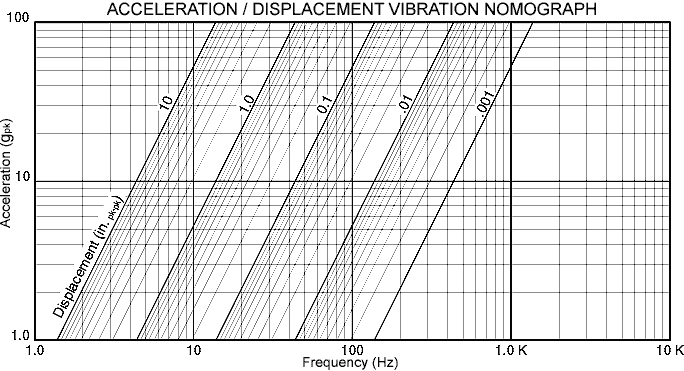
the following nomograph is from www.labworks-inc.com

From the chart 10g's with a 3600 rpm motor and 10:1 reduction = 360rpm=6Hz requires 5 inches of stroke or a 2.5" offset crank

for a 5g peak at 6hz requires about 2.5 inches of stroke for a 1.25" offset crank

If you are going to buy electrical force driven axial shakers you will have to synchonize and I don't know how that is done. The total force required will be the mounting table mass plus clamps and the test specimen for a total mass times the max g level. For example 1000 pounds at 10g's max acceleration you need 10000 pounds of force capability at an absolute minimum.

__________________
All truth passes through 3 stages. First it is ridiculed. Second it is violently opposed. Third it is accepted as being self evident. --Aurthur Schopenhauer
Register to Reply Good Answer (Score 3)
Participant

Join Date: Mar 2009
Posts: 2
#2
In reply to #1

Re: Building a Shaker for Fatigue Testing of Electrical Components

03/07/2009 12:26 AM

Thanks for the help--that is a handy chart. For some reason I was thinking it had to be harder than F=ma but I guess that's all there is to it. Yes I think sinusoidal will be okay (unless you have a better suggestion for finding broken wires, loose components, etc.)

I found an electric motor driven eccentric mass shaker that claims 0-4000rpm and variable force up to 1000lbs. I'm kind of leaning toward just building a clamp right onto the tube and hanging the whole thing horizontally (rope--maybe springs if we need them). I'm guessing that the force decreases with frequency for that shaker--and if it's fairly linear then we could probably get 5g on each 32lb module at about 10Hz. That's the simplest thing--do you think an eccentric motor like that will give that kind of displacement?

Ok if I went with a table--I'd probably get a frame welded with some steel angle iron and then mount the moving cradle on springs. Is the best way to go to set up a motor with a chain sprocket gearset as your speed reducer? Then the output gear would be attached to a wheel with adjustable offset stops to set the displacement. I could switch the pinion size to change the output frequency. Ok I figure for 10g at 5Hz for the full 68lb module (ignoring table mass for now) that'd be 182 ft-lb at 300rpm--about a 10hp motor. Probably double that with the cradle included. Can you just bolt something like this to the floor? Does this become a giant jackhammer?

I'm starting to think this project is going to be more involved than I anticipated.

Register to Reply
Active Contributor

Join Date: Sep 2006
Location: Michigan, USA
Posts: 20
Good Answers: 2
#3
In reply to #2

Re: Building a Shaker for Fatigue Testing of Electrical Components
03/08/2009 1:28 PM

piuscompleo,

Hanging sounds like a cheap way to get there but it won't work. You depending on gravity to to do some of the work but gravity tops out at 1g so 5-10g requires you to impart forces in both directions. You need a solid link and constraint system for straight line of motion. Hanging will bounce it around and get you a looping random vibration profile that you will not be sure what your getting. It could become much more vibration than you think because of line snap reactions and bouncing.

If the slide table is separately mounted. The floor doesn't need any springs under the cradle because the only force it will see is the friction in the slide bearings. The motor WILL be a giant jack hammer. BUT if you setup the shaker to be secured to the floor for lateral forces you will be using concrete in its strongest direction. If the motor is on springs you will have to be sure it can only bounce up and down. If you setup the forces to slide the test specimen laterally, you can't allow it to split the reaction forces from your required displacement and put part of it into moving the motor side to side instead of the part you are testing. If your motor bounces side to side at all it will rob displacement and force from your test specimen.

__________________
All truth passes through 3 stages. First it is ridiculed. Second it is violently opposed. Third it is accepted as being self evident. --Aurthur Schopenhauer
Register to Reply
Register to Reply 3 comments

Good Answers:

These comments received enough positive votes to make them "good answers".

Previous in Forum: calibration of horizontal tank   Next in Forum: Pipe Sizing

Advertisement