Previous in Forum: labview   Next in Forum: Carbon fibre resistivity
Close
Close
Close
6 comments
Rate Comments: Nested
Anonymous Poster

Unbalanced Three-phase Current Calculation

10/30/2009 7:43 PM

Considering a three-phase power distribution device with:

  • Three-phase Wye input, 120/208, measuring phase-neutral voltage and phase current
  • Unbalanced Delta output @ 208V in three sections, section 1 is X-Y, section 2 is Y-Z, section 3 is Z-X

How could I calculate the section current given the three phase currents?

For example, I know from the other way around that if there is 5A on section 1 (X-Y) and 5A on section 2 (Y-Z), then phase X will have 5A, phase Y will have 8.66A, and phase Z will have 5A. This assumes unity power factor, which is an acceptable assumption. The formula for this is x^2 = n1^2 + n1*n2 + n2^2, etc. But working backward from these formulas doesn't seem to go anywhere easily.

Thanks for any suggestions.

Reply
Interested in this topic? By joining CR4 you can "subscribe" to
this discussion and receive notification when new comments are added.

"Almost" Good Answers:

Check out these comments that don't yet have enough votes to be "official" good answers and, if you agree with them, vote them!
Power-User
United States - Member - US Citizen - Born & Raised Engineering Fields - Control Engineering - HVAC/R Simplified Using PLC Controls Engineering Fields - Instrumentation Engineering - HVAC/R Simplified Using PLC Controls Engineering Fields - Energy Engineering - HVAC/R Simplified Using PLC Controls

Join Date: Mar 2007
Location: Brick, NJ (USA)
Posts: 110
Good Answers: 5
#1

Re: Unbalanced Three-phase Current Calculation

11/01/2009 5:36 AM

Thanks to Wikpedia, here is a primer on three phase power. If you post your actual numbers, we can perform and duplicate your results and give further assistance.

We are here to help!

Three-phase

From Wikipedia, the free encyclopedia Jump to: navigation, search This article is about the basic mathematics and principles of three-phase electricity. For information on where, how and why three-phase is used, see three-phase electric power.

In electrical engineering, three-phase electric power systems have at least three conductors carrying voltage waveforms that are 2π/3 radians (120°,1/3 of a cycle in-phase) offset in time. In this article angles will be measured in radians except where otherwise stated.

Contents

[hide]
  • 1 Variable setup and basic definitions
  • 2 Balanced loads
    • 2.1 Star connected systems with neutral
      • 2.1.1 Constant power transfer
      • 2.1.2 No neutral current
    • 2.2 Star connected systems without neutral
  • 3 Unbalanced systems
  • 4 Revolving magnetic field
  • 5 Conversion to other phase systems
  • 6 References
  • 7 See also

[edit] Variable setup and basic definitions

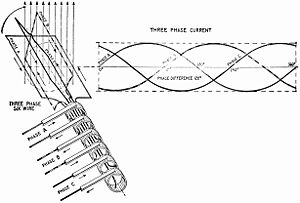
One voltage cycle of a three-phase system, labeled 0 to 360° (2 π radians) along the time axis. The plotted line represents the variation of instantaneous voltage (or current) with respect to time. This cycle will repeat 50 or 60 times per second, depending on the power system frequency. The colors of the lines represent the American color code for 120v three-phase. That is black=VL1 red=VL2 blue=VL3 Elementary six-wire three-phase alternator, with each phase using a separate pair of transmission wires. Elementary three-wire three-phase alternator, showing how the phases can share only three transmission wires.

Let x be the instantaneous phase of a signal of frequency f at time t:

Using this, the waveforms for the three phases are

where VP is the peak voltage and the voltages on L1, L2 and L3 are measured relative to the neutral.

[edit] Balanced loads

Generally, in electric power systems, the loads are distributed as evenly as is practical between the phases. It is usual practice to discuss a balanced system first and then describe the effects of unbalanced systems as deviations from the elementary case.

[edit] Star connected systems with neutral

This refers to a system with a resistive load R between each phase and neutral.

[edit] Constant power transfer

An important property of three-phase power is that the power available to a resistive load, , is constant at all times.

To simplify the math, we define a nondimensionalized power for intermediate calculations,

Using angle subtraction formula

Using the Pythagorean trigonometric identity

Hence (substituting back):

since we have eliminated x we can see that the total power does not vary with time. This is essential for keeping large generators and motors running smoothly.

[edit] No neutral current

For the case of equal loads on each of three phases, no net current flows in the neutral. The neutral current is the sum of the phase current.

We define a non dimensionalized current, .

Using angle subtraction formulae

Hence also f

[edit] Star connected systems without neutral

Since we have shown that the neutral current is zero we can see that removing the neutral core will have no effect on the circuit, provided the system is balanced. In reality such connections are generally used only when the load on the three phases is part of the same piece of equipment (for example a three-phase motor), as otherwise switching loads and slight imbalances would cause large voltage fluctuations.

[edit] Unbalanced systems

Practical systems rarely have perfectly balanced loads, currents, voltages or impedances in all three phases. The analysis of unbalanced cases is greatly simplified by the use of the techniques of symmetrical components. An unbalanced system is analyzed as the superposition of three balanced systems, each with the positive, negative or zero sequence of balanced voltages.

[edit] Revolving magnetic field

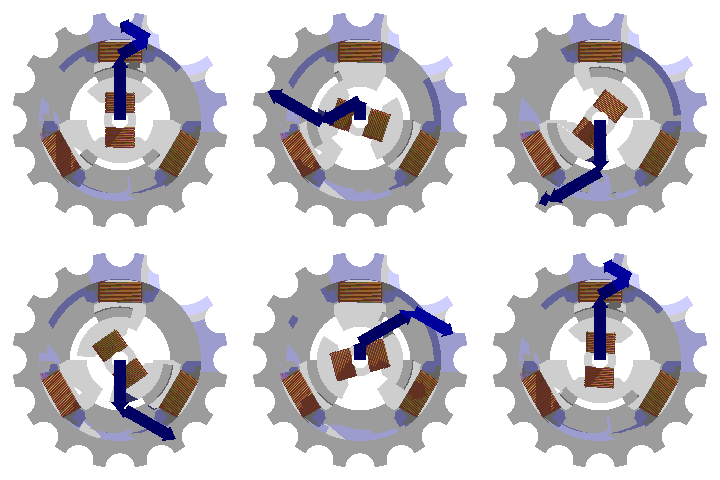
The rotating magnetic field of a three-phase motor.

Any polyphase system, by virtue of the time displacement of the currents in the phases, makes it possible to easily generate a magnetic field that revolves at the line frequency. Such a revolving magnetic field makes polyphase induction motors possible. Indeed, where induction motors must run on single-phase power (such as is usually distributed in homes), the motor must contain some mechanism to produce a revolving field, otherwise the motor cannot generate any stand-still torque and will not start. The field produced by a single-phase winding can provide energy to a motor already rotating, but without auxiliary mechanisms the motor will not accelerate from a stop when energized.

A rotating magnetic field of steady amplitude requires that all three phase currents are equal in magnitude and accurately displaced one-third of a cycle in phase. Unbalanced operation results in undesirable effects on motors and generators.

[edit] Conversion to other phase systems

Provided two voltage waveforms have at least some relative displacement on the time axis, other than a multiple of a half-cycle, any other polyphase set of voltages can be obtained by an array of passive transformers. Such arrays will evenly balance the polyphase load between the phases of the source system. For example, balanced two-power can be obtained from a three-phase network by using two specially constructed transformers, with taps at 50% and 86.6% of the primary voltage. This Scott T connection produces a true two-phase system with 90° time difference between the phases. Another example is the generation of higher-phase-order systems for large rectifier systems, to produce a smoother DC output and to reduce the harmonic currents in the supply.

When three-phase is needed but only single-phase is readily available from the electricity supplier a phase converter can be used to generate three-phase power from the single phase supply.

[edit] References

  • Stevenson, William D., Jr. (1975). Elements of Power Systems Analysis. McGraw-Hill electrical and electronic engineering series (3rd ed. ed.). New York: McGraw Hill. ISBN 0-07-061285-4.

[edit] See also

  • John Hopkinson
  • Nikola Tesla
  • Polyphase systems
  • Mikhail Dolivo-Dobrovolsky
  • Electric motor
  • Charles Proteus Steinmetz
  • Y-Δ transform

Retrieved from "http://en.wikipedia.org/wiki/Three-phase"

__________________
"Memorize the calculations, you look like a fool searching your notes while teaching class"
Reply Score 1 for Good Answer
Power-User

Join Date: Nov 2008
Location: US - TEXAS
Posts: 196
Good Answers: 18
#2

Re: Unbalanced Three-phase Current Calculation

11/01/2009 10:15 AM

I just gave JCCHIEFENG a good answer vote. Not only is it a good answer it is everything you would want to know about three phase unbalanced circuit calculations.

If you are looking for something a little simpler than that, I refer you to the NEC section 220.55 which will refer you to Examples in Annex D.

Reply
Anonymous Poster
#3
In reply to #2

Re: Unbalanced Three-phase Current Calculation

11/02/2009 1:05 PM

I'm afraid the answer really hasn't helped me, but maybe it's just me. I think I understand what is shown on Wikipedia, but what is there is only for balanced three-phase, not un-balanced. It briefly says that for unbalanced systems you should use the technique of symmetrical components, but I'm just not getting it when I look up info on symmetrical components on the web. Maybe my math is just rusty .


I'm just looking for a way to calculate the delta load currents based on knowing the individual unbalanced phase currents. For example, if Ix = 5A, Iy = 10A, and Iz = 8A, what are the three delta load currents (X-Y, Y-Z, and Z-X)?

Reply
Power-User
United States - Member - US Citizen - Born & Raised Engineering Fields - Control Engineering - HVAC/R Simplified Using PLC Controls Engineering Fields - Instrumentation Engineering - HVAC/R Simplified Using PLC Controls Engineering Fields - Energy Engineering - HVAC/R Simplified Using PLC Controls

Join Date: Mar 2007
Location: Brick, NJ (USA)
Posts: 110
Good Answers: 5
#4
In reply to #3

Re: Unbalanced Three-phase Current Calculation

11/02/2009 1:41 PM

Work these formulas....

__________________
"Memorize the calculations, you look like a fool searching your notes while teaching class"
Reply
Anonymous Poster
#5
In reply to #4

Re: Unbalanced Three-phase Current Calculation

11/02/2009 2:11 PM

The sqrt(3) formulas only apply to balanced loads. That's my problem.

The example phase currents I gave in my previous post are actually impossible. Possible values would be Ix = 5A, Iy = 10A, and Iz = 9.84A.

Reply
Power-User
United States - Member - US Citizen - Born & Raised Engineering Fields - Control Engineering - HVAC/R Simplified Using PLC Controls Engineering Fields - Instrumentation Engineering - HVAC/R Simplified Using PLC Controls Engineering Fields - Energy Engineering - HVAC/R Simplified Using PLC Controls

Join Date: Mar 2007
Location: Brick, NJ (USA)
Posts: 110
Good Answers: 5
#6
In reply to #5

Re: Unbalanced Three-phase Current Calculation

11/02/2009 10:27 PM

You keep referring to your current and I keep giving you the formulas to calculate, algebraically, everything else. Maybe I'm missing the point that you do not understand that an inbalance in an AC polyphase circuit, Wye or Delta, is created by an asymmetrical impedance in one or more of the circuits. What impedance values are you using? What voltage values are you using?

Imbalanced loads cause imbalanced current and voltage drops. If you are measuring these currents in an actual circuit, you should be able to measure what is needed to calculate the impedance of each load on each phase. Then algebraically rearrange the formulas for what you want to calculate.

If you detail ALL of your measurements on a piece of paper and substitute your values into the appropriate formulas you may see your result. Without knowing all of your parameters in the circuits you are referring to, it is difficult to understand what you are looking at.

Does this help?

__________________
"Memorize the calculations, you look like a fool searching your notes while teaching class"
Reply
Reply to Forum Thread 6 comments

"Almost" Good Answers:

Check out these comments that don't yet have enough votes to be "official" good answers and, if you agree with them, vote them!
Copy to Clipboard

Users who posted comments:

Anonymous Poster (2); GRAY HAIRED OLD GOAT (1); jcchiefeng (3)

Previous in Forum: labview   Next in Forum: Carbon fibre resistivity

Advertisement