Previous in Forum: Capacitor Forming in Siemens Sinamic S120 Drives   Next in Forum: Difference Between Mark V and Mark VI Control GT.
Close
Close
Close
17 comments
Rate Comments: Nested
Power-User

Join Date: Apr 2009
Location: NY
Posts: 160
Good Answers: 2

Light Sensing Circuit

02/02/2012 6:30 PM

Hello folks. I have a bit of a problem. I studied electronics over 30 years ago and have seldom used it. I am trying to build a simple circuit to turn a single LED on at dark. I have used the following circuit and it works, but the problem is the light intensity required to turn off the LED is high (it almost has to be in direct sunlight or bright light to turn off) I need this for a device at the bedside that simply turns off in the morning and on at night. Can I modify this circuit to do so or is there a way I can use a photoresistor to trigger a switching circuit? This is battery operated using a button cell battery 3V. This circuit uses the 2N3904 transistor and a radio shack NPN silicon phototransistor (the LTR 4206E called for in the circuit diagram did not work.) I have a drawer full of the 2n3904 and similar transistors and photoresistors, I have a few of the radioshack phototransistors as well. Thanks in advance for your help

folks.

best regards,

Shawn

__________________
Shawn P. Galloway
Register to Reply
Interested in this topic? By joining CR4 you can "subscribe" to
this discussion and receive notification when new comments are added.

Good Answers:

These comments received enough positive votes to make them "good answers".

"Almost" Good Answers:

Check out these comments that don't yet have enough votes to be "official" good answers and, if you agree with them, vote them!
2
Guru
Engineering Fields - Electrical Engineering - Been there, done that. Engineering Fields - Control Engineering - New Member

Join Date: Dec 2008
Location: Long Island NY
Posts: 15600
Good Answers: 981
#1

Re: help with circuit

02/02/2012 7:04 PM

Well your 2n3904 transistor will always have a Vce voltage greater than the saturation voltage so this transistor will never saturate. Well as long as your battery voltage is still at 3V it will never switch. With a nominal β of 100 and a LED ON current of 5 mA at 1.2V, it only takes about 50 μA for ib to achieve this current. Ignoring the dark collector current of your opto-transistor and assuming that the opto-transistor saturates at a nominal 0.2V, the current through your resistor will vary from 2.8 mA to 1.6 mA of current. So until you get enough light to strike the opto-transistor to draw at least 1.55 mA you will not possibly divert enough current from the base of the transistor to reduce the light. I would first just replace the 1K resistor with a 24K resistor.

__________________
"Don't disturb my circles." translation of Archimedes last words
Register to Reply Good Answer (Score 2)
Guru

Join Date: Mar 2007
Location: by the beach in Florida
Posts: 33392
Good Answers: 1817
#2

Re: help with circuit

02/02/2012 7:23 PM

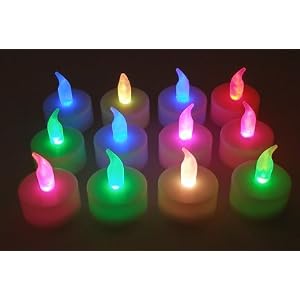
you need a variable pot to adjust resistance...You know you can buy the flickering candle led's for $2, with manual switch..or 12 for $9...

Amazon tea light set

__________________
All living things seek to control their own destiny....this is the purpose of life
Register to Reply Score 1 for Good Answer
Participant

Join Date: Dec 2011
Posts: 2
#3

Re: Light Sensing Circuit

02/03/2012 1:52 AM

please engineer

try to use the operational amplifier technique,,,it is very sensitive and can operate by any light intensity,,,try and if you failed we can operate together

,,,,,,,,,,,,,,thanks,,,,,,,,,,,,,,,,ahmed,,,,,,,,,,,,,,,,,,,,,,,

Register to Reply
Guru
Popular Science - Weaponology - New Member United Kingdom - Member - New Member

Join Date: May 2007
Location: Harlow England
Posts: 16512
Good Answers: 670
#4

Re: Light Sensing Circuit

02/03/2012 3:29 AM

Redfred has given you a great answer.
Start with more volts, say a 9v old battery. You can then design the circuit properly. You also want a resistor in series with the LED to limit it's current, between the LED and -ve rail will work well, as it will help the transistor to start turning off.
I strongly advise against adding op amps and stuff, it just complicates it.
Keep it simple at first.
Del

__________________
health warning: These posts may contain traces of nut.
Register to Reply
Power-User

Join Date: Apr 2009
Location: NY
Posts: 160
Good Answers: 2
#5

Re: Light Sensing Circuit

02/03/2012 7:29 AM

Thanks redfred and del, and everyone else for that matter. The resistor did the trick. I am, however, curious as to how to use the cadmium sulfide photoresistors in a circuit. I tried using it in place of the phototransistor and the LED goes off at dark and on at light. Is there any way to get it to work in the same fashion except going on at dark? I am not sure it will make much difference cost wise but am just curious as to how they would work. (my electronics courses were still in vaccuum tubes, they were just starting to introduce transistors but did not go into much detail, so I am very much green in modern electronics. Thanks all very much.

__________________
Shawn P. Galloway
Register to Reply
2
Guru
Popular Science - Weaponology - New Member United Kingdom - Member - New Member

Join Date: May 2007
Location: Harlow England
Posts: 16512
Good Answers: 670
#6
In reply to #5

Re: Light Sensing Circuit

02/03/2012 7:59 AM

If you swap the fixed resitor and the photoresistor it will work the other way.
However the resistor value may need some adjustment.
If you measure or look up the dark resistance and light resistance of the photoresistor and do some sums you should be able to figure it out.
Del

__________________
health warning: These posts may contain traces of nut.
Register to Reply Good Answer (Score 2)
Power-User

Join Date: Jan 2012
Location: California
Posts: 184
Good Answers: 10
#7

Re: Light Sensing Circuit

02/04/2012 12:38 PM

The circuit with really great sensitivity can be found in a light sensitive night light. The product is very inexpensive and available in most hardware stores.

__________________
A hand without an arm is a useless tool
Register to Reply
Power-User

Join Date: Apr 2009
Location: NY
Posts: 160
Good Answers: 2
#8
In reply to #7

Re: Light Sensing Circuit

02/04/2012 4:41 PM

Byron, the problem is that I need to design it for my customer. Initially he called for simply an LED for his device, now he wanted it to go on at night. I can find hundreds of devices out there that turn off at light and on at dark, and likely I could copy a circuit that way. I have the circuit and all I needed was to increase the sensitivity which I accomplished thanks to this forum using a higher value resistor and it now works great. I still am interested just as curiosity for the photoresistor and tried switching the resitor and the photoresistor with no luck but think it is simply the size of the resistors that is the problem. I have a circuit that works as I want now so all I need to do is create a small enough package and it is done. thanks.

__________________
Shawn P. Galloway
Register to Reply
Power-User

Join Date: May 2011
Posts: 102
Good Answers: 2
#9

Re: Light Sensing Circuit

02/04/2012 6:49 PM

Like the man said earlier just replace the 1k with 22k or 27k.

If you want a real on/off trip, put another 2N3904 in darlington, and put a potentiometer say 0-47k in series with the base resistor until you find the threshold that you want.

Register to Reply
Power-User

Join Date: Apr 2009
Location: NY
Posts: 160
Good Answers: 2
#10
In reply to #9

Re: Light Sensing Circuit

02/04/2012 7:28 PM

engineertony, If you had read my reply you would note that I did replace the resistor and took care of the problem. My comment here was simply that I can very well go to hardware store and find night lights, that is not what I was after. I have been able to make the circuit as needed and it works great.

__________________
Shawn P. Galloway
Register to Reply
Guru
Engineering Fields - Electrical Engineering - Been there, done that. Engineering Fields - Control Engineering - New Member

Join Date: Dec 2008
Location: Long Island NY
Posts: 15600
Good Answers: 981
#11
In reply to #10

Re: Light Sensing Circuit

02/04/2012 9:55 PM

Glad I could help. Depending on how many you will be making, you might consider using a field effect transistor instead of a bipolar transistor. You'll get a sharper ON/OFF transition and possibly cheaper components.

__________________
"Don't disturb my circles." translation of Archimedes last words
Register to Reply
Power-User

Join Date: Apr 2009
Location: NY
Posts: 160
Good Answers: 2
#13
In reply to #11

Re: Light Sensing Circuit

02/05/2012 3:10 PM

Thanks, I will look at the FET idea. I am not sure how much cheaper they would be will check mouser. the transistor I used I got for about 14 cents (cost more for shipping) and I think there is a substantial discount for high volume, not sure about digikey. I will look into it though.

__________________
Shawn P. Galloway
Register to Reply
Guru
Engineering Fields - Electrical Engineering - Been there, done that. Engineering Fields - Control Engineering - New Member

Join Date: Dec 2008
Location: Long Island NY
Posts: 15600
Good Answers: 981
#14
In reply to #13

Re: Light Sensing Circuit

02/05/2012 5:24 PM

The price break difference of switching to a MOSFET would likely come at the 1000's quantity. I hope that you have to consider this redesign.

__________________
"Don't disturb my circles." translation of Archimedes last words
Register to Reply
Power-User

Join Date: May 2011
Posts: 102
Good Answers: 2
#12

Re: Light Sensing Circuit

02/05/2012 12:21 PM

Sorry didn't see your success post.

Register to Reply
Participant

Join Date: Dec 2015
Posts: 2
#15

Re: Light Sensing Circuit

12/31/2015 8:05 AM

Hello. I was woundering if I could replace the ltr-4206E with an other phototransistor. I am not from US, so geting ltr-4206E is not cheap. Please help me.

Register to Reply Off Topic (Score 5)
Guru
Engineering Fields - Electrical Engineering - Been there, done that. Engineering Fields - Control Engineering - New Member

Join Date: Dec 2008
Location: Long Island NY
Posts: 15600
Good Answers: 981
#16
In reply to #15

Re: Light Sensing Circuit

12/31/2015 9:39 AM

Yes, one can use another photo-transistor for the ltr-4206E. Depending on the parameters of the new transistor you will get a different performance level.

You have to remember that the OP brought us this circuit because they did not like the performance they got. I dislike this circuit topology. It has no feedback to stabilize the circuit performance. It looks to me more like a circuit for testing a parameter of the photo-transistor than making a repeatable performance.

__________________
"Don't disturb my circles." translation of Archimedes last words
Register to Reply Off Topic (Score 6)
Participant

Join Date: Dec 2015
Posts: 2
#17
In reply to #16

Re: Light Sensing Circuit

01/01/2016 1:31 PM

Thank you for the answer.

Register to Reply Off Topic (Score 5)
Register to Reply 17 comments

Good Answers:

These comments received enough positive votes to make them "good answers".

"Almost" Good Answers:

Check out these comments that don't yet have enough votes to be "official" good answers and, if you agree with them, vote them!
Copy to Clipboard

Users who posted comments:

ahmed el sonbaty (1); Byron Jay (1); engineertony (2); redfred (4); SolarEagle (1); toolman911965 (4); Urban (2); user-deleted-1105 (2)

Previous in Forum: Capacitor Forming in Siemens Sinamic S120 Drives   Next in Forum: Difference Between Mark V and Mark VI Control GT.

Advertisement