Previous in Forum: Education from Study Smart Coaching Institute for AIEEE   Next in Forum: Specializations in MS in Electrical Engineering
Close
Close
Close
34 comments
Rate Comments: Nested
Associate

Join Date: Nov 2011
Posts: 48

"Principle of Equivalence" in General Relativity

02/09/2012 4:46 PM

principle of equivalence:

Whether in "flat" space-time, or "curved" space-time, particles "prefer" to propagate along "straightest possible paths", i.e. geodesics, through space-time. Per Newton's first law, each & every deviation, from the "desired" geodesic "free fall" path, must result from forces; and all are experienced, equivalently, as 'accelerations'. Is this accurate ?

space (horizontal) vs. time (vertical) diagrams, depicting curvature of space-time fabric, caused by a massive body, whose "world-swath" through space-time is indicated, by the shaded region (adapted from Rucker. Geometry, Relativity, 4th Dimension). Force-ful interactions, generating experiences of "accelerations", indicated by red "explosions".

I understand, that, ultimately, all force-ful interactions arise, from the three 'fundamental forces', of the Standard Model, i.e. Strong, Weak, EM, via boson exchange. E.g. standing on earth is, ultimately, an EM interaction, between electrons ("in the bottoms of your feet, and the surface of earth"), via virtual photons; whereas standing on a neutron-star would, hypothetically, be a Strong interaction, via virtual pions. Is that accurate ?

Register to Reply
Interested in this topic? By joining CR4 you can "subscribe" to
this discussion and receive notification when new comments are added.
Guru
Engineering Fields - Aerospace Engineering - Retired South Africa - Member - The Rainbow-nation Engineering Fields - Engineering Physics - Relativity & Cosmology Popular Science - Cosmology - The Big Picture!

Join Date: May 2006
Location: Pretoria, South Africa
Posts: 3804
Good Answers: 69
#1

Re: "Principle of Equivalence" in General Relativity

02/10/2012 12:15 AM

"... each & every deviation, from the "desired" geodesic "free fall" path, must result from forces; and all are experienced, equivalently, as 'accelerations'. Is this accurate ?"

Yes, with the exception of the gravitational (pseudo) force, which if present, 'causes' the geodesic path and hence only results in a coordinate acceleration, not a proper acceleration. An accelerometer does not measure the coordinate acceleration of free fall; it reads zero.

"E.g. standing on earth is, ultimately, an EM interaction, between electrons ("in the bottoms of your feet, and the surface of earth"), via virtual photons; whereas standing on a neutron-star would, hypothetically, be a Strong interaction, via virtual pions. Is that accurate ?"

Not my field, but since there are only neutrons beneath you, I guess you may be right.

-J

__________________
"Perplexity is the beginning of knowledge." -- Kahlil Gibran
Register to Reply
Associate

Join Date: Nov 2011
Posts: 48
#2
In reply to #1

Re: "Principle of Equivalence" in General Relativity

02/11/2012 2:00 AM

visualizing space-time curvature ?

If our (3+1)D space-time fabric, is imagined to be embedded, in a higher-dimensional 'hyperspace'; then the curvatures imputed, into our space-time fabric, by massive bodies, can be visualized, as warpages into a higher dimension (w, "in-out"), orthogonal to the standard spatial dimensions (xyz, "left-right, front-back, up-down").

I understand, that the curvatures imputed into space-time, by mass, all "sag" in the same hyper-spatial direction, e.g. "out" (w>0) ? I.e. all hyper-spatial "sags" thrust in the same hyper-direction, e.g. "mass always 'hangs out-ward'" ? In many online images, the coordinate grid-mesh is depicted as being "pulled into" the massive body, omnidirectionally, as if the grid-mesh were free-falling towards the mass, through space. But, I offer, that the grid-mesh "sags out-ward", to varying degrees, but always in the same hyper-space hyper-direction. In crude analogy, "you 'hang' a mass, 'onto' a flat space-time fabric, and that space-time 'sags out-ward' under the 'loading'" ?

I have tried to visualize such "sags", in the following figures, first in a "stack" of "slices" in (2+0)D; second with a curved coordinate grid-mesh in (2+1)D:

Register to Reply
Associate

Join Date: Nov 2011
Posts: 48
#5
In reply to #2

Re: "Principle of Equivalence" in General Relativity

02/11/2012 1:20 PM

visualizing space-time curvature ?

... the curvatures imputed into space-time, by mass, all "sag" in the same hyper-spatial direction, e.g. "out" (w>0) ? I.e. all hyper-spatial "sags" thrust in the same hyper-direction, e.g. "mass always 'hangs out-ward'" ? ... the grid-mesh "sags out-ward", to varying degrees, but always in the same hyper-space hyper-direction. In crude analogy, "you 'hang' a mass, 'onto' a flat space-time fabric, and that space-time 'sags out-ward' under the 'loading'" ?

If you "color coded" the space-time fabric grid-mesh, such that "red" represented "in" (w<0); and "blue" represented "out" (w>0); then the presence of mass would impute "mono-chromatic" curvatures, into space-time, e.g. "all blue", with "darker blues" near the mass; and increasingly "lighter blues" farther from the mass; but no "red" curvatures ? Online images often show the grid-mesh "contracting onto" the central mass, such that the imputed curvature "thrusts" through different directions (on different sides of the mass); but, by the rubber sheet analogy, cp. Flamm's paraboloid, the "sag" is "all in the same direction", e.g. "down"; and, none of the "sag" is "contractile", i.e. space never "shrinks"; whilst all of the "sag" is "expansive", i.e. space only "stretches".

(2+1)D

(2+1)D sans time

(2+0)D

Register to Reply
Associate

Join Date: Nov 2011
Posts: 48
#3
In reply to #1

Re: "Principle of Equivalence" in General Relativity

02/11/2012 2:24 AM

"the gravitational (pseudo) force"

If gravity is only a fictitious force, cp. centrifugal & Coriolis 'forces'; then why would 'gravitons' exist, any more than 'centrifugal-ons' or 'Coriolis-ons' ? Why is 'Quantum Gravity' any more than "solving the Schrodinger equation, on a curved coordinate grid-mesh" ?

Register to Reply
Guru
Engineering Fields - Aerospace Engineering - Retired South Africa - Member - The Rainbow-nation Engineering Fields - Engineering Physics - Relativity & Cosmology Popular Science - Cosmology - The Big Picture!

Join Date: May 2006
Location: Pretoria, South Africa
Posts: 3804
Good Answers: 69
#4
In reply to #3

Re: "Principle of Equivalence" in General Relativity

02/11/2012 10:01 AM

Hi Widdekind,

I currently have difficulties with Imageshack Login and cannot see your graphics (I see the frozen frog only).

Can you perhaps save the images and upload them with the graphic tool on CR4, straight into a new comment?

-J

__________________
"Perplexity is the beginning of knowledge." -- Kahlil Gibran
Register to Reply
Guru
Popular Science - Cosmology - Let's keep knowledge expanding Engineering Fields - Retired Engineers / Mentors - Hobbies - HAM Radio - New Member

Join Date: Dec 2006
Location: North America, Earth
Posts: 4528
Good Answers: 106
#23
In reply to #1

Re: "Principle of Equivalence" in General Relativity

02/18/2012 1:44 PM

Yes, with the exception of the gravitational (pseudo) force, which if present, 'causes' the geodesic path and hence only results in a coordinate acceleration, not a proper acceleration. An accelerometer does not measure the coordinate acceleration of free fall; it reads zero.

I have a problem with the word "pseudo" here. I have 2 physics books in my possession. There are 5 college or university professors involved in them. The word "pseudo" is not used in talking about gravity, Newton's laws, or anywhere else AFAICT. It is not in the indexes. They are old books, so apparently the teachings have changed. I don't believe that either Cavendish or C.V Boys used the term either.

The force of gravity is able to stretch a spring so that a scale can indicate a person's weight. What is fictitious about that? As a kid I was once expelled by the centrifugal force of a merry-go-round where I got some cuts and scratches. I can testify that it was a real force.

In free-fall, an accelerometer may not indicate the force because the object has already yielded to the force?

__________________
“I would rather have questions that can't be answered than answers that can't be questioned.” - Richard Feynman
Register to Reply
Power-User

Join Date: Sep 2011
Posts: 164
Good Answers: 1
#24
In reply to #23

Re: "Principle of Equivalence" in General Relativity

02/18/2012 5:33 PM

This reminds me of a slinky demonstration that was going around a while ago. http://www.youtube.com/watch?v=2419QiLteE0

Register to Reply
Guru
Engineering Fields - Aerospace Engineering - Retired South Africa - Member - The Rainbow-nation Engineering Fields - Engineering Physics - Relativity & Cosmology Popular Science - Cosmology - The Big Picture!

Join Date: May 2006
Location: Pretoria, South Africa
Posts: 3804
Good Answers: 69
#25
In reply to #23

Re: "Principle of Equivalence" in General Relativity

02/19/2012 11:45 AM

Hi S: "The force of gravity is able to stretch a spring so that a scale can indicate a person's weight. What is fictitious about that?"

One can obviously argue about the 'real' meaning of "fictitious", but in Einstein's GR, the 'real' force is the one holding one end of the spring static relative to the earth (the floor, or whatever), not the gravitational pseudo-force. The person tends to follow a geodesic in spacetime (free-fall), which will take it closer to Earth's center; the floor forcefully prevents it from doing that.

I guess that Newton would have disagreed.

-J

PS: sorry not to have more time to respond, but family responsibilities demand priority at present.

__________________
"Perplexity is the beginning of knowledge." -- Kahlil Gibran
Register to Reply
Associate

Join Date: Nov 2011
Posts: 48
#6

Re: "Principle of Equivalence" in General Relativity

02/11/2012 1:53 PM

metric matrix is defined at grid-mesh coordinates, i.e. "events" (x,y,z,t); and converts coordinate displacements (dx,dy,dz,dt) into "absolute" space & time differences ?

I understand, that space-time can warp; but that physical "rulers" remain the same absolute physical length; whilst physical "clocks", e.g. oscillating cesium atoms, always "tick" at the same absolute rate. I.e. when space-time warps, physical objects, e.g. "rulers" & "clocks", are "caught inside" the "elastic membrane" of space-time, and simply "slide through", remaining unaffected -- even as a curving coordinate grid-mesh "meanders past" their positions?

Somehow, the coordinate grid-mesh defines someone's sense of "simultaneity" (t=const) and "stationary" (x=const). So, as the coordinate grid-mesh "snakes around" in some region of space-time; remote observers can become "de-synchronized", so that remote "clocks" seem to "tick" at different times, i.e. appear to "tick" relatively slower or faster. But, in an absolute sense, the "molecular bond lengths" in "rulers" remain the same; and the time required for some quantum system to oscillate to-and-fro, e.g. cesium atoms, remains the same. Only the coordinate grid-mesh, i.e. the space-time fabric itself, is directly affected by mass -- "QM processes continue occurring, according to the Schrodinger equation, inside curved space-time, without noticing". And, the metric matrix, defined at every coordinate grid-mesh "event", converts, from coordinate displacements (dx); to absolute displacements (dxT.g.dx = dx.dx = dx2):

Register to Reply
Guru
Popular Science - Cosmology - Let's keep knowledge expanding Engineering Fields - Retired Engineers / Mentors - Hobbies - HAM Radio - New Member

Join Date: Dec 2006
Location: North America, Earth
Posts: 4528
Good Answers: 106
#7
In reply to #6

Re: "Principle of Equivalence" in General Relativity

02/11/2012 3:22 PM

I understand, that space-time can warp; but that physical "rulers" remain the same absolute physical length; whilst physical "clocks", e.g. oscillating cesium atoms, always "tick" at the same absolute rate.

From Einstein's book Relativity page 81:

"Thus on our circular disk [rotating], or, to make the case more general, in every gravitational field, a clock will go more quickly of less quickly, according to the position in which the clock is situated..."

This has been proven time and time again.

__________________
“I would rather have questions that can't be answered than answers that can't be questioned.” - Richard Feynman
Register to Reply
Associate

Join Date: Nov 2011
Posts: 48
#8
In reply to #7

Re: "Principle of Equivalence" in General Relativity

02/12/2012 1:17 AM

From Einstein's book Relativity page 81:

"Thus on our circular disk [rotating], or, to make the case more general, in every gravitational field, a clock will go more quickly of less quickly, according to the position in which the clock is situated..."

This has been proven time and time again.

-------------------------------------------------------------------

May I insert the word "appear" ? I.e.

"in every gravitational field, a clock will [appear to] go more quickly of less quickly, according to the position in which the clock is situated"

Near massive bodies (having geometric mass RS = 2GM/c2), space stretches, e.g. grr = -(1 + RS/r), i.e. |grr| > 1; whilst time shrinks, e.g. gtt = +(1 - RS/r), i.e. |gtt| < 1. However, physical "rulers" remain the same, absolute, physical length, i.e. the actual electron bond lengths, in those "rulers", do not themselves stretch, but only the fabric of space-time itself. Indeed, that those "rulers" remain the same physical length, is the means, by which the stretching of space could be measured. Cp. deep space between galaxies stretches, during cosmological expansion; but bound objects, e.g. stars & galaxies, do not stretch.

Likewise, physical "clocks" keep "ticking", over the same, absolute, physical durations, i.e. the actual electron oscillations keep occurring, according to QM, at the same absolute frequency. Indeed, that is why observers, near masses, never notice that their clocks run slow -- every quantum system keeps "whirring away" at the same absolute rate, "making do" within its curved space-time environment. But, mass warps the fabric of space-time, such that time shrinks, so that "clocks", functioning as "time rulers", "thread through" more time. Thus, for distant observers, clocks near masses appear to run slow.

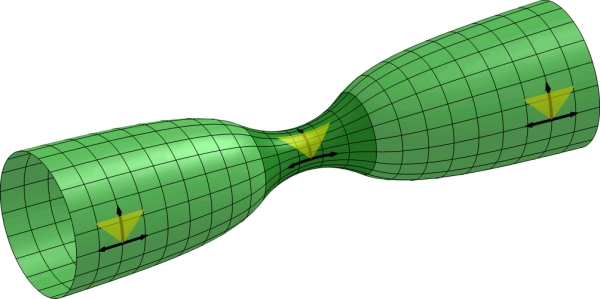
In the image I tried to post, a "ruler" is depicted, in two locations, both far from, and near to, the (implied) mass, in the center of the figure, whose mass causes the curvatures (schematically) shown. And so, since mass stretches space, that ruler appears to "thread through" less-and-less space (as measured by the coordinate grid-mesh system), as it is brought nearer the mass. Likewise, a "clock" is depicted, representing some fixed quantum oscillator system, whose oscillations track time. That "clock", amounting to a "time ruler", remains a fixed absolute "length". But, the mass shrinks time, in its vicinity, so that that "time ruler" appears to "thread through" more time.

Logically, if you can accept, that mass can stretch space, cp. "rubber sheet"; then you should be able to accept, that mass can shrink time (since space-and-time form a single unified fabric). Yet, regardless of the warpages & contortions of the space-time fabric; physical quantum systems persist in their properties, e.g. electron bond lengths span the same distances; and electron oscillations last the same durations of time. But, the contortions of space-time "throw everybody out of sync", so that rulers appear to shrink, and clocks appear to run slow, near masses -- even though "in reality" space stretches, and time shrinks.

Register to Reply
Guru
Popular Science - Cosmology - Let's keep knowledge expanding Engineering Fields - Retired Engineers / Mentors - Hobbies - HAM Radio - New Member

Join Date: Dec 2006
Location: North America, Earth
Posts: 4528
Good Answers: 106
#9
In reply to #8

Re: "Principle of Equivalence" in General Relativity

02/12/2012 12:15 PM

So let me get this straight. Are you saying that if you had two atomic clocks that were set to the same time, and put one on a rotating disk, it would appear to tick slower while rotating, but once the disk was stopped the two times would still agree?

__________________
“I would rather have questions that can't be answered than answers that can't be questioned.” - Richard Feynman
Register to Reply
Associate

Join Date: Nov 2011
Posts: 48
#10
In reply to #9

Re: "Principle of Equivalence" in General Relativity

02/13/2012 2:21 AM

So let me get this straight. Are you saying that if you had two atomic clocks that were set to the same time, and put one on a rotating disk, it would appear to tick slower while rotating, but once the disk was stopped the two times would still agree?

-------------------------------------------------------------

Journey into Gravity & Spacetime, by J.A.Wheeler, compares the fabric of space-time, to elastic membranes, e.g. soap films. Matter is embedded into space-time, as specs of dust & splinters could be embedded into soap films. Mass warps space-time, as soap films could be contorted. Yet, rigid masses are not themselves warped, when space-time warps "around" them, as dust & splinters simply "slide through", or "slide around in", soap films, when they are deformed.

Near masses, space-time deforms, such that space stretches; and time shrinks. But, rigid "rulers" remain the same absolute length; and "clocks" (which can be considered as "time rulers") tick over the same absolute amount of time. I.e. "rulers" & "clocks" simply "slide around in" deforming space-time, near masses, without being deformed themselves.

Importantly, the speed of light remains an absolute constant. If you grant me suitably sized "rulers", and suitably timed "clocks"; then photons propagate one absolute ruler's length, every absolute clock tick. However, the deformation, of the fabric of space-time, within which those "rulers" & "clocks" are embedded, generates the appearance, of gravitational space & time dilations, when separated observers, near to, and remote from, massive bodies, attempt to "compare notes":

I speculate, from the above understanding, that quantum "entangled" photons, undergoing quantum simultaneous wave-function "collapse", upon quantum measurement, would "collapse" along "lines of simultaneity", defined by (a lattice-work of) those absolute "rulers" & "clocks" -- even if different amounts of apparent local dilated time had elapsed, since the photons were emitted:

Register to Reply
Associate

Join Date: Nov 2011
Posts: 48
#11
In reply to #10

Re: "Principle of Equivalence" in General Relativity

02/13/2012 2:53 AM

I want to emphasize, the difference, between a choice of coordinate grid-mesh, "threaded through" the space-time fabric; and "rulers" & "clocks". The former is "locked into" the space-time fabric, and so does deform, with warpings of that space-time fabric. The latter are "absolute", e.g. "rigid" rulers, and so do not deform with warpings, of that space-time fabric, but rather "slide through", or "slide around in", deforming space-time.

The metric matrix guv converts differences in coordinate values (dx,dy,dz,dt), into "absolute" differences, in "absolute" space-and-or-time intervals, via the generalized (Minkowski) dot-product:

(dx,dy,dz,dt)T . g . (dx,dy,dz,dt) = ds2 ~ time2 - space2

Note that the specialized definition, of the vector dot-product, "as you learned in school", is a simplification, of the special case, of flat Euclidian space:

vT . g . v = vT.v

when the (flat-space Euclidian) metric matrix, is the Identity matrix, i.e. g = 1. If school-teachers taught the generalized definition, of the dot-product; then the extrapolation, from flat space (g=1), to curved space (guv), would be quickly comprehensible. Instead, GR text-books try to be "back-wards compatible", with the specialized grade-school dot-product definition. To do so, they define "dual-vectors", sometimes called "(one) forms":

vdual = g . v

with which "hybrid mathematical object" -- resembling a vector, but implicitly involving a matrix pre-multiplication -- said text-books can then write:

"v dot v" = vT.vdual

Much additional mathematical rigamarole is then required, i.e. "vectors have super-scripts vu & one-form dual-vectors have sub-scripts vu", conceivably causing confusion.

Register to Reply
Guru
Engineering Fields - Aerospace Engineering - Retired South Africa - Member - The Rainbow-nation Engineering Fields - Engineering Physics - Relativity & Cosmology Popular Science - Cosmology - The Big Picture!

Join Date: May 2006
Location: Pretoria, South Africa
Posts: 3804
Good Answers: 69
#12
In reply to #11

Re: "Principle of Equivalence" in General Relativity

02/13/2012 3:16 PM

Hi guys: due to other commitments, I'm somewhat out of the running at the moment, but will try to catch up in a week or two.

Widdekind, with only superficial reading I must say that I'm a little baffled by your spacetime charts. That 'warp pattern' changing in time from 'convex' to 'concave', with a 'flat' in the middle, does not make any sense to me. Do you have any reference for such a spacetime chart?

"Near masses, space-time deforms, such that space stretches; and time shrinks. But, rigid "rulers" remain the same absolute length; and "clocks" (which can be considered as "time rulers") tick over the same absolute amount of time."

This is very subjective (coordinate-dependent), because in Schwarzschild coordinates, both time and space shrinks near a massive body. Another thing is that 'absolute length and time' do not exist in general relativity - only coordinate lengths and times.

-J

__________________
"Perplexity is the beginning of knowledge." -- Kahlil Gibran
Register to Reply
Associate

Join Date: Nov 2011
Posts: 48
#15
In reply to #12

Re: "Principle of Equivalence" in General Relativity

02/13/2012 11:39 PM

Widdekind, with only superficial reading I must say that I'm a little baffled by your spacetime charts. That 'warp pattern' changing in time from 'convex' to 'concave', with a 'flat' in the middle, does not make any sense to me. Do you have any reference for such a spacetime chart? ...

-J

---------------------------------------------------------

According to Wheeler, the curvature, imputed into the fabric of space-time, by mass, is qualitatively different, in the empty space-time outside the object vs. in the matter-dense space-time inside the object. In the former "exterior" regions, space-time is "extensile", having zero net scalar space curvature (Ktheta = Kphi = -1/2 Kr). In the latter "interior" regions, space-time is "contractile", having negative net scalar curvature. I.e. along individual "slices", of constant co-moving coordinate time, i.e. "lines of simultaneity"; all that is being depicted, are the conjoined "exterior" (Flamm's paraboloid) & "interior" Schwarzschild (hyper-sphere) solutions, for the curved space-time, without & within (constant density ball-shaped) masses:

The pictures provided are adapted from Geometry, Relativity, and the Fourth Dimension, by Rudy Rucker.

Register to Reply
Associate

Join Date: Nov 2011
Posts: 48
#16
In reply to #12

Re: "Principle of Equivalence" in General Relativity

02/14/2012 12:54 AM

'absolute length and time' do not exist in general relativity - only coordinate lengths and times.

-J

---------------------------------------------------------

Please define the quantities:

RS = 2GM/c2

x = RS / r

T = ct

then the Schwarzschild metric is:

ds2 = (1-x) dT2 - (1-x)-1 dr2

Now, the metric (matrix) is defined, at each space-time event (T,r), on a co-moving coordinate grid-mesh, which is "locked into" the space-time fabric. Cp. "co-moving coordinates" in cosmology. And, the metric (matrix) converts co-moving coordinate displacements (dT,dr), i.e. differences in co-moving coordinate values; into absolute physical displacements.

For example, near to a massive body, space stretches & time shrinks. Therefore, the co-moving coordinate displacement (1,1), which would be a light-like interval (ds2=0) in flat space; becomes a space-like interval (ds2 < 0), in the curved space-time, near to masses:

ds2 = (1-x) 12 - (1-x)-1 12 < 0

For, since space stretches, one unit of co-moving coordinate distance, translates to more than one unit of actual absolute distance; and, since time shrinks, one unit of co-moving coordinate time, translates to less than one unit of actual absolute time. Therefore, the co-moving coordinate displacement (1,1) translates to "too much space, too little time"; and becomes a space-like separation:

To calculate the co-moving coordinate displacement, corresponding to a light-like separation, in the curved space-time near to mass, we recognize, that light always propagates at the same absolute speed, i.e. one absolute unit of distance, in one absolute unit of time:

12 = (1-x) dT2, i.e. dT > 1

12 = (1-x)-1 dr2, i.e. dr < 1

ds2 = 12 - 12 = 0

I understand, that there are "absolutes", even in Relativity. For example, the space-time interval (ds2 ~ time2 - space2), between any two space-time events, is absolutely invariant, for all observers, in all reference frames. Likewise, "good quantum numbers", e.g. the number of Fermions & Bosons, in some region of space-time, is absolutely invariant, for all observers, in all reference frames, i.e. "everybody can count, that there are N electrons 'there-then' ".

Likewise, there are "absolute" distances, e.g. "co-moving" vs. "absolute" coordinates, in cosmology. I.e. galaxies, which are bound stable structures, remain the same "absolute" physical size, 'locally', e.g. 105 light-years = 1031 Angstroms = 1031 atom-widths (and atoms do not stretch); even whilst space throughout our universe stretches, 'globally':

According to Wheeler, "mass tells space-time how to curve & curved space-time tells mass how to move". I.e. "mass curves space-time", but "mass does not curve mass". Thus, space-time is elastic & deformable, but even when space-time warps, material "rulers" & "clocks" do not warp. Quantum processes, e.g. propagation of photons, continue to occur, microscopically & locally, over the same "absolute" space & time intervals, simply "accommodating" to the curved space-time fabric, like a stable galaxy residing within the expanding Hubble flow. However, global deformations, of the space-time fabric, and the "entrained" co-moving coordinate grid-mesh, generate "relative" differences, in the co-moving coordinate displacements, to which those "absolute" Quantum processes translate, in different regions of space-time, e.g. near to vs. far from mass.

Register to Reply
Associate

Join Date: Nov 2011
Posts: 48
#17
In reply to #16

Re: "Principle of Equivalence" in General Relativity

02/14/2012 2:35 AM

The co-moving coordinate grid-mesh, mathematically models, the space-time fabric. I.e., that co-moving coordinate grid-mesh represents the "reality", of the space-time fabric. In analogy, a coordinate grid, painted onto a rubber sheet, would mathematically model, the "real" physical structure, of that rubber sheet, as the elastic membrane was deformed, e.g. "stepped on, jumped on, twisted, stretched".

Now, according to GR, our universe is composed of a "real" space-time fabric, i.e. "the stage"; into which material objects, i.e. "the actors", are embedded. And, the space-time fabric & matter inter-communicate, i.e. "the actors walk around on the stage, which 'sags' under their weight" and "the 'sagging' stage influences how the actors move about".

The metric matrix converts co-moving coordinate displacements, into "absolute" displacements, as measured by 'rigid' material objects, i.e. "rulers" & "clocks", embedded into the space-time fabric, "like bugs in amber". (Cp. "comoving Mpc" vs. "absolute Mpc" in cosmology.) Er go, the metric matrix converts from "space-time 'stage' dimensions", to "matter 'actor' dimensions". E.g. near mass, co-moving coordinate time shrinks, so that more coordinate time elapses, during each "tick" of a material "clock", i.e. "space-time 'stage' time runs fast vs. matter 'actor' time".

This mental model may help comprehend the "meaning" of the metric matrix (?).

Register to Reply
Associate

Join Date: Nov 2011
Posts: 48
#18
In reply to #12

Re: "Principle of Equivalence" in General Relativity

02/16/2012 3:41 AM

'absolute length and time' do not exist in general relativity - only coordinate lengths and times.

-J

----------------------------------------------------------

The Schwarzschild metric, for curved space-time, near to, but outside of, mass, is, in normalized units (c 1, RS 1):

ds2 = (1-x-1) dt2 - (1 - x-1)-1 dx2

Photons propagate along lines of null interval (ds2 = 0):

dx/dt = ± (1-x-1)

That equation can be integrated, to calculate the trajectory of photons, through the space-time fabric, in co-moving coordinates:

dx/(1-x-1) = ± dt

x dx / (x-1) = ± dt

letting u = x-1; and integrating; w.h.t.:

∫(u+1) du / u = ± ∫dt

Δ( u + ln(u) ) = ± Δt

Δx + ln((xf-1)/(xi-1)) = ± Δt

Thus, for any given change in co-moving radial coordinate Δx → Δu, 'inbound' (dx/dt < 0) & 'outbound' (dx/dt > 0) photons cross that co-moving radial displacement, in equal coordinate time displacements Δt. So, 'lines of simultaneity' (t ≡ const.), i.e. co-moving radial coordinate axes, are defined by the propagation of photons, such that pairs of 'inbound' & 'outbound' photons, departing 'simultaneously' (e.g. t=0), from 'high' & 'low' (respectively), will arrive at 'low' & 'high', again 'simultaneously' (e.g. t=1):

But, time shrinks near mass - the 'absolute' time, i.e. 'proper' time or 'matter time' ("number of Cesium atom oscillations"), elapsing between two lines of simultaneous coordinate time, is less near to mass, as compared to far from mass. Thus, 'low' observers will perceive less 'absolute' time to pass, between transmission & reception, of simultaneous signals, to & from 'high' observers; than those 'high' observers.

Vaguely, 'falling' photons, 'inbound' from 'high'; and 'rising' photons, 'outbound' from 'low'; accumulate equal elapsed coordinate times. Yet, for the 'inbound' photon, propagating into regions of increasingly 'shrunken' time; that accumulating coordinate time is a "depreciating asset", which has "lost value", by the time that 'inbound' photon reaches 'low'. Conversely, for the 'outbound' photon, propagating into regions of increasingly 'expanded' time; that accumulating coordinate time is an "appreciating asset", which has "gained value", by the time that 'outbound' photon reaches 'high'. Thereby, both photons can cross each other, and arrive at the other's starting location, after equal coordinate times, which correspond to different 'absolute / proper / matter' times.

Register to Reply
Associate

Join Date: Nov 2011
Posts: 48
#19
In reply to #18

Re: "Principle of Equivalence" in General Relativity

02/16/2012 5:08 PM

trying to understand (1+1)D curved space-time diagrams

I. from initially-isolated flat space-time

Please ponder an idealized, ball-shaped mass, e.g. "world", "star". Then, "thread" a single, radially-directed, "r" axis, through the center of the mass. That "r" axis represents space, within-and-without the mass, in 1D. Then, that "r" axis "sweeps through" the time dimension "t"; thereby forming a (1+1)D r-t fabric:

That r-t fabric is (mathematically) embedded within; and, curved through; a higher dimensional "hyper-space", i.e. the "bulk" existing "beyond" our "brane".

According to the Schwarzschild solution, near mass, space stretches (←r→); and, time shrinks (→t←). In words:

In pictures:

In extreme circumstances, i.e. near relativistically compact masses, the curved r-t fabric can "wrap back around onto itself":

However, the previous picture represents the r-t fabric, near a relativistically compact object, which is "infinitely old", so that the space-time fabric has accommodated to the idealized, static, steady-state, Schwarzschild solution. But, in our universe, no relativistically compact objects are "infinitely old". Thus, their formation, from increasingly condensed matter, "wraps" an initially flat r-t fabric, "on-towards" the curved Schwarzschild solution:

II. from cosmologically-connected "globally" curved space-time

Our universe is plausibly "globally" curved, into a spatially "closed" configuration:

Thus, that (slightly) curved (1+1)D space-time fabric, of our universe, is the initial condition, which condensing masses modify, i.e. "warp out-wards" - not the idealized flat (1+1)D space-time, presumed for the Schwarzschild solution.

Now, mass density, within the space-time fabric, always curves that space-time fabric, "in the same direction", i.e. "towards the center-of-curvature". And, compact objects, at present epoch, have the same mass density, as our universe, in ancient epochs. Thus, compact objects, at present epoch, plausibly curve our "universal" space-time fabric, "locally", "in the same direction", as our "universal" space-time fabric was curved, "globally", in ancient epochs:

The previous picture "stacks" successive time-slices, of the "universal" space-time, depicted in the prior picture. "Putting the pieces together", the following figure attempts to depict the stretching of space; and the shrinkage of time; near a mass; within our "universal" space-time fabric:

If so, then masses "hang out ('hyper-spatially') & back ('hyper-temporally')" from the universal space-time fabric - as if the elastic membrane, of the space-time fabric, were "having difficulty reigning the mass in".

III. references:

Rudy Rucker. Geometry, Relativity, & 4th Dimension.

relativity tutorial

physorg 2009

Register to Reply
Guru
Engineering Fields - Aerospace Engineering - Retired South Africa - Member - The Rainbow-nation Engineering Fields - Engineering Physics - Relativity & Cosmology Popular Science - Cosmology - The Big Picture!

Join Date: May 2006
Location: Pretoria, South Africa
Posts: 3804
Good Answers: 69
#20
In reply to #19

Re: "Principle of Equivalence" in General Relativity

02/17/2012 12:01 AM

Hi W, as I said before, I do not now have the time to respond properly, but I should have in ~ a month's time. I am intrigued by some of your statements. At the rate of your postings, I'll have a lot of catching up to do.

-J

__________________
"Perplexity is the beginning of knowledge." -- Kahlil Gibran
Register to Reply
Associate

Join Date: Nov 2011
Posts: 48
#21
In reply to #20

Re: "Principle of Equivalence" in General Relativity

02/17/2012 6:00 AM

Hi W, as I said before, I do not now have the time to respond properly, but I should have in ~ a month's time. I am intrigued by some of your statements. At the rate of your postings, I'll have a lot of catching up to do.

-J

----------------------------------------------

I stated, that "light propagates along null-geodesics, traveling 'one absolute unit' of distance, per 'one absolute unit' of time". But, according to the Schwarzschild metric (in normalized units), null-geodesics satisfy:

0 = ds2 = (1-x-1) dt2 - (1-x-1)-1 dx2

(1-x-1) dt = dx

Separately, units of proper time & space satisfy:

1 = ds2 = (1-x-1) dt2

1 = ds2 = (1-x-1)-1 dx2

So, corresponding amounts of coordinate time & space satisfy:

dt = (1-x-1) > 1

dx = (1-x-1)½ < 1

(1-x-1) dt = dx

Thus, photons propagate "properly", i.e. photons propagate "one absolute (proper) ruler-length per one absolute (proper) clock-tick". Yet, somehow, pairs of oppositely-directed photons can propagate "properly", and still arrive, "upwards from low", at "high"; and "downwards from high", at "low"; i.e. arrive at each others' starting locations; after equal elapsed coordinate times, but after (potentially) different proper times. I do not understand, how such photons, can "set out" at the same (coordinate) time; and each take the same total number of "proper steps", i.e. "one ruler length"; each step of which takes the same "proper time", i.e. "one clock tick"; and yet arrive after (potentially) different amounts of total elapsed "proper time".

I observe, that the above equations, are equivalent, to dt × dx = 1, where dt → ∞, dx → 0, approaching the Schwarzschild radius.

Register to Reply
Associate

Join Date: Nov 2011
Posts: 48
#22
In reply to #21

Re: "Principle of Equivalence" in General Relativity

02/17/2012 5:30 PM

space & time axes are "non-orthogonal" near mass ?

According to the Schwarzschild metric, nearing mass, space stretches; and time shrinks. Er go, absolute 'proper' distances, i.e. "ruler lengths", correspond to less-and-less spatial coordinate displacement; and absolute 'proper' times, i.e. "clock ticks", correspond to more-and-more time coordinate displacement. On a space-time diagram, drawn according to 'raw' coordinate values, null-geodesics steepen, nearing mass (dx/dt = (1-x-1)):

The previous picture can be transformed, from coordinate values, to absolute 'proper' values, by stretching space; and shrinking time:

Such deformation, of the x-t space-time fabric, "tilts" the space axes, i.e. 'lines of simultaneity' (t = const.), so that the space axes are no longer orthogonal, to the time axes (x = const.):

Therefore, from a hypothetical "hyper-spatial" perspective, "looking down onto" the x-t space-time fabric; the space axes, along which photons "step", as they propagate "upwards from low to high", are constantly "rotating counter-clockwise", from "angled down" nearly anti-parallel to their time axes; to "angled up" nearly parallel to their time axes. Thus, "outbound" photons are constantly "pushed further forwards through time" by the "relative rotation", of their space axes. So, "outbound" photons "gain time", as the travel from "low to high".

Likewise, the space axes, along which photons "step", as they propagate "downwards from high to low", are also constantly "rotating counter-clockwise", from "angled up" nearly parallel to their time axes; to "angled down" nearly anti-parallel to their time axes. Thereby, "inbound" photons are constantly "pulled further backwards through time" by the "relative rotation", of their space axes. So, "inbound" photons "lose time", as they travel from "high to low".

Geometrically, photons, "outbound from low", begin their journey "upwards", with their space axes oriented at Θi › 90º from their time axes, i.e. (partially) anti-parallel; but, by the time they reach "high", their space axes have rotated, relative to their time axes, to Θf ‹ 90°, i.e. (partially) parallel. Thus, "upward" movements develop increasingly positive time-like components, "pushing photons forward in time"; i.e. "outbound" photons "gain time". Et vice versa, for "inbound" photons:

If so, then the non-orthogonality, of space & time, near mass, allows "outbound" & "inbound" photons, traveling between "low" & "high", to take equal numbers of "proper" steps through space, i.e. "ruler lengths"; each step lasting equal amounts of elapsed "proper" time, i.e. "clock ticks"; and yet accumulate (potentially) different amounts of total elapsed "proper" time.

Register to Reply
Guru
Engineering Fields - Aerospace Engineering - Retired South Africa - Member - The Rainbow-nation Engineering Fields - Engineering Physics - Relativity & Cosmology Popular Science - Cosmology - The Big Picture!

Join Date: May 2006
Location: Pretoria, South Africa
Posts: 3804
Good Answers: 69
#32
In reply to #22

Re: "Principle of Equivalence" in General Relativity

03/07/2012 1:02 AM

"If so, then the non-orthogonality, of space & time, near mass, allows "outbound" & "inbound" photons, traveling between "low" & "high", to take equal numbers of "proper" steps through space, i.e. "ruler lengths"; each step lasting equal amounts of elapsed "proper" time, i.e. "clock ticks"; and yet accumulate (potentially) different amounts of total elapsed "proper" time."

This is essentially correct, equivalent to the "tilting of light-cones" near a Schwarzschild black hole. Note that not only does it influence the effect "accumulate (potentially) different amounts of total elapsed "proper" time.", but also potentially accumulate different amounts of coordinate displacement (distance).

Depending on one's POV, the two effects may be in the same sense (direction) or in the opposite sense, as you portrayed.

-J

__________________
"Perplexity is the beginning of knowledge." -- Kahlil Gibran
Register to Reply
Guru
Engineering Fields - Aerospace Engineering - Retired South Africa - Member - The Rainbow-nation Engineering Fields - Engineering Physics - Relativity & Cosmology Popular Science - Cosmology - The Big Picture!

Join Date: May 2006
Location: Pretoria, South Africa
Posts: 3804
Good Answers: 69
#34
In reply to #21

Re: "Principle of Equivalence" in General Relativity

03/08/2012 12:52 AM

"I do not understand, how such photons, can "set out" at the same (coordinate) time; and each take the same total number of "proper steps", i.e. "one ruler length"; each step of which takes the same "proper time", i.e. "one clock tick"; and yet arrive after (potentially) different amounts of total elapsed "proper time"."

One cannot actually directly measure this in the 'setup' as you stated (one-way), because it's impossible to directly observe the Schwarzschild coordinate times of the events. So you cannot "set out at the same (coordinate) time". One can do a two-way measurement with two local clocks, but then you cannot really compare the clocks, at least not without doing calculations based on theory.

I suppose if you put clocks at the same orbital radius, but at opposite sides of a BH, you can somehow synchronize them. Then one could send opposite one-way signals past the BH and observe that they arrive after the same time delay (which will include a Shapiro time delay, i.e. both will arrive slightly late).

Not sure if I'm addressing your concern...

-J

__________________
"Perplexity is the beginning of knowledge." -- Kahlil Gibran
Register to Reply
Guru
Popular Science - Cosmology - Let's keep knowledge expanding Engineering Fields - Retired Engineers / Mentors - Hobbies - HAM Radio - New Member

Join Date: Dec 2006
Location: North America, Earth
Posts: 4528
Good Answers: 106
#13
In reply to #10

Re: "Principle of Equivalence" in General Relativity

02/13/2012 7:00 PM

I didn't see a concise answer to my question. I can only assume that your answer is that the clocks would still indicate the same time after the disk is stopped. I am very skeptical of that answer. Until it has been tried, we will not know for sure. I believe your description of rigid bodies not bending with spacetime disagrees with most books on the subject. is this your pet theory?

__________________
“I would rather have questions that can't be answered than answers that can't be questioned.” - Richard Feynman
Register to Reply
Associate

Join Date: Nov 2011
Posts: 48
#14
In reply to #9

Re: "Principle of Equivalence" in General Relativity

02/13/2012 11:06 PM

So let me get this straight. Are you saying that if you had two atomic clocks that were set to the same time, and put one on a rotating disk, it would appear to tick slower while rotating, but once the disk was stopped the two times would still agree?

---------------------------------------------------------------------

No. According to the Equivalence Principle, all accelerations "felt" have equivalent physical effects. Er go, a clock put onto a merry-go-round, and spun around once, would "feel" an acceleration, which would be equivalent, to putting that clock, onto a rocket-ship, and thrustering out-and-back. I.e. both of those examples, are Special Relativistic (SR) "twins paradoxes", implicitly occurring, in flat space-time.

Again by Equivalence Principle, that same clock, positioned upon the surface of earth, would "feel" an acceleration, which would be equivalent, to the rocket-ship; and to the merry-go-round. Such is the General Relativistic (GR) "twins paradox".

In all cases, "felt" accelerations, are indicators, that the particle's path, through space-time, is being forcefully deflected, from the "desired" geodesic trajectory. And, geodesics maximize the (path integrated) interval, i.e. the proper time. So, all non-geodesic trajectories experience less-than-maximal proper time. I.e. "accelerating twins age less".

Note, in flat space-time, geodesics are straight. So, the "stationary twin" free-falls along a geodesic, and ages more than the "accelerating twin", e.g. on the rocket-ship or merry-go-round. But, in curved space-time, geodesics are curved. So, the "freely falling twin", freely falling through a tunnel through earth, is actually free-falling along a geodesic; and ages more than the "accelerating twin", standing on earth's surface.

Register to Reply
Guru
Popular Science - Cosmology - Let's keep knowledge expanding Engineering Fields - Retired Engineers / Mentors - Hobbies - HAM Radio - New Member

Join Date: Dec 2006
Location: North America, Earth
Posts: 4528
Good Answers: 106
#26
In reply to #14

Re: "Principle of Equivalence" in General Relativity

02/19/2012 12:57 PM

That makes sense, and agrees with what I have been told earlier. Since you brought up the twins paradox, I will tell you I have read about an alternate explanation of it that I am trying to make sense of. I may present my conclusions in another thread, but no promises.

__________________
“I would rather have questions that can't be answered than answers that can't be questioned.” - Richard Feynman
Register to Reply
Power-User

Join Date: Nov 2010
Posts: 277
#27

Re: "Principle of Equivalence" in General Relativity

02/23/2012 12:41 PM

One can't, conceptually speaking, stand on a neutron star can they? Because one there are no electrons on the "surface of the star" to repel the electrons on the end of your feet. Second, given the density of a neutron star we would be sucked into it due to its gravitational pull and sucked into oblivion.

In regard to the idea of space-time being curved and linear, could anyone explain if this concept is a hypothetical one or something that has some practical basis? If I draw a straight line between my house and my neighbour across the road, is there a "shorter path" any object can take to reach from my home to his? If the straight line I drew is in a "curved space-time" plane, what exactly would mean in making it a straight line in a "flat space-time" plane.

Alternatively, if the drawn line is on a "flat space-time" place, what sense does it make to make the region into "curved space-time". I have seen these illustrations of planes, with grids on them being bend into various shapes to depict curved and flat space-time but what sense does it actually make to speak of things in that manner.

I am assuming we aren't speaking of physically bending the road, and the earth under it so that distance between my neighbour's home and mine reduces!

Register to Reply
Power-User

Join Date: Sep 2011
Posts: 164
Good Answers: 1
#28
In reply to #27

Re: "Principle of Equivalence" in General Relativity

02/23/2012 4:33 PM

I think it's all about perception. The theories are products of math being applied.

Register to Reply
Guru
Popular Science - Cosmology - Let's keep knowledge expanding Engineering Fields - Retired Engineers / Mentors - Hobbies - HAM Radio - New Member

Join Date: Dec 2006
Location: North America, Earth
Posts: 4528
Good Answers: 106
#29

Re: "Principle of Equivalence" in General Relativity

03/04/2012 6:30 PM

I understand, that, ultimately, all force-ful interactions arise, from the three 'fundamental forces', of the Standard Model, i.e. Strong, Weak, EM, via boson exchange. E.g. standing on earth is, ultimately, an EM interaction, between electrons ("in the bottoms of your feet, and the surface of earth"), via virtual photons; whereas standing on a neutron-star would, hypothetically, be a Strong interaction, via virtual pions. Is that accurate ?

No, the strong force holds neutrons together via gluons. You are held to the earth and to a neutron star by gravity in both cases. Gravity has not yet been explained in terms of the other 3 forces, and may never be.

__________________
“I would rather have questions that can't be answered than answers that can't be questioned.” - Richard Feynman
Register to Reply
Power-User

Join Date: Sep 2011
Posts: 164
Good Answers: 1
#30
In reply to #29

Re: "Principle of Equivalence" in General Relativity

03/06/2012 3:42 PM

As far as gravity is concerned, I just had to reply with with this rather bazaar view of things:

According to one of the illustrations from the "Theory of Relativity" concerning gravity one could imagine a person inside of a cabinet suspended in space. This cabinet is being pulled from some external force at a constantly accelerating speed. Due to this, everything the person experiences inside the cabinet mimics a gravitational field. So I was thinking in order for that to work in reality, all matter in our universe must be expanding at an accelerated rate. This would include our planet as well as ourselves. One problem might seem to be that all the planets would eventually collide with each other because of the expansion. But then again the solar system is expanding as well. The only thing that doesn't quite fit with this interpretation might be explaining why a person would weigh only one third as much on the moon. That would mean the moon is expanding at on a third the rate of the earth.

Register to Reply
Guru
Engineering Fields - Aerospace Engineering - Retired South Africa - Member - The Rainbow-nation Engineering Fields - Engineering Physics - Relativity & Cosmology Popular Science - Cosmology - The Big Picture!

Join Date: May 2006
Location: Pretoria, South Africa
Posts: 3804
Good Answers: 69
#31
In reply to #30

Re: "Principle of Equivalence" in General Relativity

03/07/2012 12:13 AM

"As far as gravity is concerned, I just had to reply with with this rather bazaar view of things:"

Yes, the "expansion theory of gravity" is quite bizarre. It cannot be made to fit all observations in any way.

People seem to have a 'craving' for understanding "what gravity really is". The truth is that we can never answer that question fully, because every theory will have deeper and deeper levels of 'explanation', until we again do not understand it.

-J

__________________
"Perplexity is the beginning of knowledge." -- Kahlil Gibran
Register to Reply
Guru
Popular Science - Cosmology - Let's keep knowledge expanding Engineering Fields - Retired Engineers / Mentors - Hobbies - HAM Radio - New Member

Join Date: Dec 2006
Location: North America, Earth
Posts: 4528
Good Answers: 106
#33
In reply to #31

Re: "Principle of Equivalence" in General Relativity

03/07/2012 8:09 PM

we can never answer that question fully, because every theory will have deeper and deeper levels of 'explanation', until we again do not understand it.

Maybe, but I wouldn't mind having one more level of understanding!

__________________
“I would rather have questions that can't be answered than answers that can't be questioned.” - Richard Feynman
Register to Reply
Register to Reply 34 comments
Copy to Clipboard

Users who posted comments:

Jay_ (1); Jorrie (8); snatr (3); StandardsGuy (7); Widdekind (15)

Previous in Forum: Education from Study Smart Coaching Institute for AIEEE   Next in Forum: Specializations in MS in Electrical Engineering

Advertisement