Previous in Forum: Forklift Body Material   Next in Forum: vertex mounting in cyclon cfbc boiler125mw
Close
Close
Close
13 comments
Rate Comments: Nested
Participant

Join Date: Jun 2012
Posts: 4

Torque Required to Rotate a Hollow Cylinder

06/28/2012 12:59 PM

I'm selecting a gearmotor drive package to turn a hollow cylinder that is used to dewater sewage sludge. All of the research I've done to find the right way to calculate torque has resulted in many different answers and methods, none of which are consisent.

The cylinder is 8ft in dia and 20ft long. It weighs 7500lbs. empty. The inside radius is 3.75ft and the outside radius is 4.0ft. It is supported on 4 rollers and turns at a slow 0.04 rpm. The time to reach that acceleraton should only take 5 seconds. It is turned by a chain drive connected to the gearbox.

The cylinder is filled approx. 80% full of a watery sludge mixture. It begins turning and the water quickly drains off and leaves the tank about 1/3 full of a wet sludge. So, I calculated this much:

volume of tank= 1005.31 cu. ft.

1/3 of tank volume=335.10 cu. ft

density of wet sewage sludge=50-60lbs/cu.ft.

(335.10 cu. ft. x 60lb/cu. ft) That comes out to be 20,106 lbs of sewage + 7500 lb tank weight= 27,606 lbs to rotate.

The sewage sludge has an angle of repose of 45 degrees while the tank is turning.

I've used a formula that says T (torque) = I (moment of inertia) * angular accel. However I'm confused because I've been told in calculating the moment of inertia you can't use the weight in lbs, you have use mass. I've also been told you have to use slugs but haven't seen any examples where slugs are used.

The biggest problem I'm having is finding the correct formula and units to use. If someone can get me started I can do the calculations. I may have questions as I go along. Thanks in advance for your help!

Register to Reply
Interested in this topic? By joining CR4 you can "subscribe" to
this discussion and receive notification when new comments are added.

Good Answers:

These comments received enough positive votes to make them "good answers".
Guru

Join Date: Mar 2007
Location: by the beach in Florida
Posts: 33392
Good Answers: 1817
#1

Re: Torque Required to Rotate a Hollow Cylinder

06/28/2012 3:04 PM

This will give you the basics...


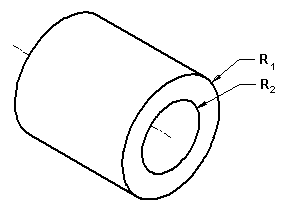
Hollow Cylinder

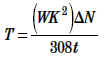
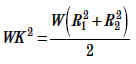
Equation:

and

Open Calculator

Where:

T =Required Torque, lb-ft
WK

2 =

Inertia of load to be accelerated lb-ft

2
(See moment of inertia calculations)

=Change of speed, rpm
t =Time to accelerate the load, seconds

W =

Weight of object, lb

R1 =

Outside Radius of cylinder, ft

R2 =

Inside Radius of cylinder, ft

http://www.engineersedge.com/motors/hollow_cylinder_axis_torque_force_equation.htm

__________________
All living things seek to control their own destiny....this is the purpose of life
Register to Reply
Guru

Join Date: Oct 2008
Posts: 42355
Good Answers: 1693
#2
In reply to #1

Re: Torque Required to Rotate a Hollow Cylinder

06/28/2012 3:26 PM

Yes, but..........................

The diameter of the cylinder is immaterial.

What really matters is the diameter of the drive, and driven sprockets, which OP has not given us.

Also complicating this is the rolling resistance of the drum against the idler rollers that support the weight.

Register to Reply
Participant

Join Date: Jun 2012
Posts: 4
#3
In reply to #2

Re: Torque Required to Rotate a Hollow Cylinder
06/28/2012 3:32 PM

The diameter of the drive and driven sprockets are more relative to the speed of the drum which I have given as 0.04 rpm.

The diameter of the cylinder is very relevant to the moment of inertia, and the capacity of material it will hold.

Register to Reply
Guru

Join Date: Oct 2008
Posts: 42355
Good Answers: 1693
#4
In reply to #3

Re: Torque Required to Rotate a Hollow Cylinder
06/28/2012 3:38 PM

Sorry.

Good luck.

Register to Reply
2
Guru
Engineering Fields - Electrical Engineering - Been there, done that. Engineering Fields - Control Engineering - New Member

Join Date: Dec 2008
Location: Long Island NY
Posts: 15603
Good Answers: 982
#5

Re: Torque Required to Rotate a Hollow Cylinder
06/28/2012 4:29 PM

While the moment of inertia of the cylinder will be a factor that can be calculated, I suspect that this will be a red herring. I suspect that rolling friction and sludge viscosity will become a much larger mechanical load than the moment of inertia of the cylinder, particularly with a rotation rate of 2.4 rotations an hour. The 45° repose attests to the drag this sludge will be imparting.

It's been a long time since I've done this kind of Calculus so I would not offer any Math. I suspect it will be easiest to calculate the amount of energy imparted to the sludge by raising it.

__________________
"Don't disturb my circles." translation of Archimedes last words
Register to Reply Good Answer (Score 2)
Guru

Join Date: Mar 2007
Location: City of Light
Posts: 3943
Good Answers: 183
#6

Re: Torque Required to Rotate a Hollow Cylinder

06/29/2012 3:56 AM

I shall try to explain how I see your problem and its solution.

The cylinder is filled with the sludge and the outside is empty of any thing. When it starts to rotate the internal wall will slide on the sludge which is still at rest and accelerate progressively due to shear strain, same for the bottom. From layer to layer the sludge depending on its viscosity (apparent) will accelerate till it turns all to same speed as cylinder. At same time the weight will load the rollers and a rolling and sliding (if the bearings are journals) resistance will also appear. The 5 seconds depend on the shear resistance the sludge will offer to the turning cylinder. If the dimensions are di= internal diameter/h= height/ρ1= specific mass of barrel material/ρ2= specific mass of sludge (wet)/τ=shear strain at wall between cylinder and sludge/Mr= resistance moment of rollers. Your moment will be M= J*(dω/dt)+(π*di*h*di/2+π/16*di^3)*τ+Mr. The problem is more complex since the shear depends on the relative sliding speed between layers. If you work in metric units the problem of lbs and slugs is easier to solve!

Register to Reply
Guru

Join Date: Jul 2005
Location: Stoke-on-Trent, UK
Posts: 4496
Good Answers: 137
#7

Re: Torque Required to Rotate a Hollow Cylinder

06/29/2012 5:48 AM

Just to comment on slugs - slug is a unit of mass = 32 lb. 1 lbf accelerates 1 slug at 1 ft/sec2. Analogous to bewton and kg in SI system. If you want to use formulas without any g factors, need to use lbf for force and slug for mass. If you want force in lbf and mass in lbm you need to put g = 32 ft/sec2 in at the appropriate place (as in earlier issues of Perry, Chemical Engineers' Handbook)

__________________
Give masochists a fair crack of the whip
Register to Reply
Power-User

Join Date: Sep 2010
Location: Orinda, CA
Posts: 249
Good Answers: 14
#8

Re: Torque Required to Rotate a Hollow Cylinder

06/29/2012 12:50 PM

Metric units would be less confusing to use for your calculations. Here is a link to Online Conversions. Slugs and other quaint English units are out of step with the rest of the world and will probably disappear when the few remaining holdouts retire.

Your objective, as I understand it, is to select a motor that will bring a 7500 lb. (3402 kg) 8 ft diameter cylinder, 80% full of "a watery sludge mixture," from rest to 0.04 rpm in no more than 5 seconds. The cylinder rotates horizontally, supported by rollers. So there will be a free surface in the cylinder, and between the sludge mixture and the cylinder wall will be an air space. The moment of inertia calculation for the cylinder charged with sludge mixture will therefore be complicated because of its non-uniform mass distribution about the axis of rotation.

The "wet sludge" (50-60lb/cu.ft) is only a third of the "watery sludge mixture" and that other 2/3 needs to be taken into account for the moment of inertia calculation.

Do you have to fill the cylinder before you rotate it? Startup torque could be reduced a lot if you could rotate an empty cylinder and then fill it once you have loaded it with angular momentum. The motor would then sustain the rotation, and would not need to start a huge load from rest. You could also rig some falling weight to assist starting from rest, which is when your motor will be most challenged.

__________________
"Education is lighting a fire, not filling a bottle." -- Plutarch
Register to Reply
Participant

Join Date: Jun 2012
Posts: 4
#9
In reply to #8

Re: Torque Required to Rotate a Hollow Cylinder

06/29/2012 1:14 PM

The cylinder itself weighs 7500lbs and is filled approx 80% full of the watery sludge mix so the total weight is around 20,106 lbs. The cylinder can be started before it's filled. The water in the cylinder quickly drains off and only the solids remain, which leaves it about 1/3 full of a wet sludge. When the cylinder is first filled it really doesn't rotate the load, it seems to spin around it since it is mostly water. As the water drains off, the weight decreases but it then starts to turn a solid load that adheres to the side of the tank and has an angle of repose of about 45%.

Betwen the sludge mixture and the cylinder wall are filter tiles that allow water to drain off.

I agree that calculating the moment of inertia of the sludge mixture is the real difficulty here. The rotation is slow so the angle of repose of the sludge is approx. 45%. I haven't found any examples online where this is demonstrated, and if it is I believe I will have a hard time determining the necessary information. For example, the shear resistance of the sludge (as one poster previously mentioned) is critical.

I havent gotten into the rolling resistance of the rollers but I know that can be figured out.

I appreciate everyone's input.

Register to Reply
2
Guru

Join Date: Jun 2010
Posts: 1296
Good Answers: 104
#10

Re: Torque Required to Rotate a Hollow Cylinder

06/29/2012 7:58 PM

I think your main concern is not the start-up torque, but the operating torque. Your sludge density is about the same as the cylinder density, so some of the calculations are simplified. I ran out quick calc's assuming a solid cylinder 8ft diam x 20ft long with a density of 61.7 lb/cu ft, accelerating from 0 to 0.04 rpm in 5 sec and came up with 12.9 ft-lb required. Using a 1 HP 1725 rpm motor as a driver, you would have a ratio of 43,125:1. The motor would deliver about 3 ft-lb, so you would have . . ., well, almost a jillion times more torque than required, even factoring in bearing, roller, and drive losses.

Please check my calcs, and let me know if i slipped a decimal.

As for the operating torque, you could attack it as a circular segment with the chord at a 45, and maximize the mass weight (volume or area) times the distance of the CG from the vertical centerline. I tend to be a belt and suspenders type of guy, so I'd see what it looked like if half the volume on one side of the centerline was full of sludge, and the other side was empty. I suspect you're still in the 1 to 3 HP range.

This problem seems similar to a rotary kiln or cement mixer problem. Let us know what you come up with.

Register to Reply Good Answer (Score 2)
Participant

Join Date: Jun 2012
Posts: 4
#11
In reply to #10

Re: Torque Required to Rotate a Hollow Cylinder

07/03/2012 12:20 PM

BIGG, everything I've researched says that is the right way to approach it. Calculating the inertia of the empty tank is no problem. I'm having difficulty getting started with determining the torque required to continue turning the cylinder with the sludge at a 35-45 deg angle of repose.

BIGG you mentioned attacking it as a circular segment and I've done some research on that approach. What I don't understand is how determining the center of gravity of the load will help find the torque required to turn it. I cant find anything that explains this. The cylinder is about 1/3 full, and with the angle of repose I can determine what my segment would be, I just don't know how to eventually get a torque value from that.

Thanks for the input. I think I'm on the right track to solving this but my lack of physics education is killing me.

Register to Reply
Guru

Join Date: Jun 2010
Posts: 1296
Good Answers: 104
#12
In reply to #11

Re: Torque Required to Rotate a Hollow Cylinder

07/10/2012 8:43 PM

I've delayed long enough. The distance, x, of the CG to the center of a semi-circle is 0.424 * r, where r is the radius. Imagine the sludge to be the white half of the cylinder below (end view). Then the weight of that much sludge would be acting at a distance x from the center of rotation. Isn't that the definition of a torque?

If you want to try 1/3 full at 45deg angle, x for a circular segment is (2r3sin3a)/(3A) where A=r2(2a-sin2a)/2 and a is half the included angle. Then you'll have to use a little vector geometry to get the horizontal component of r for the moment length.

Being the rude SOB I am, I have to ask: how did someone with a 'lack of physics education' become responsible for solving this problem?

Register to Reply
Power-User

Join Date: Jun 2010
Location: Kolkata, West Bengal, India
Posts: 172
Good Answers: 1
#13

Re: Torque Required to Rotate a Hollow Cylinder

07/11/2012 8:57 AM

Dear ary520,

If all mathematical calculations and other methods already stated are not suffice, you may try with a very crude method to determine the starting torque as follow:

Pl. fixup a suitable torque wrench on the shaft and try to rotate the shaft; note down the reading in the torque wrench when the shaft is starting to move.

Thanks,

Manindra

__________________
Manindra
Register to Reply
Register to Reply 13 comments

Good Answers:

These comments received enough positive votes to make them "good answers".
Copy to Clipboard

Users who posted comments:

ary520 (3); bigg (2); Codemaster (1); lyn (2); manindra (1); nick name (1); redfred (1); SolarEagle (1); wilmot (1)

Previous in Forum: Forklift Body Material   Next in Forum: vertex mounting in cyclon cfbc boiler125mw

Advertisement