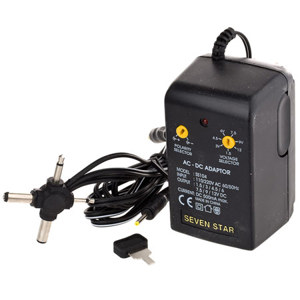
The best solution is to make a DC voltage regulator. I would suggest buying something at Digikey like the LX8585-15CDD (Digikey part # LX8585-15CDD-ND) for $5.31.
You did not specify the amount of current you needed, but this part will deliver up to about 4.5 amps at 1.5 Volts.
The picture is for the 3.3 volt part, but it is the same circuit for the 1.5 volt part. You will need capacitors at the input and output to smooth any ripple and noise.
I assume currents would be very low for this sort of adaptor/application. Would it not be easiest just to make a simple voltage divider, two resistors, series and parallel, 2:1 impedance ratio giving 1.5v from 3.0v input?
Possibly, but if the current load changes at all during operation, then a voltage divider will not yield a constant voltage. A zener would be one way, but a linear voltage regulator will use less quiescent current and provide good ripple control.
A battery should provide a very predictable voltage curve for any given load over time, even a variable load.
That means, a 3.3 VDC battery will tend to remain close to 3.3 VDC output regardless of load for the first half to two thirds of its discharge life, then the curve trends downward at the knee.
A resister network will sag and swell depending on load dynamics, whereas a battery does not behave that way. Adding more current draw simply accelerates the rate that you get to the knee in the battery discharge curve while maintaing most of its voltage output.
Since both your input and output voltages, are too small for mainstream linear regulators or even zener shunt, you could use a combination of silicon diodes in series, so that in your working temperature range, will drop your voltage by about 1.5V. Two appropriately current rated, 0.7V forward voltage drop diodes in series will generally do. BUT in case the load is NOT always connected, and there is a capacitor somewhere before the disconnection point, you MUST permanently connect a (high value) resistor as minimum load, before the disconnection point, because when output is unloaded, the small diode leakage current WILL eventually charge the capacitor near the input voltage, and when you reconnect, POP! S.M.
__________________
Life is complex. It has a real part and an imaginary part.
"Almost" Good Answers: