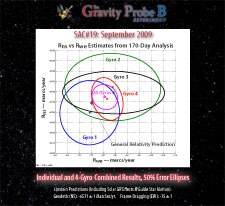
After more than 2 years of sweat with two unexpected errors (misalignment torques and a varying polhode motion), the Stanford team now announced a result in reasonable agreement with Einstein's Theory of General Relativity. The 'geodetic precession' (space curvature near Earth) is relatively large and was clearly visible two years ago. The 'frame-dragging' (by Earth's rotation) is much smaller and was originally masked by the two errors mentioned.
They now wrote: "The accuracy of the GP-B experimental results has improved
seventeen-fold since our preliminary results announcement at the
American Physical Society annual meeting in April 2007. At that time,
only the larger, geodetic effect was clearly visible in the data. Over
the past two and one half years, we have made extraordinary progress in
understanding, modeling and removing three Newtonian sources of
error—all due to patch potentials on the gyroscope rotor and housing
surfaces. The latest results, based upon treatment of 1) damped polhode
motion, 2) misalignment torques and 3) roll-polhode resonance torques,
now clearly show both frame-dragging and geodetic precession in all
four gyroscopes (see figure at top right).
"The figure at lower right displays the science estimates as of
September 2009, with the gyroscopes analyzed individually and combined.
The estimates are indicated with colored "X"s, and the statistical
uncertainty associated with each estimate is plotted with a
corresponding colored ellipse.
"The combined four-gyro result in the figure gives a statistical
uncertainty of 14% (~5 marcsec/yr) for the frame-dragging (EW). The
gyroscope-to-gyroscope variation gives a measure of the current
systematic uncertainty. The standard deviation of this variation for
all four gyroscopes is 10% (~4 marcsec/yr) of the frame-dragging
effect, suggesting that the systematic uncertainty is similar in size
(or smaller) than the statistical uncertainty."
-J
| 



 Re: GP-B: Frame-Dragging Clearly Visible


