|
As one of the newer GEA Associates I'm going to share some of the knowledge and experience I gained in my 38 years with Trane. We won't be limited to just North America since Trane has factories around the world making a broad range of products, using many different types of joining processes and having to meet differing code requirements.
Is Brazing Welding? If you answered - No - you are correct. Brazing is not welding as defined by AWS(American Welding Society) standard A3.0 which defines technical terms for the welding industry. The same answer applies to soldering, which is like a 1st cousin to brazing. See definitions below.
Pressure joints on HVAC equipment are commonly joined by the welding, brazing and soldering processes. When ASME applies only welding and brazing processes can be considered. When ASME does not apply, soldering can be considered. The selection of any process for an application is dependent on meeting the service conditions. For example, brazing or soldering should never be considered for joining steam lines because the filler metals could not meet the service temperature requirements.
Do you know why foreign countries, U.S. states and local jurisdictions define codes and standards to follow for welding and brazing? The reason is because they are special processes. In other words the quality of the joint is difficult or impossible to measure. When you look at a completed joint all you see is the outside. You are looking at the tip of an iceberg. The great majority of the quality or lack of quality is subsurface. Nondestructive testing equipment is available like x-ray and ultrasonics, but the great majority of companies cannot justify them. This is one of the reasons why additional safety factors are built into the design calculations for joints. The detailed requirements in codes like ASME involve documented procedures for process and worker performance qualifications.
When codes and standards do not apply it is known through out the industry that the manufacturer is responsible to use SEP(Standard Engineering Practice) for applying welding, brazing and soldering.
Definitions
Welding requires fusion or melting of the base metals being joined. It can be with or without the use of filler metals and with or without the use of pressure. The most common welding processes that use an electric arc in generating the heat are the generic names stick, mig, flux-core, tig and subarc.
Brazing uses filler metals that melt above 840°F (450°C) but below the melting point of the base metals to be joined. The base metals are heated around the joint until the filler metal melts and flows by capillary attraction into the parallel joint clearance between the base metals. A permanent bond is the result. Silver brazing is a commonly used term if brazing filler metals contain any percentage of silver. Brazing fluxes are used to prevent oxidation of the base metals, except for copper to copper joints that may be brazed with copper/phosphorous filler metals.
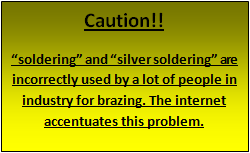  Soldering uses filler metals that melt below 840°F (450°C) but below the melting point of the base metals to be joined. The base metals are heated around the joint until the filler metal melts and flows by capillary attraction into the parallel joint clearance between the base metals. A permanent bond is the result. Silver soldering is a correct term if the soldering filler metals contain any percentage of silver. Soldering fluxes are used to prevent oxidation of the base metals. Soldering is not permitted by the ASME codes. Soldering uses filler metals that melt below 840°F (450°C) but below the melting point of the base metals to be joined. The base metals are heated around the joint until the filler metal melts and flows by capillary attraction into the parallel joint clearance between the base metals. A permanent bond is the result. Silver soldering is a correct term if the soldering filler metals contain any percentage of silver. Soldering fluxes are used to prevent oxidation of the base metals. Soldering is not permitted by the ASME codes.
Next month I'll get into specifics of welding, brazing and soldering for HVAC equipment and we'll discuss the key variables for all three.
Editor's Note: CR4 would like to thank Bill Spietz of GEA Consulting for contributing this blog entry.
| 




 Re: Is Brazing Welding????


"Almost" Good Answers: