|
I always thought ice was pretty cool. We cool things down
with it, skate and play hockey on it, make sculptures from it, and sometimes
even fight evil mutants with it…


(Credit: X-men Wiki |
The Adventurers Club)
But when dealing with a lot of technologies, ice is not so
much fun. Icing (no, not the hockey penalty HUSH) is a big problem for roads,
carbureted engines, wind
turbines, air conditioners, refrigerators, planes, and electrical
and telecommunications equipment. The buildup of ice can cause poor equipment
performance or failure and can be a severe safety hazard in certain situations.
Icing Problems
A number of ice-related accidents and hazards are related to
extreme weather. Those of us in the northeastern U.S. know particularly well
the dangers and damage that ice storms can cause to roads and power lines. In
these cases, the best we can hope to do is avoid the bad weather where we can,
and have safety measures and procedures in place to deal with it when it comes.
But even in warm climates, certain technologies face icing
problems during normal operation. For example, as airplanes pass through clouds
on takeoff and landing, they can strike ice particles and cloud-borne water
droplets that can be transformed into ice. Refrigerators and air conditioners
can also lose their cooling capacity due to accumulated ice. In these cases, anti-icing
technology would be a convenient solution.
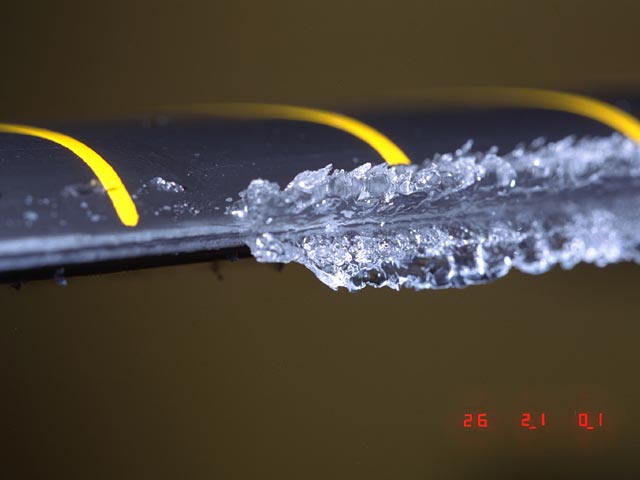
(Credit: Ice
accumulation on a rotor blade)
At GE Global Research in Niskayuna, NY, a team of scientists
led by Azar Alizadeh is working on just that: anti-icing surfaces.
Understanding the
Freeze
Research into ice-phobic materials has been going on for the
past 50 years, but scientists say the limited level of success shows a lack of
understanding of the fundamentals of water-surface interactions. This includes
an understanding of the process through which water cools when in contact with
a surface, the onset of ice nucleation, and the detailed nature of water layers
adjacent to a cold surface.
By conducting freezing and heating experiments on a number
of different types of surfaces, and using instruments such as a high speed
camera and infrared thermometers, the team at GE pinpointed that surface structure
(roughness) and surface chemistry (hydrophobicity) can dictate heat transfer as well as the rate of ice nucleation.
These parameters have been the focus of new superhydrophobic anti-icing
materials being developed by GE and other organizations.

One example includes SLIPS (slippery liquid-infused porous
surfaces) aluminum developed by Harvard University. In a recently-published
study, the material demonstrated resistance to icing in high humidity and
cold temperature environments.
(<-- Still images simulating ice formation by deep freezing and
subsequent deicing. Credit: Harvard
University)
What's So E&E
About It?
You may be wondering what makes anti-icing technology an
environmental/energy topic. The reality is that anti-ice materials have the
potential to save a lot of energy and reduce current dependence on certain
chemical agents. In regards to aircraft, some 25 million gallons of deicing
agents are currently used on planes taking off from U.S. commercial airports
each year, and there is also a lot of energy wasted on electrical heating
systems used for ice prevention in-flight. Using materials like the SLIPS aluminum
for aircraft could eliminate the need for these chemical and heat treatments.
Anti-icing materials could also potentially prevent failure and help maintain
an effective cooling capacity for air conditioners and refrigerators in humid
environments.
References
GE Scientists Demonstrate Promising Anti-Icing Nano Surfaces
| 


 Re: Anti-Icing Surfaces


