|
 Let's take a guess at the nature of your morning commute,
shall we? After stopping for coffee and maybe a
doughnut, you speed through a yellow light to make it to the onramp. You
promptly hit wall-to-wall traffic, put your car in park, glare menacingly at
adjacent drivers, and otherwise tap your thumbs to classic rock. See? I'm all knowing. Let's take a guess at the nature of your morning commute,
shall we? After stopping for coffee and maybe a
doughnut, you speed through a yellow light to make it to the onramp. You
promptly hit wall-to-wall traffic, put your car in park, glare menacingly at
adjacent drivers, and otherwise tap your thumbs to classic rock. See? I'm all knowing.
Though a disappointing commute is the reality of millions,
in 1958 Disney had a rather different vision of what the freeway of the future
would look like. I encourage YouTube-enabled readers to view their
animated visualization.
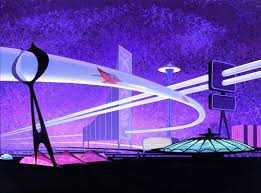 Some of these predictions are obvious nods to 1950s culture.
Machine input via punch cards? Atom powered cars? Radiation harnessed to
prevent slick roads? Airborne emergency units that rescue drivers and clear
accidents at once? Yeah right. Some of these predictions are obvious nods to 1950s culture.
Machine input via punch cards? Atom powered cars? Radiation harnessed to
prevent slick roads? Airborne emergency units that rescue drivers and clear
accidents at once? Yeah right.
But many predictions came true. Radar to detect forward
objects, variable speed limits, reverse cameras, underwater thoroughfares, road
trains, synchronized mapping (GPS), and automated driving have all become
transportation benchmarks.
While Disney isn't the best authority on future
transportation endeavors, let's see what actual engineers are implementing or
cooking up for us impatient drivers.
The
Road of Tomorrow!
 In 2013, roads in Holland will be getting a stark nighttime
makeover. Foremost, painted road markings will be replaced by glow in the dark
versions. Roadways will also receive special temperature-activated decals that
will only appear under certain conditions. The most prominent example would be
snowflakes that appear when road conditions are suitable for ice patches. When
an accident is ahead, red warning signs would be used to alert drivers. In 2013, roads in Holland will be getting a stark nighttime
makeover. Foremost, painted road markings will be replaced by glow in the dark
versions. Roadways will also receive special temperature-activated decals that
will only appear under certain conditions. The most prominent example would be
snowflakes that appear when road conditions are suitable for ice patches. When
an accident is ahead, red warning signs would be used to alert drivers.
Provided these improvements improve the safety and comfort
of drivers, other projects will see their execution shortly after. Lights that usher vehicles and then turn off
after the auto has passed will save the country on energy expenditure, and the
hope is that these lights will become wind powered. Perhaps the most ambitious
of Studio Roosegaarde's 'smart highway' projects would be an electromagnetic
induction lane that would recharge electric vehicles as it travelled. The
company believes that these benefits should not be made available to just those
who can afford luxury vehicles, but to all drivers.
 While these ideas are terrific for self-driven vehicles,
Google is intent on providing consumers with fully autonomous vehicles. In 2011, Nevada became the first
jurisdiction to legalize electronic deductive reasoning for vehicle control.
While still experimental, the cars rely on smart cameras, radar sensors,
lasers, and a human-compiled database for navigation. Luxury car brands like
Mercedes and Audi have developed control mechanisms that allow the driver to
turn auto-pilot on in low-speed, traffic-dense scenarios. As the system
progresses, cars would likely need some form of communication device and RFID
tags are the most likely solution. Drivers today are able to utilize their smart
phones to scan license plates and send messages between vehicles, so really this is just implementing old technology. While these ideas are terrific for self-driven vehicles,
Google is intent on providing consumers with fully autonomous vehicles. In 2011, Nevada became the first
jurisdiction to legalize electronic deductive reasoning for vehicle control.
While still experimental, the cars rely on smart cameras, radar sensors,
lasers, and a human-compiled database for navigation. Luxury car brands like
Mercedes and Audi have developed control mechanisms that allow the driver to
turn auto-pilot on in low-speed, traffic-dense scenarios. As the system
progresses, cars would likely need some form of communication device and RFID
tags are the most likely solution. Drivers today are able to utilize their smart
phones to scan license plates and send messages between vehicles, so really this is just implementing old technology.
For highways to advance to a more modern state, it needs to
be done with stress on the speed, safety, and comfort of commuters. And while
many of the technologies listed above require massive amounts of funding and
infrastructure adjustment, a much easier and cheaper method of providing safe
highway ramps has been introduced in some parts of the American Midwest.
Missouri has been one of the first states to adopt the
'diverging diamond' at freeway intersections. The result is improved traffic
flow and fewer accidents, and the process is as follows.

- Drivers approach an intersection as normal. To enter the freeway and travel northbound, they would yield right and continue on their merry way. To travel west or south, they would maintain their lane position.
- Upon the traffic signal, westbound drivers would cross the median and travel in a left hand traffic fashion. Vehicles traveling north that wish to go east or west will not have to stop at a traffic light, but would proceed after yielding.
- Drivers wishing to travel southward would enter the leftmost lane of traffic, and proceed with the right of way to the south-oriented freeway.
- The occupied lane shifts right at the next divergent traffic light. Traffic travelling south that wishes to alter their direction in a latitudinal manner would only have to yield.
This traffic pattern eliminates
all turns that must cross opposing traffic lanes, and also eliminates at least
two traffic lights in many cases. This style is starting to become quite
prevalent in the U.S. and Canada, and can be implemented in any bidirectional
thoroughfare.
 According to Infrastructure Report Card (an organization
funded by the American Society of Civil Engineers--mind you), poor road
conditions cost the average American motorist $333 per year. Another 33% of
major American roads are in less than optimal condition, and 36% of urban highways
are congested. It recommends that nearly one trillion dollars be allocated
towards highways reform. If it's the future, "shut up and take my money." According to Infrastructure Report Card (an organization
funded by the American Society of Civil Engineers--mind you), poor road
conditions cost the average American motorist $333 per year. Another 33% of
major American roads are in less than optimal condition, and 36% of urban highways
are congested. It recommends that nearly one trillion dollars be allocated
towards highways reform. If it's the future, "shut up and take my money."
However, outdated infrastructure needs to be replaced and
the inability of our governments to facilitate these modernizations leads to
tragedies such as 2007's I-35
bridge collapse in Minneapolis. And if we don't want to see any more car pile-ups
like
 in The Blues Brothers, safety needs to be the first focus. If we can get
that teenage girl from tailgating me by use of an autonomous vehicle, that'd be
great too. in The Blues Brothers, safety needs to be the first focus. If we can get
that teenage girl from tailgating me by use of an autonomous vehicle, that'd be
great too.
Overall, the best thing driving technique we can practice is
patience. Patience to our destination; patience with civil engineers as they fix
our roadways; and patience as future technology provides us better
transportation.
Resources
Image credits: Lecaun Unplugged; Laughing Squid; Gnarld; Repair Pal; Meme Generator
Popular Mechanics - Highway of the Future: Interstate Intelligence
Smart Planet - Nevada first to approve guidelines...
NPR - 'Diverging Diamond' Traffic Flow: Way Of The Future?
Wired - Netherlands highways will glow in the dark from mid-2013
Studio Roosegaarde
Wikipedia - Autonomous cars
Pop Sci - Scan Someone's License Plate and Message Them Instantly...
ASCE - Fact Sheet - Roads
| 


 Re: Freeways of the Future


