|
We've all heard it at some point: the spooky, ethereal glissandos at just the right moment during a 1960's sci fi flick. Many of us know that the theremin, a proto-electronic instrument, is responsible for these sounds, but have we ever thought of the world of possibilities it opened?
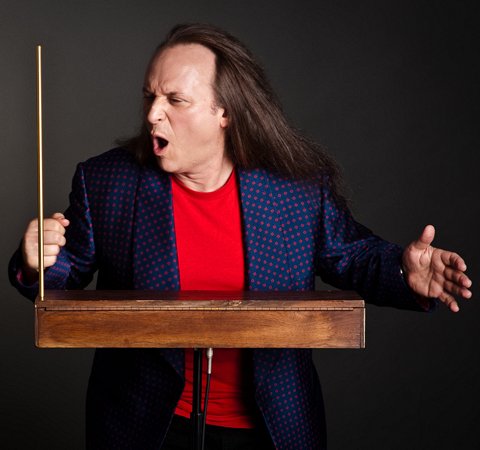
Rob Schwimmer, the prototypical theremin virtuoso. Via RiffRaf
The theremin was patented in 1928 by Lev Terman, known to us Westerners as Leon Theremin, and was based in part on his government-sponsored research into proximity sensors. The instrument's operation is relatively simple: each of the performer's hands acts as the "variable" aspect of a separate variable capacitor in relation to two antennae, with one hand controlling a pitch circuit and one operating a volume circuit. Each circuit includes two RF oscillators, one of which is fixed and the other of which is varied by hand movements relative to the pitch or volume antenna. Detuning these oscillators results in changes in audio frequency (pitch) or amplifier attenuation (volume).
The obvious drawback to this design is that it's really hard to stick your hand into a more or less imaginary space with no position indicators and expect to hear the pitch you're looking to hear. Because musicians have enjoyed the theremin's unique, eerie tone, the instrument has spawned many equally unique contraptions that operate on similar principles but with improved interfaces.
The ondes Martenot was invented in 1928 by Maurice Martenot (the name is French for "Martenot's waves"). This device operates on theremin's heterodyne oscillator principle, but the Martenot allows for two tactile playing methods for the right hand: by playing a piano keyboard, or by sliding a finger-mounted metal ring across a ribbon in front of the corresponding keys. The left hand controls volume and timbre: late versions of the instrument had presets for sine, triangle, square, and pulse waves, as well as pink noise of indefinite pitch. The Martenot also included three different loudspeakers, including the Palme, a large speaker with vibrating strings that would make any antique radio enthusiast drool or perhaps cringe.
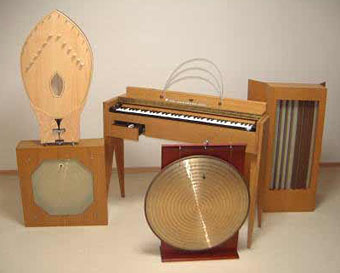
A Martenot and its battery of speakers. Via John Coulthart
While the Martenot ceased production in 1988, some French conservatories still teach the instrument.
The Electro-Theremin was a simple prototype instrument built by a trombonist named Paul Tanner in the late 1950s. It used a sine wave generator with a pitch knob in a wooden box, while a slider (marked as a flat piano keyboard) was attached to the pitch knob by a string. This seemingly crude instrument is best known for its recorded uses: Tanner himself played the Electro-Theremin on three Beach Boys songs, including "Good Vibrations", and on several TV and movie soundtracks, most notably the series My Favorite Martian. Tanner donated his prototype to audiology researchers in the late 1960's.
Straight from the Weird and/or Viral file, the Otamatone is a modern Japanese instrument resembling a music note with a face. "Performers" squeeze the mouth to produce a sound, and slide a finger up and down the "neck" to change the pitch. While literature on its operating principle is difficult to find, its crude tone indicates that it's probably a voltage-controlled oscillator, with each pitch represented by a different-value resistor.
The Haken Continuum (2002) is a neat three-axis musical controller played with two hands, with the X-axis controlling pitch, the Y-axis controlling tone, and the vertical Z-axis controlling volume or amplitude. While its operation is decidedly more high-tech (it uses FireWire and MIDI connections to drive synthesizers), the Continuum could be seen as an extension of the theremin's principles.
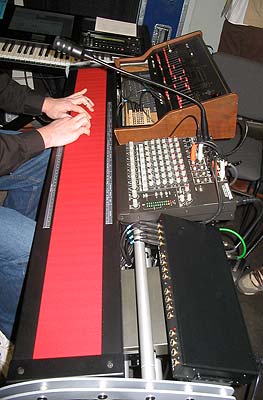
Jammin' on the Continuum. Via NAMM Oddities
Now that you've been educated, spend the $32, get yourself an Otamatone, and celebrate the theremin's lasting influence by endlessly annoying your friends and family.
| 


 Re: Theremins...and Beyond!


