|
 According to the ozone sensors on Europe's MetOp weather satellite,
the hole over Antarctica in 2012 was the smallest in the last 10 years.
Since the beginning of the 1980s, an ozone hole has developed over
Antarctica during the southern spring - September to November -
resulting in a decrease in ozone concentration of up to 70%. Man-made
chlorofluorocarbons - CFCs - have a negative effect on the ozone,
depleting it and creating the infamous hole.
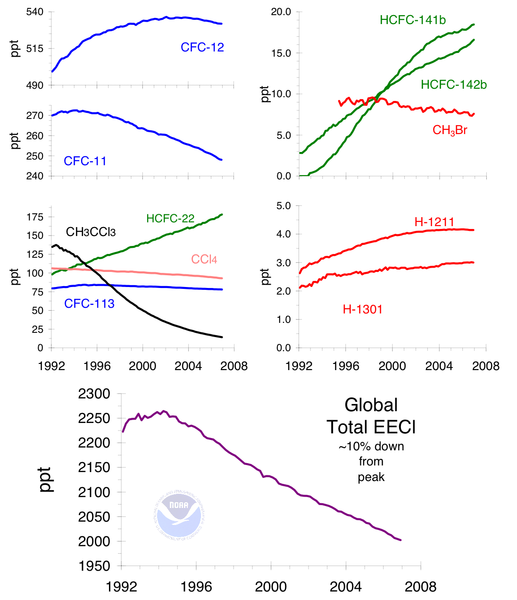
The Montreal Protocol has stopped the increase of CFC concentrations,
and a drastic fall has been observed since the mid-1990s. You can see
the Total Ozone values in the Northern Hemishpere and Southern
Hemisphere along with the climate model prediction (in blue) showing
recovery continuing over several decades. According to the ozone sensors on Europe's MetOp weather satellite,
the hole over Antarctica in 2012 was the smallest in the last 10 years.
Since the beginning of the 1980s, an ozone hole has developed over
Antarctica during the southern spring - September to November -
resulting in a decrease in ozone concentration of up to 70%. Man-made
chlorofluorocarbons - CFCs - have a negative effect on the ozone,
depleting it and creating the infamous hole.
The Montreal Protocol has stopped the increase of CFC concentrations,
and a drastic fall has been observed since the mid-1990s. You can see
the Total Ozone values in the Northern Hemishpere and Southern
Hemisphere along with the climate model prediction (in blue) showing
recovery continuing over several decades.
 The good news is that the Antarctic ozone hole is on the way to
recovery. The bad news is that scientists now think it is helping to
slow the polar seas' ability to absorb carbon dioxide, a leading
contributor to Global Warming. Antarctic accounts for about 40% of the
total carbon absorbed by the world's seas. Scientists at Johns Hopkins
University found the same winds that caused extremely low temperatures
leading to higher levels of ozone depletion are speeding circulation
patterns in polar waters, with the currents closer to the land pushing
more deep water up to the ocean surface. Scientists worry that the
increasing upwelling of that water, hundreds of years old and naturally
rich in carbon dioxide, is reducing the amount of manmade carbon
absorbed by sub-polar waters. The good news is that the Antarctic ozone hole is on the way to
recovery. The bad news is that scientists now think it is helping to
slow the polar seas' ability to absorb carbon dioxide, a leading
contributor to Global Warming. Antarctic accounts for about 40% of the
total carbon absorbed by the world's seas. Scientists at Johns Hopkins
University found the same winds that caused extremely low temperatures
leading to higher levels of ozone depletion are speeding circulation
patterns in polar waters, with the currents closer to the land pushing
more deep water up to the ocean surface. Scientists worry that the
increasing upwelling of that water, hundreds of years old and naturally
rich in carbon dioxide, is reducing the amount of manmade carbon
absorbed by sub-polar waters.
Thanks to the Montreal Protocol we are well on our way to eliminating
the use of CFCs. The damage however will go on for decades and more.
Further information on these most recent studies can be found in the Feb 15, 2013 issue of OzoNews.
Editors Note: CR4 would like to thank Larry Butz of GEA Consulting, for contributing this blog entry, which
originally appeared here.
| 

 4
4

 Re: Ozone Layer Healing, But...




Good Answers: