|
The neural links between music, math, and technology have
long been studied and established, and a number of great inventors or engineers
have had side interests in the arts. This post will delve into the life of
Laurens Hammond, inventor of one of the most widely-heard electromechanical
instruments of the 20th century.
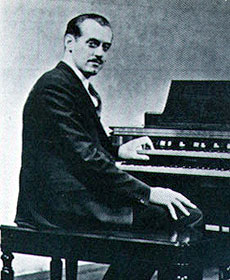
Laurens Hammond (usually referred to as "Larry") was a
tinkerer from a young age, and this interest led him to pursue a mechanical
engineering degree at Cornell University. After graduating in 1916, he worked
for several Detroit-area automobile manufacturers, although he continued to
invent on the side. In 1919 he invented a silent spring-driven clock, and in
1922 developed a 3-D motion picture projection system called the Teleview. Only one feature
film was made for this system, and although it was a great critical success the
economics of refitting theaters with new projection systems ended the
Teleview's run.
While working on the Teleview, Hammond perfected his skill
at designing and building increasingly small synchronous motors. In the late
1920s he used this skill to design an electric clock in which the motor was
synchronized with the current frequency of the power grid, resulting in great
precision so long as the current's frequency remained constant. Hammond
patented his clock and formed the Hammond Clock Company, which eventually
produced dozens of models and employed 700 people. Due to the Great Depression
and problems with patent royalties, the company ran into financial problems in
the mid-1930s. Hammond scrambled to invent a lucrative solution: he developed
an electric
bridge table that sold well enough to pay off outstanding debts, but this
proved to be a short-lived solution.

Hammond had long toyed with the idea that his synchronous
motors could be put to musical use. While developing the synchronous clock, he had
stumbled upon the fact that if a gear is rotated within a magnetic field, it
will theoretically produce a musical tone if connected to a speaker. (This was
a sort of precursor to the concept of a guitar pickup.)
If Hammond synchronized these "tone wheels" with the frequency of the power
current, the instrument would perpetually stay in tune. Hammond gutted a used
piano, worked with Hammond Clock's treasurer - who was a church organist - to
develop suitable tones, and in 1933 completed his first "Hammond organ." The
instrument contained 91
tone wheels, each of which was connected to nine switches. These switches
activated different harmonics of each tone wheel fundamental, effectively
producing nine different tones for each wheel. Using additive synthesis of
different waveforms produced by the tone wheels, the instrument was capable of
hundreds of different tones and musical colors. Hammond added drawbars, based
on a church organ's register system, so that the performer could precisely
select and alter the organ's range and sound on the fly.
Hammond patented the instrument in 1935, and it was an
immediate success. Churches jumped on the Hammond organ because it was cheaper,
lighter, and easier to maintain than traditional pipe organs, and could
replicate many of the latter's complex layered sounds. The instrument
eventually made its way into jazz and rock, is
featured on various landmark recordings of the 60s and 70s and was revived in
the 90s and 21st century.
Although Hammond developed his own corresponding speaker system, most Hammond
players took to the Leslie
speaker, which was built with a rotating horn to enable a swirling Doppler
effect sound.
Hammond organs were eventually redesigned with transistor
circuitry, but most players still gravitate to the antique tone wheel models.
Interestingly, many design flaws that Laurens Hammond tried and failed to
correct - such as a percussive key click and unintended
crosstalk interference between rotating and stationary tone wheels - are now
highly valued by studio musicians and collectors as integral parts of the
instrument's sound.
Laurens Hammond was an eccentric fellow who never expected
or enjoyed the fame his invention brought him. He was intimately involved in
the Hammond Organ Company into his later life and also forayed into economics,
publishing an 80-page pamphlet about mathematically eliminating unemployment;
this publication understandably did not catch on. Hammond died in 1975 with
over 100 patents to his name. I find it interesting that, whenever I appreciate
the sound of a Hammond organ, I can thank Larry's bankrupt clock company and
ingenious mind for its invention.
(Images via NNDB & AcesandEights)
| 


 Re: Musical Engineers: Laurens Hammond


