|
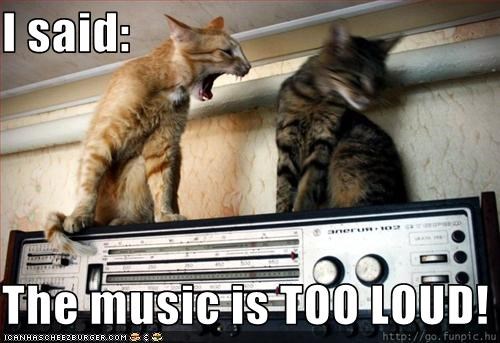 Most would agree that the technological development of music
players during the past twenty years has been astounding. From the bulky
portable cassette players of my childhood through portable CD players, MiniDisc
players, and increasingly-smaller digital media players, portable music has
become ubiquitous in most international communities. It's perhaps not
surprising that noise-induced hearing loss (NIHL) is also on the rise and is
becoming an increasingly prevalent concern for both the medical and musical
communities. Most would agree that the technological development of music
players during the past twenty years has been astounding. From the bulky
portable cassette players of my childhood through portable CD players, MiniDisc
players, and increasingly-smaller digital media players, portable music has
become ubiquitous in most international communities. It's perhaps not
surprising that noise-induced hearing loss (NIHL) is also on the rise and is
becoming an increasingly prevalent concern for both the medical and musical
communities.
The National Institute on Deafness defines NIHL
as damage to the inner ear from overexposure to harmful environmental noise. This
overexposure can take two forms. Acoustic trauma is defined as a one-time overexposure
that causes permanent damage due to high-intensity sounds like gunfire, a
single loud drum hit, or firecrackers. Gradually developing NIHL, on the other
hand, is caused by repeated exposure to dangerously loud sounds. This type
tends to develop as a result of combined sound intensity and time of exposure
to loud sounds. (I supposed the guy in this
well-documented case would place himself between these two extremes.) OSHA
states that exposure to 85 dB of noise for eight hours a day has the potential to cause permanent hearing
loss.
Most organizations recommend specific techniques to curb
NIHL, namely to first avoid exposure to excessively loud sounds as often as
possible (and let's face it, this is more difficult than it sounds). Many
industrial workers - including those working in manufacturing, agriculture,
transportation, and around aircraft - have little choice but to be exposed.
While ear protection standards is well-established in these industries, most
individuals planning to attend loud concerts or nightclubs skip ear protection
due to embarrassment, lack of comfort, and reduced sound quality.
The NIHL discussion becomes a little more interesting - and
controversial - when applying it to musicians. It may come as no surprise that
many (if not most) rock musicians suffer from resultant hearing loss, but
orchestral musicians and conductors are now considered susceptible as well. Hearing
researchers have avoided making broad generalizations because of the lack of
conclusive research, but many believe that musicians' exposure to sound levels
on par with harmful industrial noise renders much of the research on
occupational noise applicable to the art music world. The fact that orchestral
musicians depend on hearing themselves clearly to make a living, and therefore
are unable to use earplugs or other protective devices, adds an interesting wrinkle
to the debate.
 Despite the lack of conclusive research, NIHL among
professional musicians and conductors has steadily increased in recent years.
This awareness affected me on a personal level: during my time playing in
college bands and orchestras, a longtime conductor was diagnosed with NIHL
after years of rehearsing large, noisy ensembles in rooms that were too small
and acoustically poor. Our school responded by installing temporary anechoic
panels in the same rehearsal spaces as a short-term solution, before eventually
renovating all rehearsal spaces to be acoustically safe under high decibel
levels. Several organizations have been founded to raise awareness of NIHL and
its effect on musicians as well as youth, including Don't Lose the Music
and Hearing Education and
Awareness for Rockers (HEAR). Despite the lack of conclusive research, NIHL among
professional musicians and conductors has steadily increased in recent years.
This awareness affected me on a personal level: during my time playing in
college bands and orchestras, a longtime conductor was diagnosed with NIHL
after years of rehearsing large, noisy ensembles in rooms that were too small
and acoustically poor. Our school responded by installing temporary anechoic
panels in the same rehearsal spaces as a short-term solution, before eventually
renovating all rehearsal spaces to be acoustically safe under high decibel
levels. Several organizations have been founded to raise awareness of NIHL and
its effect on musicians as well as youth, including Don't Lose the Music
and Hearing Education and
Awareness for Rockers (HEAR).
Noise-induced hearing loss is perfectly avoidable, but even
for those already afflicted the prognosis is good thanks to improving hearing
aid technology. Thanks to awareness and forward thinking, advocacy groups are
causing us to think twice about constantly slipping on headphones or burning
out our car speakers with excessive noise.
(Images via cheezburger | eBay)
| 

 2
2


 Re: How Loud is Too Loud?


Good Answers:
"Almost" Good Answers: