|
Could you imagine a life lived permanently at sea? It may be
tough to do, but there is little reason to doubt that such an existence could be
that of your children's. The  concept is known as 'seasteading' and it has
attracted some increased study in recent years. The less dynamic half of the
PayPal brain trust, Peter Thiel, donated $500,000 to The Seastead Institute, a
think tank formed to create an autonomous, permanent, mobile community in
international waters. They've produced the video at right, which envisions "a 1,000 floating Hong Kongs." concept is known as 'seasteading' and it has
attracted some increased study in recent years. The less dynamic half of the
PayPal brain trust, Peter Thiel, donated $500,000 to The Seastead Institute, a
think tank formed to create an autonomous, permanent, mobile community in
international waters. They've produced the video at right, which envisions "a 1,000 floating Hong Kongs."
There are obvious obstacles to overcome-waste
disposal, energy collection, security, etc.-but there isn't an issue some
determined engineering can't overcome. These design constraints--and the lack
of funding to confront them--have meant that the number of sea settlements on
the high seas is currently at an all-time high: zero. But some innovative new
ideas may yield the first seastead in 2014.
It's easy to consider an offshore oil platform as a seaborne
living station, but it doesn't quite harness the freedom of living on the ocean
permanently that seasteaders are seeking. Oil platform crews are regularly
replaced and are there to collect fossil fuels, frequently with national
interests. The distinct attraction of seasteading would be quasi-lawlessness
once outside a nation's 12 miles of territorial waters. It's what allowed
pirate radio boats to broadcast to audiences in the U.K. in  the 1960s. The
closest thing to a seastead at present would be the Principality of Sealand, a
5,900 sq. ft. sea fort (pictured left) built by the British in World War II to protect the
Suffolk coast from mine-laying aircraft. It was built seven miles offshore and
after the war fell into disuse. It was eventually overtaken by a pirate radio
broadcaster and turned into a "sovereign nation." It's hard to consider Sealand
a seastead however. No nation formally recognizes it, it does not have a
permanent resident, and it has been reduced to selling the titles of baron,
lord, and knight in order to finance its upkeep. Essentially, Sealand
is a joke. the 1960s. The
closest thing to a seastead at present would be the Principality of Sealand, a
5,900 sq. ft. sea fort (pictured left) built by the British in World War II to protect the
Suffolk coast from mine-laying aircraft. It was built seven miles offshore and
after the war fell into disuse. It was eventually overtaken by a pirate radio
broadcaster and turned into a "sovereign nation." It's hard to consider Sealand
a seastead however. No nation formally recognizes it, it does not have a
permanent resident, and it has been reduced to selling the titles of baron,
lord, and knight in order to finance its upkeep. Essentially, Sealand
is a joke.
But the enterprise spirit behind Sealand is at least
coherent with seasteading. Sealand
attempted to capitalize on its marine base by hosting an online casino and
creating a data haven, a place with no internet data restrictions. Both enterprises
failed due to mismanagement, but there is at least a lesson to be learned for
the creators of Blueseed, which is expected to be the first true ocean
settlement.
 Blueseed will be built upon a repurposed cruise ship
anchored 12 miles offshore from Silicon Valley. Representatives of Blueseed
call it, "a vibrant workplace for innovative industries to bloom, unencumbered
by onerous regulations on new technology-sector businesses." The ship
would allow foreign entrepreneurs a chance to work on their companies in office
spaces aboard the ship, along with living quarters. These individuals would not
need to obtain a hard-to-acquire U.S. work visa, and for trips to Silicon
Valley would only need a tourist or business visa, which are easier to acquire.
Once their business is successful enough to move to the mainland, it can begin
hiring employees. Nearly 400 startup projects have expressed interest in
Blueseed and each would pay between $1,200 and $3,000 in monthly rent. However,
that is only a drop in the bucket considering Blueseed's initial $27 million
budget, which has been the most considerable problem with Blueseed. Blueseed will be built upon a repurposed cruise ship
anchored 12 miles offshore from Silicon Valley. Representatives of Blueseed
call it, "a vibrant workplace for innovative industries to bloom, unencumbered
by onerous regulations on new technology-sector businesses." The ship
would allow foreign entrepreneurs a chance to work on their companies in office
spaces aboard the ship, along with living quarters. These individuals would not
need to obtain a hard-to-acquire U.S. work visa, and for trips to Silicon
Valley would only need a tourist or business visa, which are easier to acquire.
Once their business is successful enough to move to the mainland, it can begin
hiring employees. Nearly 400 startup projects have expressed interest in
Blueseed and each would pay between $1,200 and $3,000 in monthly rent. However,
that is only a drop in the bucket considering Blueseed's initial $27 million
budget, which has been the most considerable problem with Blueseed.
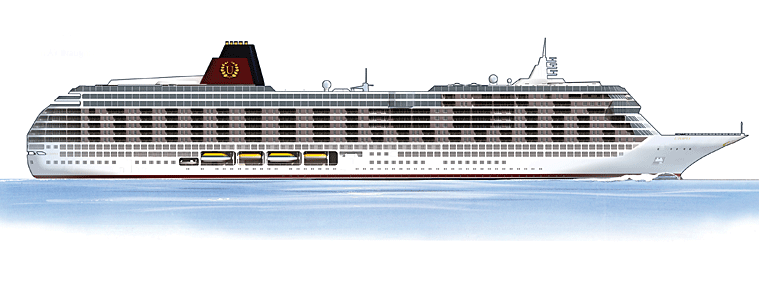 Blueseed isn't the only settlement on its way, however.
Utopia, an ultra-luxury cruise ship, has received $1.1 billion in financing to
be built by 2016. The ship will have 200 residences and 175 hotel rooms. Aboard
the ship will be a casino, full-service spa, multiple swimming pools, a water
slide, rock climbing wall, movie theatre, 11 decks, golf simulators, a sports
bar, several lounges and restaurants, a deli, a grocery store, and other retail
spaces. Utopia will be powered by several thrusters under the waterline and the
entire ship will be a permanent holiday. By 2016, the number of individuals
permanently living at sea is expected to reach 500. Blueseed isn't the only settlement on its way, however.
Utopia, an ultra-luxury cruise ship, has received $1.1 billion in financing to
be built by 2016. The ship will have 200 residences and 175 hotel rooms. Aboard
the ship will be a casino, full-service spa, multiple swimming pools, a water
slide, rock climbing wall, movie theatre, 11 decks, golf simulators, a sports
bar, several lounges and restaurants, a deli, a grocery store, and other retail
spaces. Utopia will be powered by several thrusters under the waterline and the
entire ship will be a permanent holiday. By 2016, the number of individuals
permanently living at sea is expected to reach 500.
It remains unclear if either of these projects will take shape beyond their current statuses; Blueseed needed another $18 million in funding at last tally, and the superstructure for Utopia has yet to be laid. Nonetheless, these are the closest realizations yet to Ron Herron's 'Walking City' idea--entire metropolises mounted on robotic legs which could haul their infrastructure and productivity to the highest bidder. Provided we're willing to compromise the giant robot legs part for something more akin to Waterworld, we may be very close to colonizing our world's last true frontier.
Resources
The Seasteading Institute
Utopia Residences
Wikipedia - Seasteading
| 


 Re: Seasteading: No Landlubbers Allowed


