|
Moore's Law
Gordon E. Moore, in his 1965 paper entitled "Cramming More Components onto Integrated Circuits" made the observation that the number of components (such as transistors) in an integrated circuit doubles every two years. At the time Moore wrote his paper, integrated circuits had around 50 transistors per chip.
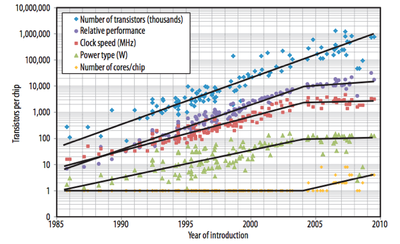
By 1972, the Intel 8008 had 3,500 transistors. The semiconductor industry had adopted "Moore's Law" as an industry standard and reinvested profits into research and development to meet the schedule, thus the law became a self fulfilling prophecy. In 1982 Intel introduced the 80186 which had 55,000 transistors. 1993 saw the release of the Pentium chip with its 3,100,000 transistors. By 2008 AMD had reached 758 million transistors in the K10 Quad-Core. This year Intel released the 62-core Xeon Phi with 5 billion transistors. Next year Oracle will release the 32-core Sparc M7, a chip with 10 billion transistors. Moore's law is alive and well....for now.
But there are clouds on the horizon. There is a fundamental limit on the number of transistors you can fit on a chip. The semiconductor industry is already using a 20 nm process to make these chips and are quickly approaching the atomic scale. by 2020 the industry is expected to be using a 5 nm process. As the industry edges closer and closer to that fundamental atomic limit, it is becoming increasingly difficult to maintain the hectic pace set by Moore in 1965.
That's not to say that improvements to chips can't be made, but the costs are becoming greater and greater. Today's desktop processing power dwarfs anything that existed 20 years ago, yet counter-intuitively we are increasingly confronted by computing problems that conventional computers couldn't hope to solve.
Different, Not Moore
More than 30 years ago, a group of physicists and computer scientists held a conference on the Physics of Computation at MIT. Among the points to come out of the meeting was that there were many problems in science that could not be calculated by classical computers in an efficient way. The broad outline of a computer based upon quantum mechanics was proposed.
In the decades since there has been a lot of research in the field. How would a quantum computer work? What would it physically consist of? What kind of problems could it solve? For years quantum computers were more science fiction than reality, with tantalizing promises of computing efficiency as demonstrated in the graph below.

Several weeks back Google announced that it had hired Dr. Martinis from the UC Santa Barbara to work on quantum computing. I detail the story in an article I wrote:
Google Leaps Into Quantum Computing
As the technology of computing has evolved, the limitations of "classical" computers have grown more apparent. Many problems are so unwieldy they would take several times the age of the universe to solve. It's becoming increasingly clear that more processing isn't enough. Fundamentally different approaches to computing also are needed.
For the past few decades, several types of computing have been proposed and investigated including DNA computing, chaos computing and, perhaps the closest to becoming reality, quantum computing. Last year Google, in a joint initiative with Universities Space Research Association and NASA, announced the creation of the Quantum Artificial Intelligence Lab (QuAIL). Its goal is to pioneer research into how quantum computing might help with difficult computer science problems.
Article Continues Here
Other Approaches
Quantum computers aren't the only alternative to classical computers. Mechanical computers existed in antiquity. DNA and other biomolecular computational methods have been proposed. Even Chaotic computers, which I personally find fascinating, have been suggested. There are all kinds of unconventional computer designs that may be better suited for certain problems.
It's not hard to imagine a not too far off future where a computer has multiple types of processors and software that chooses between them based upon the type of work being done. Need to factor a large number or have a program that uses machine learning? Use the Quantum Processor. Designing a new protein? Perhaps the DNA Processor is best. It's hard to say now what will be possible since unconventional computing is a nascent field. What is increasingly clear is that brute force computing isn't enough. If we want to continue to progress technologically as we have with the control and manipulation of information, we will need to develop new approaches.
| 




 Re: Moore's Not Enough: The Future of Computing by Roger Pink


