|

In the eyes of many an environmentalist, the biggest enemy of the forest is the lumberjack (i.e. the logging industry). But for many types of trees, a greater, more "natural" threat exists: insects. There are a number of insect species that have and continue to wreak havoc on forests around the world. Three pests creating problems in the northeast U.S. are the southern pine beetle, the hemlock woolly adelgid, and the emerald ash borer.
 The hemlock woolly adelgid (HWA) is an invasive insect species that attacks hemlocks of all types. The adelgid is native to parts of Asia and was first found in New York in 1985. The adelgid fatally impacts tree health by extracting sap and nutrients from the tree and thus preventing tree growth. Trees usually die within 2 years of infestation. The hemlock woolly adelgid (HWA) is an invasive insect species that attacks hemlocks of all types. The adelgid is native to parts of Asia and was first found in New York in 1985. The adelgid fatally impacts tree health by extracting sap and nutrients from the tree and thus preventing tree growth. Trees usually die within 2 years of infestation.
The Southern Pine Beetle (SPB) is a bark beetle that attacks all species of pine trees. It is native to the southern United States, but has been steadily expanding its territory to the north and west. The beetle is said to be one of the most destructive forest pests in the U.S., killing pine trees within 2-4 months of infestation. In New Jersey, an estimated 1000 acres of pine forests are destroyed each year by the bug, and it now threatens the Long Island Pine Barrens of New York.
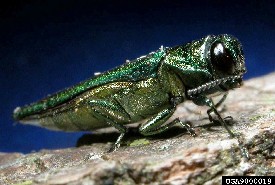 The emerald ash borer (EAB) is a green colored beetle that attacks north american ash trees. It is an invasive species, originating from eastern Russia, Japan, China, and Korea. Larvae of the beetle feed on the tree, and their feeding patterns disrupt flow of nutrients in the tree. Ash trees typically die within 2-4 years of infestation. The EAB has been responsible for killing over 50 million ash trees in the U.S. since its discovery in Michigan in 2002. The emerald ash borer (EAB) is a green colored beetle that attacks north american ash trees. It is an invasive species, originating from eastern Russia, Japan, China, and Korea. Larvae of the beetle feed on the tree, and their feeding patterns disrupt flow of nutrients in the tree. Ash trees typically die within 2-4 years of infestation. The EAB has been responsible for killing over 50 million ash trees in the U.S. since its discovery in Michigan in 2002.
Forests are an incredibly valuable resource - they provide habitats for many forms of wildlife, help prevent water erosion, provide important recreational opportunities, and of course rovide the wood and lumber we need for buildings, furniture, instruments, and other products and crafts. But can we protect our trees? What are our options in dealing with these pests?
One of the more aggressive approaches to combating invasive species is to spray pesticides and chemicals that kill the bugs and guards tree from future attacks. Typically, trees are laced with a chemical that absorbs into the wood and core of the plant. This not only kills bugs that are currently infesting the tree, but acts as a preventative shield to the critters for many years. The cost for treatment can be high, and includes not only the price of the chemicals but the possible effects they have on the surrounding environment and other organisms.
Some bugs can be combated through biological means. For instance, certain beetles feed mainly on hemlock woolly adelgid. These bugs have been released in large numbers in adelgid infested areas as a control/treatment mechanism. The predators are not always native species however, so the danger of this method is the possibility of further disrupting or unbalancing the ecosystem in these areas.
 The least aggressive alternative is to monitor the location and spread of the bugs, and make efforts to restrict their movement. Monitoring, by marking trees and recording sightings of the pests and their handiwork, can help define infestation boundaries. Spread can also be slowed by removing infected trees, and also restricting ways in which the bugs may travel. For example, in some states, laws have been enacted to prevent campers from using non-local firewood in an effort to slow EAB movement. The least aggressive alternative is to monitor the location and spread of the bugs, and make efforts to restrict their movement. Monitoring, by marking trees and recording sightings of the pests and their handiwork, can help define infestation boundaries. Spread can also be slowed by removing infected trees, and also restricting ways in which the bugs may travel. For example, in some states, laws have been enacted to prevent campers from using non-local firewood in an effort to slow EAB movement.
Unfortunately, there is no easy solution to the problem of tree-killing insects. The best strategy is often a combination of all the above methods. Some may wonder whether this effort is really worth the time and money - why not just to let "nature" take its course? Of course, the introduction of an invasive species is not a "natural" event, but it is true that eventually the environment will adapt to the changes. The harder question to answer is: how drastic will these changes be, and are we willing to live with them?
| 


 Re: The Problem of Tree-Killing Pests


