Roger's Equations Blog

Roger's Equations

This blog is all about science and technology (with occasional math thrown in for fun). The goal of this blog is to try and pass on the sense of excitement and wonder I feel when I read about these topics. I hope you enjoy the posts.

Previous in Blog: The Laniakea Supercluster (Our Home)   Next in Blog: Lunar Libration
Close
Close
Close
34 comments
Rate Comments: Nested

NASA's Investigation Into EM Drives - What if?

Posted April 30, 2015 3:56 PM by Bayes

Science (Fiction) Sells!

There's been a bunch of sensationalist headlines flying around lately:

Is NASA one step closer to warp drive? - CNET
Has NASA Accidentally Invented the Warp Drive? - Huffington Post UK
So NASA May Have Just Invented the Warp Drive - MTV

The first thing you'll notice are the sources. There are no articles from Discover, Scientific American, etc. None of the usual scientific magazines/news sites have mentioned this "warp drive" at all. That's usually an indication this is purely speculation and or hype.

However...

Whenever you hear about a new amazing technological advancement, it usually will fall within three categories. Either it's a scam, a mistake, or far less often an actual breakthrough / anomaly. The vast majority of the time it usually is the first two. That's most likely the case this time too. Still... this doesn't sound like a scam. It sounds more like a mistake. To understand why, I recommend reading this excellent article on the EM Drive at NASA. When you read about it, I want you to remember that, although the team working on it works at NASA, please be sure to understand that they are most likely a small, underfunded, unimportant group and project. This is not something NASA is taking seriously, as far as I've seen. At least not yet.

http://www.nasaspaceflight.com/2015/04/evaluating-nasas-futuristic-em-drive/

Hopefully you've had a chance to read the article above. In a nutshell it says that NASA Eagleworks - an advanced propulsion research group led by Dr. Harold White at the Johnson Space Center (JSC) has tested Electromagnetic (EM) Propulsion in a vacuum and recorded thrust measurements that seem at odds with classical physics (see article for more details).

This matters because the objections to previous experiments measuring thrust from an EM drive have centered on the fact that they haven't been tested in a vacuum. Critical scientists had used the lack of vacuum testing to suggest that the effect measured was probably convection heating of the air outside the EM drive, not thrust derived from the ground state of the vacuum (see article). The latest results seem to indicate that that objection couldn't be correct. Something else is going on.

Now please keep in mind that this doesn't mean that NASA has discovered warp drive as the sensationalist article titles I provided earlier suggest. It could just be a more complicated effect that falls within the realm of classical physics. However, if the EM drive does indeed work in a vacuum, things just got interesting.

Propellant is heavy and expensive. If a resonant microwave cavity could provide thrust, even a tiny amount of consistent thrust, it could change the way we currently travel space. Suddenly our nearest neighbor stars are within reach (the trip will still take over 100 years). Traveling to the outer solar system would only take a matter of years instead of decades round trip. Mars would be a quick trip away. Colonization could become a realistic goal.

Yay! Warp Drive Like In Star Trek!!!

No, not quite. It sounds exciting, and you can't blame MTV and CNET for the sensationalist headlines. Is this real? Is the EM drive truly creating thrust? (seriously, read the article). There hasn't been enough work done to know. It appears that way, but science is tricky and there are plenty of opportunities for mistakes and misunderstandings (see cold fusion). Most likely this will turn out to be something complicated and not useful for spaceflight...but still, if it is a real effect...that could be something amazing. Just don't get your hopes up too much!! At least not until a few other reputable institutions confirm the result. Anyway...

If you've come across any interesting articles on this subject (supporting or damning), please post them below. Best Regards! - R

Reply

Interested in this topic? By joining CR4 you can "subscribe" to
this discussion and receive notification when new comments are added.

Good Answers:

These comments received enough positive votes to make them "good answers".

"Almost" Good Answers:

Check out these comments that don't yet have enough votes to be "official" good answers and, if you agree with them, vote them!
2
Guru

Join Date: Apr 2010
Location: About 4000 miles from the center of the earth (+/-100 mi)
Posts: 9910
Good Answers: 1141
#1

Re: NASA's Investigation Into EM Drives - What if?

04/30/2015 8:06 PM

If the conservation of momentum is no longer the law of the land, that's going to affect a LOT of science! We have to assume that it will still hold. So where could the momentum be going?

Current thinking is that there is more dark matter in the universe than the ordinary matter. What if (speculating!) there is some way to transfer the momentum to the dark matter, like an airplane obtaining thrust by transferring momentum to the surrounding air.

Reply Good Answer (Score 2)
Guru
Safety - Hazmat - New Member United States - US - Statue of Liberty - New Member Engineering Fields - Chemical Engineering - Old Hand

Join Date: Mar 2011
Location: Lubbock, Texas
Posts: 14331
Good Answers: 162
#2
In reply to #1

Re: NASA's Investigation Into EM Drives - What if?

05/01/2015 4:21 PM

The real question here is whether or not the Quantum Vacuum is producing enough electron-positron virtual pairs to result in acceleration of these pairs to produce the measured force. It is my understanding the microwave fields (E-M) would circulate the pairs in opposing directions, right? Then there is also the consideration of dark matter (we seem to not have much of a clue about its properties), but suppose that it somehow does not produce pressure as gas molecules do, but is more of a membrane like material - does this mean it rebounds after the acceleration? OR does it stay stretched? I expect this will be a steep learning curve for us all.

__________________
If it ain't broke, don't fix it. Just build a better one.
Reply Score 1 for Good Answer
Guru

Join Date: Sep 2007
Location: East Texas
Posts: 1439
Good Answers: 31
#4
In reply to #1

Re: NASA's Investigation Into EM Drives - What if?

05/04/2015 12:43 AM

How is the conservation of momentum applied to the following?

A long electromagnet is fixed on a table top. It is in a demagnetized state.

A short cylindrical permanent magnet is placed near the fixed magnet aligned in such a manner so that when the electromagnet is energized it will be in repulsion.

The electromagnet is then energized.

The permanent magnet will begin to roll away from the fixed magnet.

How does the conservation of momentum apply here?

The needle of a small magnetic compass is mechanically forced into the opposite direction. It is then released. The needle is accelerated by earths magnetic field as it begins to align to the equilibrium position.

How does the conservation of momentum apply here?

What if there were some way to use the dipolar field of the Sun and planets as reaction fields?

http://cr4.globalspec.com/thread/11752

__________________
"The greater danger for most of us lies not in setting our aim too high and falling short; but in setting our aim too low, and achieving our mark." -- Michelangelo
Reply
Guru
Safety - Hazmat - New Member United States - US - Statue of Liberty - New Member Engineering Fields - Chemical Engineering - Old Hand

Join Date: Mar 2011
Location: Lubbock, Texas
Posts: 14331
Good Answers: 162
#5
In reply to #4

Re: NASA's Investigation Into EM Drives - What if?

05/04/2015 1:20 PM

F=ma

∫F·dt = ∫m dv/dt ·dt = ∫p, thus momentum is conserved through the action of a time-dependent impulse that is either changing or is contant then removed from action (by a switch).

Conservation of momentum as applies to this situation I think requires that for any force to act upon an object in an inertial frame, there must me something propelled away of the same momentum with opposite sign. If the field produced is reacting to dark matter, we may not be able to measure its departure, but it is nontheless being propelled away.

__________________
If it ain't broke, don't fix it. Just build a better one.
Reply
Guru

Join Date: Sep 2007
Location: East Texas
Posts: 1439
Good Answers: 31
#7
In reply to #5

Re: NASA's Investigation Into EM Drives - What if?

05/04/2015 2:05 PM

When considering repulsion between a long cylindrical electromagnetic and earth's electromagnetic field the instantaneous rotational torque and instantaneous accelerating force will be a function of the relative field angle between the action and reaction field, the range, and strengths of the action and reaction fields.

The electrical input power can be estimated as a function of angular acceleration and angular velocity around the spin axis of the package, moment of inertia of the package, and acceleration and velocity of the package relative to earth.

This is simple force and angle relationships; the goo goo eyed dark matter stuff is way beyond me.

__________________
"The greater danger for most of us lies not in setting our aim too high and falling short; but in setting our aim too low, and achieving our mark." -- Michelangelo
Reply
Guru

Join Date: Apr 2010
Location: About 4000 miles from the center of the earth (+/-100 mi)
Posts: 9910
Good Answers: 1141
#8
In reply to #4

Re: NASA's Investigation Into EM Drives - What if?

05/04/2015 4:11 PM

The permanent magnet will begin to roll away from the fixed magnet.

How does the conservation of momentum apply here?

Believe it or not, when the permanent magnet moves away, the fixed magnet and the entire earth move in the opposite direction an extremely minute amount.

The needle of a small magnetic compass is mechanically forced into the opposite direction. It is then released. The needle is accelerated by earths magnetic field as it begins to align to the equilibrium position.

How does the conservation of momentum apply here?

Same thing, the earth is pushing against the needle (or you are). In each case, the needle has very small mass, you and the earth have very large mass. The needle moves a lot, the earth and you very, very little.

What if there were some way to use the dipolar field of the Sun and planets as reaction fields?

You can get a reaction force from a magnetic field if you move from an intense region to a less intense region, or vice versa. That is how diamagnetic levitation works, or the force on a piece of iron in a magnetic field.

Reply
Guru

Join Date: Apr 2010
Location: About 4000 miles from the center of the earth (+/-100 mi)
Posts: 9910
Good Answers: 1141
#10
In reply to #4

Re: NASA's Investigation Into EM Drives - What if?

05/04/2015 4:40 PM

What if there were some way to use the dipolar field of the Sun and planets as reaction fields?

One of the things you can do in space is take advantage of the solar wind, the stream of particles that the sun emits. It doesn't violate momentum conservation. It's just a matter of putting up a big sail and capturing some of the solar wind's momentum the same way that sailors capture the momentum of the earthly wind.

Reply
Guru
Engineering Fields - Electrical Engineering - Been there, done that. Engineering Fields - Control Engineering - New Member

Join Date: Dec 2008
Location: Long Island NY
Posts: 15600
Good Answers: 981
#3

Re: NASA's Investigation Into EM Drives - What if?

05/02/2015 8:50 AM

This is certainly interesting.

I noticed something from the picture of the test fixture. The cabling appears to not be Kapton insulated and shrink tubing appears to be on these cables. This implies to me that this is only a rough vacuum chamber. This might be nothing more than a small RF cavity particle accelerator with the residual gasses being the material being accelerated. At such poor vacuum condition levels it is also much easier to ionize the atoms, too.

If my observation is the crux of how this drive works then this may still be of use for low orbit corrections, like the ISS application mentioned in the article. However this would be useless for interplanetary travel thrust. This scenario would also fit the non-scientific journal misunderstanding hyperbole while NASA investigates the suitability of using the gas that retards orbital velocity for thrust to maintain a low orbit.

Then again this may have been the initial goal of this experiment and more thrust than one expected from just this phenomena has been found. I can see force measuring retrofits being applied to existing accelerator facilities that already require Ultra High Vacuum conditions.

__________________
"Don't disturb my circles." translation of Archimedes last words
Reply Score 1 for Good Answer
Guru
Safety - Hazmat - New Member United States - US - Statue of Liberty - New Member Engineering Fields - Chemical Engineering - Old Hand

Join Date: Mar 2011
Location: Lubbock, Texas
Posts: 14331
Good Answers: 162
#6
In reply to #3

Re: NASA's Investigation Into EM Drives - What if?

05/04/2015 1:29 PM

Yes, it all depends on vacuum quality measurements, and how that compares to the area near an object in LEO with decaying orbit. I like the concept, as the whatever that is doing is must be traveling very fast (way faster than chemical rocket gases) to produce any measurable thrust. Why not put a giant hood scoop on these satellites and make it work even better? I guess if it was large enough to matter, then the drag would really amount to a drag?

__________________
If it ain't broke, don't fix it. Just build a better one.
Reply
Guru

Join Date: Apr 2010
Location: About 4000 miles from the center of the earth (+/-100 mi)
Posts: 9910
Good Answers: 1141
#9

Re: NASA's Investigation Into EM Drives - What if?

05/04/2015 4:21 PM

I cannot understand why nobody has tested this thing in a vacuum!

Reply
Guru
Safety - Hazmat - New Member United States - US - Statue of Liberty - New Member Engineering Fields - Chemical Engineering - Old Hand

Join Date: Mar 2011
Location: Lubbock, Texas
Posts: 14331
Good Answers: 162
#11
In reply to #9

Re: NASA's Investigation Into EM Drives - What if?

05/04/2015 4:48 PM

I think they tried to test in hard vacuum, epic fail.

__________________
If it ain't broke, don't fix it. Just build a better one.
Reply
Guru

Join Date: Apr 2010
Location: About 4000 miles from the center of the earth (+/-100 mi)
Posts: 9910
Good Answers: 1141
#12
In reply to #9

Re: NASA's Investigation Into EM Drives - What if?

05/04/2015 5:07 PM

I cannot understand why nobody has tested this thing in a vacuum!

OK, they have. If this is real, it's Science Fiction come to life! It's interesting that if it works, there seems to be no agreement in how it works.

http://www.nasaspaceflight.com/2015/04/evaluating-nasas-futuristic-em-drive/

Reply
The Engineer
Engineering Fields - Engineering Physics - Physics... United States - Member - NY Popular Science - Genetics - Organic Chemistry... Popular Science - Cosmology - New Member Ingeniería en Español - Nuevo Miembro - New Member

Join Date: Feb 2005
Location: Albany, New York
Posts: 5060
Good Answers: 129
#13

Re: NASA's Investigation Into EM Drives - What if?

05/05/2015 8:42 AM

I suspect we won't know whether or not this is a real effect for a few years yet. Only time (and more experiments) will tell. But it did get me thinking about how inefficient rocket propulsion is for interplanetary and orbital flight.

Basically we are using the same sort of propulsion to travel through space as we use for getting into orbit. That doesn't make sense to me and seems very inefficient with respect to propellant.

It should be possible to greatly improve propulsion once we're in space by finding ways of expelling propellant much faster. After all, momentum is mass times velocity, and really, when you think about it, the velocity of propellant exiting traditional rockets is pretty slow. Even if this EM drive turns out to be experimental error...it should at least make us rethink how we achieve thrust in space.

Keep in mind, I'm assuming the power is produced by a different source. I'm only viewing the propellant as the means of generating the "equal and opposite reaction". In other words, the propellant is only there to convert the energy generated by, let's say a fission generator, into motion.

Reply
Guru

Join Date: Apr 2010
Location: About 4000 miles from the center of the earth (+/-100 mi)
Posts: 9910
Good Answers: 1141
#14
In reply to #13

Re: NASA's Investigation Into EM Drives - What if?

05/05/2015 3:50 PM

Sometimes I think it's good to look at an opposing viewpoint. As exciting as it would be to have a reactionless drive, it's like holding a lottery ticket...It might be a big winner, but the odds are long. Extraordinary claims need extraordinary proof.

http://www.forbes.com/sites/ethansiegel/2015/05/04/no-nasa-did-not-accidentally-invent-warp-drive/

Reply
The Engineer
Engineering Fields - Engineering Physics - Physics... United States - Member - NY Popular Science - Genetics - Organic Chemistry... Popular Science - Cosmology - New Member Ingeniería en Español - Nuevo Miembro - New Member

Join Date: Feb 2005
Location: Albany, New York
Posts: 5060
Good Answers: 129
#16
In reply to #14

Re: NASA's Investigation Into EM Drives - What if?

05/05/2015 6:28 PM

I definitely agree. I read somewhere where they pointed out the Faster than light neutrinos that turned out to be a jiggly wire. Skepticism is warranted until more results are in.

Just to be clear though, I wasn't suggesting a reactionless drive in my last comment. I'm saying a more efficient use of propellant might be beneficial. Just think of it as, every atom of propellant is precious and must be fired off with as high a velocity as possible to maximize the "reaction". I hope that makes sense.

Reply
Guru

Join Date: Apr 2010
Location: About 4000 miles from the center of the earth (+/-100 mi)
Posts: 9910
Good Answers: 1141
#17
In reply to #16

Re: NASA's Investigation Into EM Drives - What if?
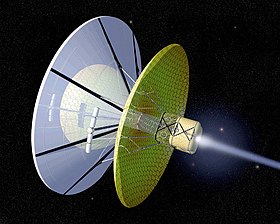
05/05/2015 8:57 PM

Maybe a Bussard ramjet is what we need...

http://en.wikipedia.org/wiki/Bussard_ramjet

Reply
Guru
Safety - Hazmat - New Member United States - US - Statue of Liberty - New Member Engineering Fields - Chemical Engineering - Old Hand

Join Date: Mar 2011
Location: Lubbock, Texas
Posts: 14331
Good Answers: 162
#19
In reply to #16

Re: NASA's Investigation Into EM Drives - What if?

05/06/2015 1:48 PM

Question:

Does wave-particle duality come into play at all here? Supposedly, the thrust measured is much larger than what photon pressure could achieve, is that right?

Already asked and answered in the above quagmire?

Could the E-M field have any effect at all on space curvature?

__________________
If it ain't broke, don't fix it. Just build a better one.
Reply
The Engineer
Engineering Fields - Engineering Physics - Physics... United States - Member - NY Popular Science - Genetics - Organic Chemistry... Popular Science - Cosmology - New Member Ingeniería en Español - Nuevo Miembro - New Member

Join Date: Feb 2005
Location: Albany, New York
Posts: 5060
Good Answers: 129
#20
In reply to #19

Re: NASA's Investigation Into EM Drives - What if?

05/06/2015 2:08 PM

Regarding wave-particle duality, it doesn't really show up here. Light in general has momentum, that's been known since the 1800s, so when it reflects off a surface the surface experiences an equal and opposite reaction, but that isn't what's happening here either according to the NASA researchers.

The vacuum continually has virtual particles and antiparticles that spring into existence and then annihilate. As I understand it, the guys doing the research are arguing the these virtual particles are being used as propellant. The microwave cavity is somehow preventing them from recombining as they ordinarily would and firing them off behind the engine (causing an equal and opposite reaction, ie thrust). This violates a number of generally accepted physical laws including but not limited to conservation of momentum. Though it's worth mentioning that scientists as a group misunderstand fundamental laws all the time (See Goddard and vacuum space flight). So we won't know for sure until the experiment is tested other places.

It's worth noting that the original designer of the drive (not from NASA) insists that the thrust can be accounted for by photon momentum from the microwave resonator, but most scientists seem to agree that his explanation is seriously flawed (I don't know enough to know myself). Obviously if other experiments confirm the measured thrust then the designer's explanation will be revisited.

I personally have no idea what's going on but if I'd have to bet I'd bet on experimental error.

That said, sometimes a mistake can introduce an interesting way of thinking. Thrust is essentially due to action and reaction. The action right now involves loads of propellant exiting a rocket at relatively slow speeds (compared to the speed of light). That is pretty inefficient (though effective for escaping Earth's gravity). I'm suggesting that there is probably an interesting drive waiting to be built that carries it's own propellant (doesn't need to grab it from the vacuum) but uses it far more efficiently .In other words it exits the drive at a much much higher speed producing more thrust per unit of propellant.

Reply
Guru
Safety - Hazmat - New Member United States - US - Statue of Liberty - New Member Engineering Fields - Chemical Engineering - Old Hand

Join Date: Mar 2011
Location: Lubbock, Texas
Posts: 14331
Good Answers: 162
#21
In reply to #20

Re: NASA's Investigation Into EM Drives - What if?

05/06/2015 2:54 PM

Perhaps they are incorrectly applying the laws of physics in this case, and there may be some relativistic correction for virtual particle mass being ejected (especially if it must travel in the frame of reference of the microwaves (as in a very high linear speed ion trap?????!) I can visualize it, but most definitely cannot put it on paper.

Perhaps the virtual particles have divergent trajectory as the are propelled outward, and cannot combine, without some use of the principles of linked behavior at a distance. Some brilliant physics graduate student somewhere will get his/her hands on this and make sausage out of it.

Also, will the virtual particles be viewed in the stationary frame (the rocket engine) as having a larger mass, less length, and therefore more speed as they accelerate away? Could it also mean that if this were true, would the particles annihilation not be "worth" a lot more energy due to relativistic masses under acceleration annihilating (linked at a distance)?

__________________
If it ain't broke, don't fix it. Just build a better one.
Reply
The Engineer
Engineering Fields - Engineering Physics - Physics... United States - Member - NY Popular Science - Genetics - Organic Chemistry... Popular Science - Cosmology - New Member Ingeniería en Español - Nuevo Miembro - New Member

Join Date: Feb 2005
Location: Albany, New York
Posts: 5060
Good Answers: 129
#25
In reply to #21

Re: NASA's Investigation Into EM Drives - What if?

05/07/2015 6:17 AM

These are questions I can't answer. The scientific majority seems to believe the experiment is probably a mistake. Only future experiments can answer these questions.

Reply
Guru
Safety - Hazmat - New Member United States - US - Statue of Liberty - New Member Engineering Fields - Chemical Engineering - Old Hand

Join Date: Mar 2011
Location: Lubbock, Texas
Posts: 14331
Good Answers: 162
#27
In reply to #25

Re: NASA's Investigation Into EM Drives - What if?

05/07/2015 9:59 AM

True, that it is quite premature to assume NASA (and others) got this right the first time, after all, this is science at the edge of what is known. After X number of confirmatory results, and anything suspicious that perturbs the accelerometer (or straingauge) that is measuring thrust has been eliminated, then conjectures that are now out there can each weighed by merits, consistency with that which is known, and a complete operating theory will emerge.

I think the best experiment might be go ahead and put one of these bad boys on a test probe and launch it into high orbit. It should not be too hard to use laser interferometry or other observations (Doppler? Transit time?) to observe any changes in the orbit to a higher one. The thing is will they be able to accurately predict at what point the probe is ready to leave Earth orbit, and travel to Mars, etc.?

__________________
If it ain't broke, don't fix it. Just build a better one.
Reply
The Engineer
Engineering Fields - Engineering Physics - Physics... United States - Member - NY Popular Science - Genetics - Organic Chemistry... Popular Science - Cosmology - New Member Ingeniería en Español - Nuevo Miembro - New Member

Join Date: Feb 2005
Location: Albany, New York
Posts: 5060
Good Answers: 129
#28
In reply to #27

Re: NASA's Investigation Into EM Drives - What if?

05/07/2015 10:58 AM

I think their (NASA researchers) plan is to do the experiment again at higher power. Their model predicts that at higher power their should be higher thrust. If that doesn't happen, or if the thrust is different than expected by a lot, then it most probably is experimental error. I'm not sure how expensive a probe is nowadays. That might be the easiest way to test it (throw it on a probe and try to use it). Plus you can be sure other experimenters will be testing their results, so we should get some feedback soon. If others fail to reproduce the effect then again it probably was experimental error.

Reply
Guru
Safety - Hazmat - New Member United States - US - Statue of Liberty - New Member Engineering Fields - Chemical Engineering - Old Hand

Join Date: Mar 2011
Location: Lubbock, Texas
Posts: 14331
Good Answers: 162
#18
In reply to #14

Re: NASA's Investigation Into EM Drives - What if?

05/06/2015 1:45 PM

Nasty bad slow to scroll link.

__________________
If it ain't broke, don't fix it. Just build a better one.
Reply
2
Participant

Join Date: May 2015
Posts: 1
Good Answers: 1
#22
In reply to #13

Re: NASA's Investigation Into EM Drives - What if?

05/07/2015 3:12 AM

"It should be possible to greatly improve propulsion once we're in space by finding ways of expelling propellant much faster."

Wasn't this the goal (among other things) of Nasa's Nuclear Engine projects like NERVA back in the Apollo era and the nuclear upper stages of the, mostly cancelled, Constellation program? Why does Nasa keep diverting away from nuclear propulsion programs. I keep reading about their successes and benefits but, I can't seem to find valid reasons (with the exception of funding) why they keep abandoning this technology.

Ad Astra's VASIMR engine seems to be using a similar technology but, uses plasma created in a magnetic field to accelerate the propellent. The VASIMR engine is more efficient than the nuclear engine but, much less powerful. At any rate, they would need a nuclear power plant to power VASIMR engines of any significant sizes, especially when in or beyond the asteroid belt.

Both technologies seem to offer the solution you are looking for. Why are we only advancing with the VASIMR technology?

Reply Good Answer (Score 2)
The Engineer
Engineering Fields - Engineering Physics - Physics... United States - Member - NY Popular Science - Genetics - Organic Chemistry... Popular Science - Cosmology - New Member Ingeniería en Español - Nuevo Miembro - New Member

Join Date: Feb 2005
Location: Albany, New York
Posts: 5060
Good Answers: 129
#26
In reply to #22

Re: NASA's Investigation Into EM Drives - What if?

05/07/2015 6:22 AM

I suppose part of the problem would be NASA not wanting to put a nuclear reactor on a rocket that may explode. Hopefully we will have fusion soon and that can be used instead.

Reply
Guru
Safety - Hazmat - New Member United States - US - Statue of Liberty - New Member Engineering Fields - Chemical Engineering - Old Hand

Join Date: Mar 2011
Location: Lubbock, Texas
Posts: 14331
Good Answers: 162
#29
In reply to #26

Re: NASA's Investigation Into EM Drives - What if?

05/07/2015 11:09 AM

The Soviets (and probably still the Russians) have used a thermal Polonium 210 source to produce onboard electricity for some of their space probes, and as near as I can recall, it is pretty hard to cause that to explode. It the launch vehicle explodes, that is an entirely different matter.

I suppose one could use far subcritical masses (pieces) of the charge to such a reactor, and cannisterize them in virtually indestructible enclosures for launch (that could be re-used, and even use robotics to retrieve the pieces from the cannisters and load them into a thermopile. I would much rather also see either cold or hot fusion take this job. By the way, there are groups out there now claiming to have calorimetrically detected excess heat at least 20 times the input heat in certain cold fusion experiments.

This is still not to say the heat is "high quality - high temperature" heat, but it is entirely sufficient for some generation purposes. No one has really tested the phenomenon at anything like a useful steam temperature, but on a spacecraft, one does not require that. The likely candidates would be hermetically sealed engines and generators that utilize low-boiling super-critical fluids such as carbon dioxide. Helium filled units also can work off low thermal differential, and none of them have ultra-high efficiency at the projected temperatures. AFAICT, it only has to work (1) with 99.99% reliability, (2) produce all the power requirements of the craft once in space, and (3) not require any consumables, and be able to recycle any/all of the materials utilized for a really long extended mission. Gosh, that can't too hard, can it? LOL

__________________
If it ain't broke, don't fix it. Just build a better one.
Reply
The Engineer
Engineering Fields - Engineering Physics - Physics... United States - Member - NY Popular Science - Genetics - Organic Chemistry... Popular Science - Cosmology - New Member Ingeniería en Español - Nuevo Miembro - New Member

Join Date: Feb 2005
Location: Albany, New York
Posts: 5060
Good Answers: 129
#30
In reply to #29

Re: NASA's Investigation Into EM Drives - What if?

05/08/2015 7:13 AM

Lol,

I know, right? It's not that complicated except where it's horribly complicated. Still, it feels like were close. I don't expect we'll get to another star in my lifetime...but I expect, if I'm lucky to live long enough, it will become plausible.

FYI, my previous response was worded ambiguously. Like you described, I was talking about the rocket exploding, not the nuclear reactor. I think they worry about an explosion and then atmospheric contamination. I would too. The politics of spaceflight is hard enough without throwing radioactive material into the atmosphere.

I too would much rather see fusion do the job. I think if Lockheed Martin is successful in their fusion ventures then we will see it start to be incorporated by NASA into probes.

Reply
Guru
Safety - Hazmat - New Member United States - US - Statue of Liberty - New Member Engineering Fields - Chemical Engineering - Old Hand

Join Date: Mar 2011
Location: Lubbock, Texas
Posts: 14331
Good Answers: 162
#31
In reply to #30

Re: NASA's Investigation Into EM Drives - What if?

05/08/2015 1:48 PM

Could be. Time will tell, but I think the hot fusion crowd will "get their day in the sun". So will the cold fusion folks. I think both will work in time, but on vastly different scales (at least at first).

I can see a large lift vehicle operating from a fusion (hot style) reactor of 100's MW power able to do a large chunk of the job (as long as there is something to be compressed and heated as in a jet aircraft engine). The real test will lie in conversion over to plasma drive in the outer reaches of earth atmosphere while still sub-orbital. Maybe somewhere in that zone, the impulse engine (EM engine) will be OK operational. Heck for all I know, it might work even as well or better in thick air?

I just don't think they will be able to scale the thing up to the point of useful for lift engine at the surface.

__________________
If it ain't broke, don't fix it. Just build a better one.
Reply
Guru

Join Date: Sep 2007
Location: East Texas
Posts: 1439
Good Answers: 31
#34
In reply to #26

Re: NASA's Investigation Into EM Drives - What if?

05/12/2015 1:53 PM

We have been flying RTGs for decades. All of our deep space missions use them.

There are designs that use closed loop reactors to drive Sterling generators. I dare to conjecture that our first attempt at this failed when only one side of a counter balancing system worked causing a high torque loss of attitude control and loss of high gain communication.

The use of nuclear power in space applications is an old and mature technology but has come at the cost of several very serious accidents resulting in wide spread contamination.

Because our environment is already so contaminated these accidents did not cause significant increases to total atmospheric "background" radiation; but in at least one case the pieces recovered would have caused death with a few hours of close contact.

I feel it is worth noting that although an accident may not cause a measurable increase in total background radiation any ingestion or body entry of the particles will cause carcinoma.

__________________
"The greater danger for most of us lies not in setting our aim too high and falling short; but in setting our aim too low, and achieving our mark." -- Michelangelo
Reply
Guru

Join Date: Sep 2007
Location: East Texas
Posts: 1439
Good Answers: 31
#23
In reply to #13

Re: NASA's Investigation Into EM Drives - What if?

05/07/2015 3:29 AM

I may be wrong but I believe specific impulse increases as the square of the exhaust velocity.

Is the idea of EM drive to eliminate expendable fuel mass or is it to use what little mass that exists in the vacuum as propellant by collecting it and then accelerating it using electromagnetic methods; not unlike ion drive.

__________________
"The greater danger for most of us lies not in setting our aim too high and falling short; but in setting our aim too low, and achieving our mark." -- Michelangelo
Reply
The Engineer
Engineering Fields - Engineering Physics - Physics... United States - Member - NY Popular Science - Genetics - Organic Chemistry... Popular Science - Cosmology - New Member Ingeniería en Español - Nuevo Miembro - New Member

Join Date: Feb 2005
Location: Albany, New York
Posts: 5060
Good Answers: 129
#24
In reply to #23

Re: NASA's Investigation Into EM Drives - What if?

05/07/2015 6:15 AM

As I understand it the EM drive supposedly eliminates the need for propellant mass.

Reply
Guru

Join Date: Apr 2010
Location: About 4000 miles from the center of the earth (+/-100 mi)
Posts: 9910
Good Answers: 1141
#32
In reply to #23

Re: NASA's Investigation Into EM Drives - What if?

05/10/2015 4:53 PM

For the record, specific Impulse Isp is actually proportional to exhaust velocity. The specific inpulse dimension is seconds, and basically indicates how long 1 "pound" of fuel can produce 1 pound of thrust.

F=(mv)' = v*m'. Force (thrust) is time derivative of momentum, and exhaust velocity is constant. So force is proportional to time rate of change of mass (how fast fuel is used up).

Weight = g*m, where g is gravitational constant (32.2 ft/sec^2)

Isp=F/(g*m')=(v*m')/(g*m')=v/g

Reply
Guru

Join Date: Apr 2010
Location: About 4000 miles from the center of the earth (+/-100 mi)
Posts: 9910
Good Answers: 1141
#15

Re: NASA's Investigation Into EM Drives - What if?

05/05/2015 6:11 PM

The solid state version uses DiLithium crystals!

Reply
Guru

Join Date: Apr 2010
Location: About 4000 miles from the center of the earth (+/-100 mi)
Posts: 9910
Good Answers: 1141
#33

Re: NASA's Investigation Into EM Drives - What if?

05/12/2015 10:36 AM

Thinking about this thread, I recalled that once when I was young, I noticed that shaking a weight while standing on a spring type bathroom scale resulted in a lower weight indication. Later I found out that friction in the scale was causing a rectifier-like effect, rectifying the "ac" shaking action. Alas, no reactionless thrust.

Here is some speculation, not knowing the details of the experimental set up:

If some microwave radiation escaped the microwave cavity in this experiment, could it affect the force sensors? The most obvious effect would be some kind of diode rectification (copper oxide, possibly). A second, less likely possibility, might be conversion of the microwave energy to sound (resonance, perhaps), which gets rectified, bathroom scale fashion, into an indicated thrust.

I would assume that these things would have been checked out, preferable by someone skeptical, trying to disprove the hypothesis that thrust was being generated.

It's way too easy to fall in love with the dream of reactionless propulsion.

Reply Score 1 for Good Answer
Reply to Blog Entry 34 comments

Good Answers:

These comments received enough positive votes to make them "good answers".

"Almost" Good Answers:

Check out these comments that don't yet have enough votes to be "official" good answers and, if you agree with them, vote them!
Copy to Clipboard

Users who posted comments:

Andrew Kenney (1); Bayes (8); Gavilan (4); James Stewart (10); redfred (1); Rixter (10)

Previous in Blog: The Laniakea Supercluster (Our Home)   Next in Blog: Lunar Libration

Advertisement
