 The Future is Now (And Soon) The Future is Now (And Soon)
Every so often a remarkable, life changing device that we've anticipating for decades finally goes mainstream, often with little fanfare at the time. This is because the technology behind it developed incrementally, and without a pivotal breakthrough to point to, we tend not to notice these things. It happened with cell phones, fracking, organ transplants, computers, the internet, radio, etc. Now it's happening again with exoskeletons.
If that sounds like hyperbole, consider Claire Lomas. Claire, who was paralyzed from the waist down after a horse-riding accident in 2006, walked the 26.2 miles of the London Marathon with the aid of an exoskeleton. Remarkable, and yet this occurred in 2012 and since then the feat has been accomplished several more times by others in exoskeleton suits.
But exoskeletons are not just for medical applications. The military and industry have been looking into exoskeletons that make loads lighter or otherwise enhance human ability. For instance there is Lockheed Martin's HULC Exoskeleton. Or the Fortis Exoskeleton.
So you see, exoskeletons are already starting to appear in medical, industrial, and military applications. I've mentioned three but there are hundreds of exoskeletons being developed as we speak. Last year three exoskeleton companies went public and there are several more companies in the pipeline. The exoskeleton industry is predicted to have a compound annual growth rate of over 70% from 2015-2019.
Engineering360 Article
I recently wrote an article for Engineering360 about Exoskeletons. Here it is:
Exoskeleton Technology Takes a Step Forward
Researchers from the European Union's (EU's) Robo-Mate project presented their first prototype of an industrial exoskeleton at Fraunhofer Institute for Industrial Engineering (IAO) in Stuttgart in mid-June 2015. According to the group, the exoskeleton makes 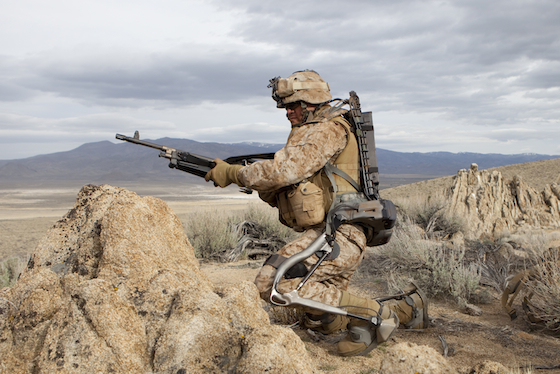 loads appear to be as much as 10 times lighter to lift. Dr. Hans Wernher van de Venn, head of the Institute of Mechatronic Systems at Zurich University of Applied Sciences and Coordinator of the Robo-Mate project, says the prototype consists of modules for the arms, the body trunk and the legs. It works by supporting the user's arms and legs as well as protecting his or her back and supporting posture. By means of motors and sensors, it reduces the effective load workers have to bear to a fraction of the actual load. loads appear to be as much as 10 times lighter to lift. Dr. Hans Wernher van de Venn, head of the Institute of Mechatronic Systems at Zurich University of Applied Sciences and Coordinator of the Robo-Mate project, says the prototype consists of modules for the arms, the body trunk and the legs. It works by supporting the user's arms and legs as well as protecting his or her back and supporting posture. By means of motors and sensors, it reduces the effective load workers have to bear to a fraction of the actual load.
The Robo-Mate project's goal is to develop an intelligent, easy-to-maneuver, wearable exoskeleton to enhance work conditions for load workers and to ease repetitive lifting tasks in an effort to reduce work-related injuries. The project consists of 12 partners from seven European countries, including players from industry and academia.
The technology at the heart of the project involves merging human-guided manipulators with computer-controlled industrial robots. If successful, Robo-Mate industrial exoskeletons could be adopted by a range of industries where heavy or repetitive lifting is required. In time, every industry may adopt some form of exoskeleton enhancement for improved safety and performance.Skepticism about exoskeletons going mainstream may be understandable.The idea of exoskeletons has been around for a long time and the technology has always seemed right around the corner.
Article Continues Here
| 

 2
2


 Re: The Emerging Exoskeleton Industry


Good Answers:
"Almost" Good Answers: