|
True story: last February I was scheduled to attend a destination wedding in Jamaica. Except a week before we left, the bride-to-be announced she would not be attending. She was pregnant and her doctor advised her not to travel to the Caribbean, as the Zika virus was just beginning to emerge in the region. So while the couple tied the knot in a private ceremony back home on the intended wedding day, 24 of their closest family and friends partied in paradise without them.
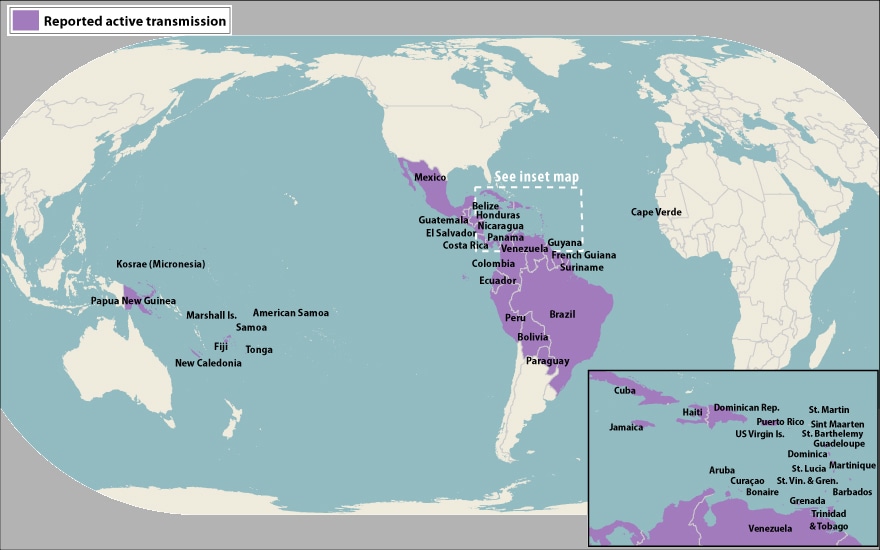 This is just a sliver of the effects Zika promises to bring stateside, as summer arrives this weekend and in short order, mosquitoes will arrive in full force. Zika can spread by two species of mosquitoes: Aedes aegypti, a tropical climate mosquito, and Aedes ablopictus, which has adapted to cooler regions including majority of the Eastern and Midwestern United States, as well as most of California. Zika can also be spread by sexual contact. To combat the Zika virus nationally, the U.S. Congress has dedicated at least $662 million towards fighting it. Brazil, the country most affected by the current epidemic, has been fumigating and using drones ahead of the 2016 Olympics. This is just a sliver of the effects Zika promises to bring stateside, as summer arrives this weekend and in short order, mosquitoes will arrive in full force. Zika can spread by two species of mosquitoes: Aedes aegypti, a tropical climate mosquito, and Aedes ablopictus, which has adapted to cooler regions including majority of the Eastern and Midwestern United States, as well as most of California. Zika can also be spread by sexual contact. To combat the Zika virus nationally, the U.S. Congress has dedicated at least $662 million towards fighting it. Brazil, the country most affected by the current epidemic, has been fumigating and using drones ahead of the 2016 Olympics.
Zika first manifests as a fever and rash, but is rarely serious for healthy individuals. Instead the biggest threats are to unborn babies, who typically suffer from microcephaly, which can be fatal. It's unknown how long the Zika virus could affect future pregnancies, so some governments have advised women against getting pregnant until more research is done. Zika also has a link to Guillain-Barré syndrome.
So as the warmest months of the year approach, governments at all levels in the U.S. are beginning to research the spread of Zika mosquitoes and initiate prevention programs. Reuters notices a large response gap between rural communities and well-off ones. Whereas the Florida Keys Mosquito District has a budget of $15 million, with four copters, two planes and 33 inspectors, towns with less resources may not even be able to conduct a basic fogging program.
Over the past couple of decades, the war on mosquitoes has increased after there were outbreaks of west Nile virus, dengue, Chikungunya and now Zika. Because of this, scientists have come up with novel, high tech ways to combat mosquitoes without the use of toxins. One of the most prominent recent methods is the sterile insect technique. Overwhelming populations of radiation-sterilized male mosquitoes are bred and released to mate with female mosquitoes, which produces no mosquito eggs and lessens the population of the next generation. There are some drawbacks, as such a breeding program is expensive, not guaranteed to work, and often requires preceding use of pesticides.
In another technique male Aedes aegypti mosquitos are bred, but are genetically modified to require tetracycline to develop beyond the larvae stage. Tetracycline is supplied to these mosquitoes in the breeding facility, but offspring created by mating with a female mosquito in the wild won't have access to tetracycline and will never develop into a mosquito. Other genetically modified mosquitoes produce 95% male offspring (males don't suck blood).
And then there is the mosquito laser, also known as the Photonic Fence. First patented in 2010, it uses infrared LED lamps and a CCD sensor to determine if an insect is present. Once confirmed, a non-lethal laser focuses on the target insect to  determine if it's both a mosquito and a female mosquito. With a second confirmation, a blue laser is given permission to shoot -- one shot and the zapped mosquito is killed. determine if it's both a mosquito and a female mosquito. With a second confirmation, a blue laser is given permission to shoot -- one shot and the zapped mosquito is killed.
When allied with conventional mosquito management options, such as pesticides, habitat removal, and mosquito predators, it's possible to eliminate mosquitoes from the Earth entirely. And according to this 2010 article in Nature, ecological consequences would be quite minimal.
Considering mosquitoes are the deadliest creatures on the planet (up to one million deaths per year from mosquito-carried illnesses), it makes some sense. And if there aren't significant ecosystem ramifications, what's stopping us?
| 


 Re: Kill All Mosquitos?


"Almost" Good Answers: