|
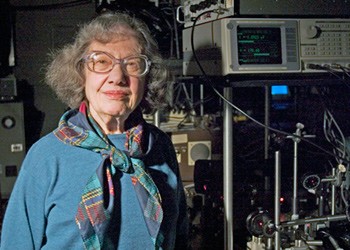
Dr. Esther Conwell practiced physics at a time when few women were entering science. Her pioneering semiconductor research earned her a place as one of Discover magazine’s 50 Most Important Women of Science in 2002.
The daughter of eastern European immigrants — her father, a portrait photographer, and her mother, a homemaker for a husband and three daughters — Conwell was born in the Bronx and raised in Brooklyn. She frequently described her home borough as a “frontier” in the 1930s. As a teen she didn’t show significant interest in math and science, Conwell excelled in math and showed an early love for order and discipline and challenge. She loved to dance throughout her life, as well.
Credit: Rochester.edu
“I began dancing in college, first modern dance and then ballet,” says Conwell said in an interview with the University of Rochester. “I think the same things I love about ballet, I love about physics. They’re both exact and require discipline. That sense of order is what really attracted me to physics in college. And the fact that there was no lab work. I always hated lab work.”
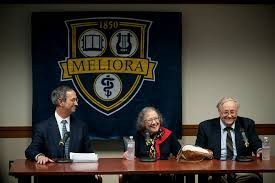
She lived her life in New York State, working in many different Empire State cities. She was a pioneer in the field of semiconductor research that revolutionized modern computers. She was also awarded the National Medal of Science by President Barack Obama in 2010. Her expertise earned her the rare honor of memberships in both the National Academy of Sciences and the National Academy of Engineering.
Credit: urchemphotos.com
Conwell studied properties of semiconductors and organic conductors, especially electron transport. She is possibly most well-known for her work elucidating how electrons travel through semiconductors, an accomplishment that helped revolutionize modern computing.
She obtained a B.A. from Brooklyn College in 1942, an M.S. from the University of Rochester in 1945, and a Ph.D. in 1948 from the University of Chicago, all in physics.
After her first year of graduate school, she got a job with Western Electric as an assistant engineer. At the time, payroll did not have a job title code for female assistant engineers. Her job title was changed – along with her pay being reduced – so she could work under an existing job code.
Conwell spent most of her life in the industry after her completing college. She worked as an industrial scientist for 47 years at Bell Telephone Laboratories (1951-1952), GTE Laboratories (1952-1972), and Xerox Corporation (1972-1998).

Credit: Pool/Getty Images North America
In 1972 she joined the Xerox Wilson Research Center, where she was a Research Fellow from 1981 to 1998. In 1998, Conwell joined the University of Rochester, where she was a professor of chemistry and of physics. She earned four patents and published more than 200 papers.
Conwell was a fellow of the IEEE and the American Physical Society, as well. She was also a member of many societies, including the National Academy of Engineering, National Academy of Sciences, and the American Academy of Arts and Sciences. She had received the Achievement Award of the Society of Women Engineers and an Honorary D.Sc. from Brooklyn College. She received the 1997 IEEE Edison Medal for "fundamental contributions to transport theory in semiconductor and organic conductors, and their application to the semiconductor, electronic copying and printing industries."
She passed away in 2014 after a car accident at her home.
Sources:
https://en.wikipedia.org/wiki/Esther_M._Conwell
http://www.democratandchronicle.com/story/news/2014/11/17/woman-struck-brighton-dies-injuries/19170219/
http://www.rochester.edu/newscenter/esther-conwell-pioneering-professor-of-chemistry-dies-at-92/
http://www.rochester.edu/news/conwell.html
http://www.rochester.edu/pr/Review/V65N3/feature3.html
| 


 Re: Woman of the Week – Esther Conwell


