|
The other afternoon I was reading about how sea sponge spicules could inspire stronger columns, and it reminded me of a structures course I took in college. Let me set the scene for you: 25 terrified first-year students and an ancient ex-Turkish military man with an accent so strong you couldn’t make out a word, a beyond-intimidating reputation, and a beard the length of his chest. The first day he assigned us a project in which we were to design a structure based off of nature, and then he proceeded to explain compression and tension using a basswood board and his beard as “the force” inflicted on it.
No one knew what was going on in that class, and I learned far more about design than I did structure, but I was forever instilled with the idea that nature was our best design precedent.
Today, in honor of my professor and sea sponge spicules, I’m going to share with you a few examples of biomimicry (“the design and production of materials, structures, and systems that are modeled on biological entities and processes”) in architecture that have really stuck with me.

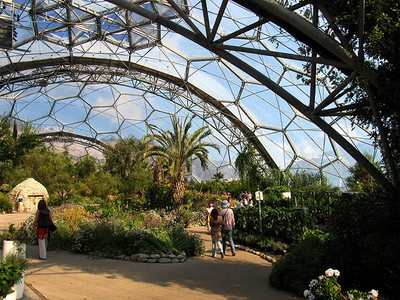 The Eden Project, which looks like something out of a science fiction movie, was inspired by “a range of biological structures,” which include soap bubbles, radiolarian, and bee hives. Located in Cornwall, England, the design was for the Humid Tropics Biome—and as you can hear in a TED Talk by Michael Pawlyn, had to be created in such a way that it could adapt to the changing surface of the quarry it was in. In the process of creating this structure, they managed to create a superstructure that “is less than the weight of the air that it contains”—a pretty significant feat when compared to the average greenhouse. The Eden Project, which looks like something out of a science fiction movie, was inspired by “a range of biological structures,” which include soap bubbles, radiolarian, and bee hives. Located in Cornwall, England, the design was for the Humid Tropics Biome—and as you can hear in a TED Talk by Michael Pawlyn, had to be created in such a way that it could adapt to the changing surface of the quarry it was in. In the process of creating this structure, they managed to create a superstructure that “is less than the weight of the air that it contains”—a pretty significant feat when compared to the average greenhouse.
Image Credit to Morphographic.com.

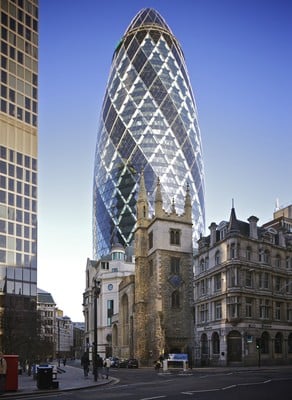 “The Gherkin” (technically named 30 St Mary Axe) was inspired by yet another sea sponge, the Venus Flower Basket Sponge. This sponge, in contrast to the orange puffball sponge that has the spicules we were talking about, is a “glowing creature that thrives in the inky depths of the sea.” The sea sponge roughly inspired the shape of the building, but the influence stemmed from the Venus Flower Basket’s ability to filter water and nutrients through a self-created grate-like exoskeleton. The building copies that ability to maneuver water though its “lattice-like exoskeleton,” instead “direct[ing] the flow of winds from street level and open windows along its spiral body, funneling it through the building’s offices naturally” and most importantly, this passive system of cooling reduces the energy consumed to half of that in a “conventionally air-conditioned office tower.” “The Gherkin” (technically named 30 St Mary Axe) was inspired by yet another sea sponge, the Venus Flower Basket Sponge. This sponge, in contrast to the orange puffball sponge that has the spicules we were talking about, is a “glowing creature that thrives in the inky depths of the sea.” The sea sponge roughly inspired the shape of the building, but the influence stemmed from the Venus Flower Basket’s ability to filter water and nutrients through a self-created grate-like exoskeleton. The building copies that ability to maneuver water though its “lattice-like exoskeleton,” instead “direct[ing] the flow of winds from street level and open windows along its spiral body, funneling it through the building’s offices naturally” and most importantly, this passive system of cooling reduces the energy consumed to half of that in a “conventionally air-conditioned office tower.”

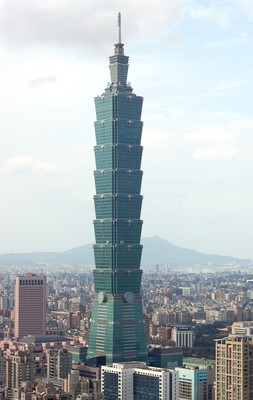 Taipei 101, or really the bamboo that inspires it, is the precedent I remember most clearly from that structures course. The tall, slender skyscraper lends itself to the form of bamboo, but the flexibility of the structural characteristics also benefit the structure during high winds and typhoons. Taipei 101 is composed of separate segments, much like the individual cavities within bamboo. In some species of bamboo, the internodes, or cavities, appear to fit within each other ever so slightly, so the segments act as a cohesive unit. Taipei 101’s flared modules are said to have the same effect. Taipei 101 is not the only building to incorporate bamboo-like structure into its design, but I would argue it does attempt to pull in more of the bamboo’s symbolism than other buildings as the architects believed that evoking bamboo helped them “[express] upward progress and prosperous business.” Taipei 101, or really the bamboo that inspires it, is the precedent I remember most clearly from that structures course. The tall, slender skyscraper lends itself to the form of bamboo, but the flexibility of the structural characteristics also benefit the structure during high winds and typhoons. Taipei 101 is composed of separate segments, much like the individual cavities within bamboo. In some species of bamboo, the internodes, or cavities, appear to fit within each other ever so slightly, so the segments act as a cohesive unit. Taipei 101’s flared modules are said to have the same effect. Taipei 101 is not the only building to incorporate bamboo-like structure into its design, but I would argue it does attempt to pull in more of the bamboo’s symbolism than other buildings as the architects believed that evoking bamboo helped them “[express] upward progress and prosperous business.”
| 


 Re: The Nature of Structure




Good Answers: