|
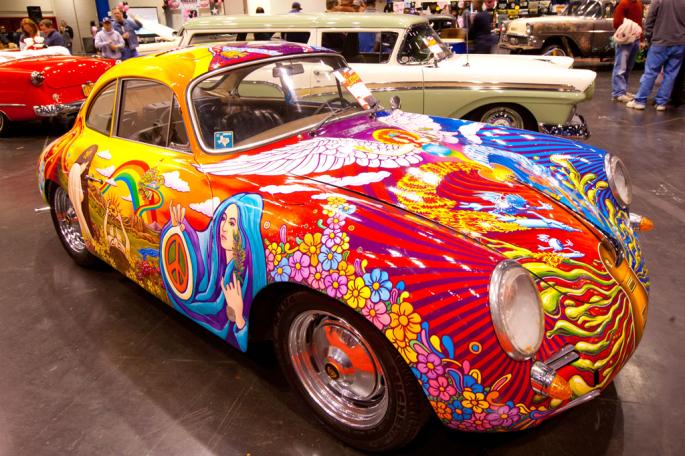
Flames and scallops have their places. Hippie buses and harlequins certainly catch the eye. Lowriders showcase mastery with all sorts of airbrush tools and techniques. And with wraps, the sky's the limit when it comes to adding graphics to a car's flanks.
But, no offense to the artists behind any of the above, if one were to view the body of a vehicle as a blank canvas upon which one could let imagination run rampant,  does any automotive paint scheme get more inventive than the 1976 Citroen GS Energetique by Jean-Pierre Lihou? does any automotive paint scheme get more inventive than the 1976 Citroen GS Energetique by Jean-Pierre Lihou?
According to Citroenet, Lihou wanted to "explore the interpretation of dynamic concepts with evidence of forces that are the arrows and lines of tension" by applying his arrow design to an automobile, creating a "mobile painting." Lihou (and, presumably, a small army of assistants) then put in 500 hours applying 73 different colors in Lihou's alternating-arrow scheme. Given that the technology to print and apply graphics of that quality and size was more than a decade away, that meant Lihou and his team had to have painted the car by hand. The GS debuted in January 1977 in the Citroen showroom on the Champs-Elysees and to this day remains in the Citroen Conservatoire collection.
Mesmerizing and masterful, the only lacking aspect of the scheme is at the back of the car, where the arrows just inexplicably turn green and stop. Still, it gets our vote as one of the most visionary and vivid paint schemes ever applied to an automobile. But convince us otherwise.
Tell us in the comments below what car's paint scheme has this one beat for avant-garde and extravagance.
| 


 Re: Open Diff: What's the Most Wildly Inventive Automotive Paint Scheme?


"Almost" Good Answers: