Roger's Equations Blog

Roger's Equations

This blog is all about science and technology (with occasional math thrown in for fun). The goal of this blog is to try and pass on the sense of excitement and wonder I feel when I read about these topics. I hope you enjoy the posts.

Previous in Blog: How to Estimate Sines and Cosines without a Calculator   Next in Blog: The Inverse Square Law
Close
Close
Close
14 comments
Rate Comments: Nested

How to Calculate Pi with Polygons

Posted October 16, 2006 4:08 PM by Bayes

The world has long been fascinated with the proportion between the Circumference and Diameter of a Circle, known as Pi (c/d = π from the equation c=πd). Note that the ratio of the circumference and its diameter is constant, no matter the size of the circle.

The ancient Egyptians and Babylonians knew Pi was slightly larger than 3, but it took Archimides, in the 3rd century BC, to devise a method to calculate Pi theoretically. Archimides realized that a regular polygon could be used to approximate a circle, the more sides you include, the closer the approximation. Since the ratio of the Perimeter to the Diagonal in Polygons can be figured exactly, and these were basically approximations of the Circumference and Diameter of a circle, he realized Pi could be approximated by using regular polygons. The more sides used, the better the approximation.
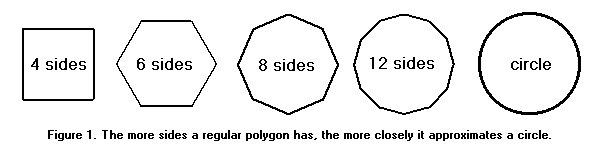
Today we have tricks that make the job even easier, but the original principle of using inscribed polygons still is the heart of the approximation.

So lets start with a square, a regular polygon of 4 sides;

It's not hard to see that the diagonals of the red square is the same as the diameters of the circle. The ratio of perimeter to the diagonal, if each side of the square is one would be:

(4/1.414)= 2.829

Note that this number is less than pi, as we would expect, since the perimeter of the square is clearly shorter than the circumference of the circle that it inscribes. This is true of any polygon inscribed in a circle. So as we add sides, we will be approaching the value of Pi from below.

Take a Hexagon incribed in a circle:
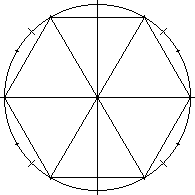
Notice in the diagram above is that the hexagon is a combination of 6 equilateral triangles. Let the sides of the equilateral triangles equal 1. From the diagram above you can see that the perimeter is 6 and the diagonal is 2 so the ratio of the diagonal to the perimeter of the hexagon is 6/2 = 3, still less than Pi = 3.1415 but getting closer.

Next let's look at an Octagon

An Octagon can be constructed out of 8 identical isosceles triangles like the one below:

And we know that angle BAC = 45° since 8 times 45° is 360° (one rotation). Let AB and AC equal 1. This tells us two things, it says that the diagonal of our octagon is equal to 2. It also allows us to calculate length BC, which in turn will tell us the perimeter (8 x BC).

Using the Law of Cosines on our isosceles triangle:

We get BC = √((1)2 + (1)2 -2(1)(1)Cos(45º)) = √(2-1.414) = .7653

Thus the perimeter of the Octagon is .7654 x 8 = 6.1232

And the ratio of the Perimeter to the Diagonal is 6.1232 / 2 = 3.0616

We're getting closer. We should note that for ANY even sided polygon (6-sided or larger) the above procedure could be used, with only the angle BAC and the number of times the line segment BC is multiplied changing. For instance:

A Hexacontagon (60 sided polygon) could be constructed out of 60 isosceles triangles. Each triangle would have an apex angle of 6º (60 x 6 = 360). Again we let the two equal sides of the isosceles triangles equal 1 and use the law of cosines to find the other side (which corresponds to a Hexacontagon side) is equal to .1046719. Multiply by 60 and we get 6.2803, which when divided by the diagonal 2 will give you 3.1402, which gets us much closer to pi.

How about a 36000 sided polygon? That's .01º or sides of 6.28318529 which when divided by the diagonal (2) gives 3.141592649, where pi is actually 3.14159265. Clearly as we add numbers of sides, we get closer and closer to the value of pi.

There are a ton of great links out there for this:

Nova Approximating Pi

A Piece of Pi

Joy of Pi

And of course (what would I do without it) Wikipedia

Reply

Interested in this topic? By joining CR4 you can "subscribe" to
this discussion and receive notification when new comments are added.
Commentator

Join Date: Sep 2006
Posts: 89
#1

Re: How to Calculate Pi with Polygons

10/17/2006 1:04 AM

Very interesting! How do you calculate the cubic capacity of a cone??

Reply
Guru

Join Date: Aug 2005
Location: Hemel Hempstead, UK
Posts: 5826
Good Answers: 322
#3
In reply to #1

Re: How to Calculate Pi with Polygons

10/17/2006 4:20 AM

Pir2h/3

It's one third of the volume of the cylinder of same diameter and height. Interestingly, just like a triangle, it doesn't actually matter (for the volume) which point on the top surface of the cylinder you subtend the points from the bottom circle to.

__________________
If you spend all your time looking for people and things to complain about: trust me, you will find plenty to complain about.
Reply
Anonymous Poster
#4
In reply to #3

Re: How to Calculate Pi with Polygons

10/17/2006 8:56 AM

A little fun; how do you calculate the cubic capacity of a pizza slice with radius z and height a?

Reply
Associate

Join Date: Mar 2006
Location: Ford Motor Company, Turkey
Posts: 26
#2

Re: How to Calculate Pi with Polygons

10/17/2006 2:24 AM

This is a great blog, Roger. It's a shame I saw it now. You select the most elegant proofs and equations.

The history of pi is really astonishing. People tried to find it all their lives and some even had it written on their tombstones. Now, there are groups as "Memorizing first 1000 digits of pi", and "Memorizing first 100 digits of pi" (amateurs).

Some used series expansions for pi, but the expansion used was really important because with one series it took 2 days of calculation, but the other made you spend your whole life to get to the same approximation. Some even had probabilistic experiments. (I read that the probability of a needle dropped from some height to hit one of the identical needles located below at same distance as the needle is 1/pi, but don't ask me how).

Many hoax news in the 19th century existed. People came up and claimed that pi is not irrational and is actually 3.20 and had supporters too.

Pi even had a political aspect. In the WW2, a German mathematician desribed pi as the value sine vanishes, it was not found "a sufficiently German" description for pi.

Finally, the approximation 22/7 goes back to Archimedes, and is the first time in the history of maths that an inequality appeared. (don't remember)<pi<22/7

These things I remember from a report I prepared when I was in high-school, some 6 years ago, so some might be a product of my failing memory. But, really incredible how squaring the circle problem evolved.

__________________
Science is the belief in the ignorance of the experts. Richard Feynman
Reply
Power-User

Join Date: Jun 2005
Posts: 394
Good Answers: 1
#5
In reply to #2

Re: How to Calculate Pi with Polygons

10/17/2006 10:45 AM

Cylindrical storage tank mounted on its side. End caps are slices of sphere with radius rc and thickness c. h gives the height of the fluid in the tank.

The volume of fluid in the cylindrical portion is given by the following formula:

(pir2/2 – (r-h)(2hr-h2)1/2 – r2 arcsin((r-h)/r))L

(there is a somewhat simpler formula using arc-cos, but I don't have it right now)

what would be the formula for the volume in the endcaps?

Reply
Guru

Join Date: Aug 2006
Posts: 4484
Good Answers: 246
#6

Re: How to Calculate Pi with Polygons

10/17/2006 12:08 PM

Good stuff, Roger.

I'd have to admit, though, that using trig functions in calculating pi seems like cheating. If I had no calculator, and no trig tables, then I'd have to calulate the value of the trig function, using pi. So the reasoning seems circular.

In one of the links, I was surprised to see this: "Second, we use decimal notation, which wasn't invented until hundreds of years after Archimedes' death." Given that we have ten fingers, I'd assumed that the system would have developed much earlier.

__________________
There is more to life than just eating mice.
Reply
The Engineer
Engineering Fields - Engineering Physics - Physics... United States - Member - NY Popular Science - Genetics - Organic Chemistry... Popular Science - Cosmology - New Member Ingeniería en Español - Nuevo Miembro - New Member

Join Date: Feb 2005
Location: Albany, New York
Posts: 5060
Good Answers: 129
#7
In reply to #6

Re: How to Calculate Pi with Polygons

10/17/2006 1:20 PM

Blink,

Thanks for responding.

You Wrote:

"I'd have to admit, though, that using trig functions in calculating pi seems like cheating. If I had no calculator, and no trig tables, then I'd have to calulate the value of the trig function, using pi. So the reasoning seems circular"

Excellent Point (and Pun). I'm not very good at proofs, so you're probably right. My goal was to try and present Pi in such a way so that it is more than just an number, its a concept. It think the method above provides some insight into what pi represents, and why its an irrational number. The reasoning could very well be circular ;)

You Wrote:

In one of the links, I was surprised to see this: "Second, we use decimal notation, which wasn't invented until hundreds of years after Archimedes' death." Given that we have ten fingers, I'd assumed that the system would have developed much earlier.

They had a base 10 system of counting, just no "partial numbers". Fractions were ratios, not actual numbers till much later. God only knows what those brilliant greeks could accomplish if they had all the mathematical tools we have today (infinity, coordinate systems, imaginary numbers, decimals (integers))

Some of the most intriguing stories from history recount the obsessive pursuit of many brilliant minds trying to express Pi as a ratio. You see, since Pi is irrational, it's impossible to express as a ratio. People spent their entire lives trying to solve an impossible problem. Impossible not because it was unsolvable, but impossible because the mathematical tool necessary to describe it (irrational numbers) didn't exist yet.

Reply
Guru
Technical Fields - Project Managers & Project Engineers - New Member

Join Date: Aug 2006
Location: Midwestern United States
Posts: 843
Good Answers: 76
#8
In reply to #7

Re: How to Calculate Pi with Polygons

10/17/2006 1:51 PM

In regards to the progressive "invention" or discovery of mathematical tools through time, does anyone know who and when "zero" was discovered? I would think that provided a huge leap forward from that point on. Also, would anyone care to speculate on what the next mathematical discovery might be or if we are currently trying to solve a present-day impossible problem to which we may need to invent/discover a new tool for?

__________________
Reuters - Investigators found that the recent thread derailment in CR4 was caused by over-weight creatures of lore and request that membership DON'T FEED THE TROLLS.
Reply
Power-User

Join Date: Jun 2005
Posts: 394
Good Answers: 1
#9
In reply to #8

Re: How to Calculate Pi with Polygons

10/17/2006 2:06 PM

PBS had a program about numbers. From what I recall of the show, the conventional belief is that zero was first used in the Islamic Middle East/North Africa around 700 - 800 AD. However the show demonstrated that little know in the Western World, the Hindus had a notation for zero something like a thousand years earlier. The Arabic advancements in mathematics were based on what they learned from Hindus.

Reply
The Engineer
Engineering Fields - Engineering Physics - Physics... United States - Member - NY Popular Science - Genetics - Organic Chemistry... Popular Science - Cosmology - New Member Ingeniería en Español - Nuevo Miembro - New Member

Join Date: Feb 2005
Location: Albany, New York
Posts: 5060
Good Answers: 129
#10
In reply to #8

Re: How to Calculate Pi with Polygons

10/17/2006 2:30 PM

I'm not sure what will come next, but I'm impressed by fractals, which are a brand new type of geometry. These objects appear everywhere, notably in the brain activity. I think this branch of mathematics will have a huge effect on science once we know what to use them for.

Keep in mind, fractals are shapes, like squares or cubes, but with fractional dimension. A point has zero dimension, a line has 1 dimension, a plane 2 dimensions, and so on. Fractals exist zero and 1, 1 and 2, ect. At first this seems outlandish, but no more crazy than the idea that there are numbers between 1 and 2, 2 and 3, ect.

Reply
Anonymous Poster
#11
In reply to #10

Re: How to Calculate Pi with Polygons

10/17/2006 2:59 PM

"God does not care about our mathematical difficulties. He integrates empirically."

Albert Einstein

Reply
Commentator

Join Date: Sep 2006
Posts: 89
#12
In reply to #8

Re: How to Calculate Pi with Polygons

10/17/2006 5:37 PM

There is Pi and the circle; what do you have for an oval? This is probably a no brainer, but I forgot!

Reply
Guru
Engineering Fields - Aerospace Engineering - Retired South Africa - Member - The Rainbow-nation Engineering Fields - Engineering Physics - Relativity & Cosmology Popular Science - Cosmology - The Big Picture!

Join Date: May 2006
Location: Pretoria, South Africa
Posts: 3804
Good Answers: 69
#13
In reply to #12

Re: How to Calculate Pi with Polygons

10/18/2006 10:40 AM

Quote: "There is Pi and the circle; what do you have for an oval? This is probably a no brainer, but I forgot!"

I guess it's still Pi; you just use A = Pi a b instead of Pi r2, where a and b are the semi-minor and semi-major axes of the ellipse respectively.

__________________
"Perplexity is the beginning of knowledge." -- Kahlil Gibran
Reply
Member

Join Date: Nov 2006
Location: Albany, NY
Posts: 6
#14

Re: How to Calculate Pi with Polygons

11/04/2006 2:06 PM

Hey roger,

The next number important in science, next to pi is e !!!

:)

I will be waiting for your nice presentation on that too.

Reply
Reply to Blog Entry 14 comments
Copy to Clipboard

Users who posted comments:

Anonymous Poster (2); Bayes (2); Blink (1); cameo (1); Erich (2); Howetwo (2); JavaHead (1); Jorrie (1); nabinkm (1); Randall (1)

Previous in Blog: How to Estimate Sines and Cosines without a Calculator   Next in Blog: The Inverse Square Law
You might be interested in: Squares, Metric Gears, DC-AC Inverters

Advertisement
