Roger's Equations Blog

Roger's Equations

This blog is all about science and technology (with occasional math thrown in for fun). The goal of this blog is to try and pass on the sense of excitement and wonder I feel when I read about these topics. I hope you enjoy the posts.

Previous in Blog: How to Calculate Pi with Polygons   Next in Blog: What are Integrals?
Close
Close
Close
7 comments
Rating: Comments: Nested

The Inverse Square Law

Posted October 23, 2006 1:48 AM by Bayes

To find the gravitational attraction between two objects, we use the equation:
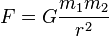
where m1 and m2 are point masses, G is the gravitational constant, and r is the distance between the two masses.

To find the electric attraction or repulsion between two objects (the coulomb force), we use the equation:

where q1 and q2 are point charges, kc is the Coulomb force consant, and r is the distance between the two charges.

To find the intensity of light a certain distance from a light source, we use the equation:

where P is the power of the light source (lightbulb, etc.) and r is the distance from the source. The same equation could be used for sound intensity.

All of the equations above have an r2 term in the denominator, why should that be?

It turns out that any point (or point like) source which spreads its influence in all directions without limit to it's range obeys the inverse square law (Hyperphysics). The reason is a force, light, sound, etc., spreads out like a growing sphere from a point source, effectively becoming diluted in space. Take a look at the image below:

In the example above, the light spreads out in all directions. Notice the further away you get from the point source, the more area the light has to cover. In general, a constant r will produce sphere centered at the point source. That means for a given r, each point on the surface of a sphere of radius r has the same intensity. If we divide the initial power of the point source by the sphere's surface area, it tells us how much that power has been "diluted" by spreading out through space. The surface area of a sphere is:

So we divide our power by 1/4πr2 and we get:

The r2 is purely a geometric consequence of the initial power being diluted by space.

Taking another look at the Coulomb Force:

Noting that the coulomb constant kc is equal to 1/4πε0 where ε0 is called the electric permeability of space, we can easily see the 1/4πr2 term. The point source in this case is the point charge, which produces an electric field. In the gravity equation:

The 1/4π appears to be missing at first glance, but it's in fact hidden in the gravitational constant G. After 300 years, don't expect to see the 1/4π pulled out of G any time soon, but rest assured it's there. The point source is the mass which produces a gravitational field.

Fun With The Inverse Square Law:

I've always been fascinated by the idea that the Sun appears smaller when seen from other planets like Mars or Saturn and bigger from Venus and Mercury. From Uranus and beyond, the Sun looks like just another star. We can calculate the intensity of the Sun on other planets as compared to Earth by using the inverse square law:

Mercury- .39 AU - 6.57x (Sun's Intensity on Earth)

Venus - .72 AU - 1.9x

Earth - 1 AU - 1

Mars - 1.5 AU - ~1/2

Jupiter - 5.2 AU - ~1/25th

Saturn - 9.5 AU - ~1/100th

Uranus - 19.2 AU - 1/300th

Neptune - 30 AU - ~1/1000th

Pluto - 39.5 AU - ~1/2000th

Sedna (at it's farthest) - 975 AU - ~one millionth

It must be cold and dark once you get past Saturn.

Here is an image of the Sun taken from the Mars Rover on Mars, notice how much smaller it looks than on Earth:

Thanks to Wikipedia for the equations and Nasa for the image above.

Reply

Interested in this topic? By joining CR4 you can "subscribe" to
this discussion and receive notification when new comments are added.
Participant

Join Date: Oct 2006
Posts: 3
#1

Re: The Inverse Square Law

10/24/2006 1:00 AM

You have posted such an intelligent view. It gave me an idea of researching on this topic. Very beautiful insite Very good thinking.

Reply
Guru
Engineering Fields - Aerospace Engineering - Retired South Africa - Member - The Rainbow-nation Engineering Fields - Engineering Physics - Relativity & Cosmology Popular Science - Cosmology - The Big Picture!

Join Date: May 2006
Location: Pretoria, South Africa
Posts: 3804
Good Answers: 69
#2

Re: The Inverse Square Law

10/24/2006 8:04 AM

Cool article Roger! Interesting to note that (as I pointed out in my blog) the negative of the slope (first derivative) of the gravitational potential

gives Newton's gravitational acceleration, which is just the force as you gave it, divided by the free-falling mass.

__________________
"Perplexity is the beginning of knowledge." -- Kahlil Gibran
Reply
Commentator

Join Date: Jan 2006
Location: Panama
Posts: 58
#3

Re: The Inverse Square Law

10/24/2006 9:46 AM

Piece of cake !!!. Roger, as humans, We are always looking for patterns, like seen a face with eyes and mouth on the car´s front side (remember Walt Disneys´s comics?) or happen to see faces on walls or faces and figures on summer clouds?

Remember A BEATIFULL MIND the movie? Things like this and your article makes me feel fine about knowing these little tricks, very usefull. The world is build into these analogies and little bricks (as fractals analogy), and knowing these can lead us very high into the sky. Keep the good work. Regards.

Luis

Reply
Guru

Join Date: Aug 2006
Posts: 4484
Good Answers: 246
#4

Re: The Inverse Square Law

10/25/2006 12:37 AM

In other threads, I've written something like what I am about to write AGAIN…

I think the Thousand Meter Solar System walk is well worth doing for anyone with even the faintest interest in astronomy, cosmology, philosophy, or faith. You'd mentioned your interest in the appearance of the sun from other planets, something which is demonstrated in an unforgettable way by taking the walk. If you start with a soccer-ball-sized sun, by the time you walk out to Pluto (that washed up wreck of a former planet!) you need binoculars to see the sun, a kilometer away. At this scale, earth is the size of a peppercorn, and if you didn't clearly mark its location, you'd never find it again on your walk back in toward the sun (even though you put the planets in a neat little line, which would make it much easier than in the real solar system). It's a great walk to do with a few kids.

__________________
There is more to life than just eating mice.
Reply
The Engineer
Engineering Fields - Engineering Physics - Physics... United States - Member - NY Popular Science - Genetics - Organic Chemistry... Popular Science - Cosmology - New Member Ingeniería en Español - Nuevo Miembro - New Member

Join Date: Feb 2005
Location: Albany, New York
Posts: 5060
Good Answers: 129
#5
In reply to #4

Re: The Inverse Square Law

10/26/2006 12:49 PM

I've never done the walk but I would like to. I'm sure it really adds nuances to your understanding of the solar system, especially in terms of size. I'm sure when you're standing at Pluto, which is probably like a spec of sand, and you look back and know that the Sun is out of view and tiny, it really drives home what a lonely cold place that planet must be.

Reply
Member

Join Date: Nov 2006
Location: Albany, NY
Posts: 6
#6

Re: The Inverse Square Law

11/04/2006 2:05 PM

Nice work Roger!!!

However, Did u list pluto as a planet?

When u posted it, pluto had already been dropped off from the list of planets:

http://news.nationalgeographic.com/news/2006/08/060824-pluto-planet.html

and one more thing I wonder is that one can not tell how small or large the object is just by looking on the picture, there should be some scale, or overlap of another pic, taken with the same scale.

Reply
The Engineer
Engineering Fields - Engineering Physics - Physics... United States - Member - NY Popular Science - Genetics - Organic Chemistry... Popular Science - Cosmology - New Member Ingeniería en Español - Nuevo Miembro - New Member

Join Date: Feb 2005
Location: Albany, New York
Posts: 5060
Good Answers: 129
#7
In reply to #6

Re: The Inverse Square Law

11/05/2006 1:13 PM

As far as I'm concerned, Pluto is still a planet. I refuse to recognize the IAU as an authority on planetary status.

Reply
Reply to Blog Entry 7 comments
Copy to Clipboard

Users who posted comments:

Bayes (2); Blink (1); Jorrie (1); llizarraga (1); nabinkm (1); xspark_hq (1)

Previous in Blog: How to Calculate Pi with Polygons   Next in Blog: What are Integrals?

Advertisement
