Previous in Forum: Check The Error On The Multitek Energy Meter For 4000A DB   Next in Forum: The Input Rating and also Three Phase Power Supply
Close
Close
Close
27 comments
Rate Comments: Nested
Power-User

Join Date: May 2013
Posts: 351
Good Answers: 22

Challenge: Control of Latching Relay (Contactor)

04/13/2015 8:51 AM

Background: I have a large need for power on a pickup with a pop-up camper on it. My wife and I have both been required to use CPAP type machines and we like to camp away from others (as in no where near a plug in electrical supply) I removed the old Lead acid batteries and now have an adequate number of LiFePO4 cells to install. However, since these will not be readily accessible and cost dearly (Thousands not Hundreds of US dollars) I would like to protect my investment. At the same time I wanted to keep the price down as much as possible. I choose a MINIBMS to look at individual cell voltages and provide alarm and isolation should a problem occur on a cell pack. At this time I am involved in my moving my Church to a temporary location for beginning of construction on a new building and am short on time to design circuits.

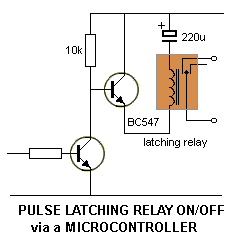
Question: The problem is that the MINIBMS is designed to provide a constant 12 volt output (sinking) if the cells are good and drop that if a cell drops below a safe value or goes above a safe value during charging. Also included is an alarm circuit for high or low cell volts that outplut separate sinking outputs. (It also has a limited amount of balancing action during charging that is not important here) Applying a conventional relay contactor would present a constant load on the batteries which is not acceptable to me. I would like to use a Latching relay and found one that will provide the needed capability. It has 2 coil terminals which need a short pulse to set or trip the relay. The polarity must be reversed to unlatch the relay. I would like to take the constant output of the MINIBMS when it first starts to latch the relay and then drop that out and then if a problem occurs, take either the loss of output from the MINIBMS and create a pulse in the opposite direction to unlatch the relay or to use the alarm output to unlatch the relay While i can think of a number of possibilities, I would like any suggestions of the type of circuit(s) to pursue.

Register to Reply
Interested in this topic? By joining CR4 you can "subscribe" to
this discussion and receive notification when new comments are added.

"Almost" Good Answers:

Check out these comments that don't yet have enough votes to be "official" good answers and, if you agree with them, vote them!
Guru

Join Date: Mar 2007
Location: by the beach in Florida
Posts: 33392
Good Answers: 1817
#1

Re: Challenge: Control of Latching Relay (contactor)

04/13/2015 9:53 AM
__________________
All living things seek to control their own destiny....this is the purpose of life
Register to Reply Score 1 for Good Answer
Power-User

Join Date: May 2013
Posts: 351
Good Answers: 22
#2
In reply to #1

Re: Challenge: Control of Latching Relay (contactor)

04/13/2015 7:02 PM

I have been through all of the suppliers documentation. Also websites of user groups that apply the product. The question I am asking goes beyond that.

Register to Reply
Guru

Join Date: Mar 2007
Location: by the beach in Florida
Posts: 33392
Good Answers: 1817
#3
In reply to #2

Re: Challenge: Control of Latching Relay (contactor)

04/13/2015 7:23 PM

What question? I think the links I provided cover every aspect, including how to monitor and control the battery pack via cell phone....

__________________
All living things seek to control their own destiny....this is the purpose of life
Register to Reply
Power-User

Join Date: May 2013
Posts: 351
Good Answers: 22
#4
In reply to #3

Re: Challenge: Control of Latching Relay (contactor)

04/13/2015 7:54 PM

The question is to take an output from the House Power Board which is 12 volts with a sinking contact to ground and provide a pulse to close a latch relay but remove the 12 volts from the coil. Then when the sinking contact was no longer there, but the 12 volts was, to provide a negative pulse on the latch relay to trip the contacts. Their equipment is designed to be used with a conventional relay contactor which has a coil energized all the time when there is no problem on the battery. This represents a constant drain on the battery which is not acceptable to me. The few miliamps drain of the board is acceptable, but not a relay coil. Besides, most brands of the 100 or200 amp conventional relays have a very high failure rate when continuously energaize which I fin unacceptable.

You went into some of their products which are not applicable in my case. I am not building an electric car which will be used every day. This is a camper 12 volt auxillary supply which will be used intensly at times but at other times may sit without use.

Register to Reply
Guru

Join Date: Mar 2007
Location: by the beach in Florida
Posts: 33392
Good Answers: 1817
#5
In reply to #4

Re: Challenge: Control of Latching Relay (contactor)

04/13/2015 8:34 PM
__________________
All living things seek to control their own destiny....this is the purpose of life
Register to Reply
Guru

Join Date: Aug 2014
Location: Port Macquarie N.S.W. Australia
Posts: 1071
Good Answers: 225
#7
In reply to #5

Re: Challenge: Control of Latching Relay (contactor)

04/13/2015 10:46 PM

That circuit still has the relay coil energised, it is not a mechanical latch as the OP requires.

Register to Reply
Guru

Join Date: Mar 2007
Location: by the beach in Florida
Posts: 33392
Good Answers: 1817
#17
In reply to #7

Re: Challenge: Control of Latching Relay (contactor)

04/14/2015 10:11 AM

Like this?

__________________
All living things seek to control their own destiny....this is the purpose of life
Register to Reply
Power-User

Join Date: May 2013
Posts: 351
Good Answers: 22
#14
In reply to #5

Re: Challenge: Control of Latching Relay (contactor)

04/14/2015 9:16 AM

Doesn't this do the exact opposite of what I want. I am trying to produce the pulse to control a latched relay, not create a latched relay. What i want is a positive pulse when the 12 volt output is started and a negative pulse when the 12 volt output is stopped.

Register to Reply
Guru

Join Date: Oct 2009
Posts: 1460
Good Answers: 30
#9
In reply to #4

Re: Challenge: Control of Latching Relay (contactor)

04/14/2015 5:16 AM

The question is really why you want to do it with lithium cells at all. The power consumption of conventional CPAP machines is only a few watts. Replacing previous tired lead-acid batteries with a new deep-discharge battery or two would give you a perfectly adequate power supply without any worries about a special charger.

Register to Reply
Guru

Join Date: Aug 2014
Location: Port Macquarie N.S.W. Australia
Posts: 1071
Good Answers: 225
#10
In reply to #9

Re: Challenge: Control of Latching Relay (contactor)

04/14/2015 5:22 AM

You generally don't require a special charger for LiFePo4 cells. Even an old bulky transformer type will do the job. The cells just require careful management of their individual charge and discharge voltage levels.

Register to Reply
Guru

Join Date: Oct 2009
Posts: 1460
Good Answers: 30
#11
In reply to #10

Re: Challenge: Control of Latching Relay (contactor)

04/14/2015 5:32 AM

If you don't use LiFePo4 cells you don't need careful management of their individual charge and discharge voltage levels either.

Register to Reply
Guru

Join Date: Aug 2014
Location: Port Macquarie N.S.W. Australia
Posts: 1071
Good Answers: 225
#12
In reply to #11

Re: Challenge: Control of Latching Relay (contactor)

04/14/2015 8:44 AM

That's true, but the OP hasn't told us the capacity of his LFP battery, or for how long he wishes to stay off the grid, or the Ah requirements of his 2 x CPAPs (this will vary depending on pressure settings and if a humidifier is included), but would be somewhere between 3 amps and 7 amps per machine, so 50 - 110Ah per night for both machines is not unreasonable.

This would require a lead acid capacity of between 200Ah to 500Ah down to 50% DOD (12.1v) for just one night without any reserve for lighting etc., and then they would require a 50 amp charger running all day to recharge them for the next night, and they would still not be fully charged and would get progressively flatter with each discharge/charge cycle. So we don't really know how much capacity he requires between charges.

By comparison, that maximum 14 amps/hr for 8 hours plus allowance for other loads could easily be accommodated by an LFP battery of just 200 Ah capacity and less than one quarter the weight. It could still supply that load for another 6 hours before the terminal voltage got down to 12v.

Then there is the recharge rate to consider.

Due to the fact that LFP batteries will accept just about any amount of charge current that you can throw at them, they will charge far more rapidly than LAs, so he will run his charger for far less time to recharge when needed, a 50 amp charger would do the job in around 4 hours.

LFPs have an energy density roughly 4 times that of LAs, weigh around a quarter as much for the same usable watt hours, are less sensitive to temperature, and have a lower average cost per cycle over the life of the battery. A 100Ah LFP battery can replace a 250Ah SLA battery for the same energy output and comparable cycle life.

A 100Ah VRLA battery if discharged at the 10 hour rate (10 amps) would drop below 12 terminal volts in around 4 hours and below the 11.5v safety disconnect voltage of most inverters in about 7 hours. A 100Ah LFP battery discharged at the same rate will still be above 12v at 9 hours and safety disconnect would occur about an hour later.

My view is that he's made a wise choice going with LiFePo4. When it comes to deep cycle requirements, LA is Jurassic era technology.

Register to Reply
Guru

Join Date: Oct 2009
Posts: 1460
Good Answers: 30
#19
In reply to #12

Re: Challenge: Control of Latching Relay (contactor)

04/14/2015 11:49 AM

I see what you are trying to say, but you will have to help me with the details. Let us take your 7 amps for each CPAP machine for an 8 hour night and neglecting the lighting for the moment, that is 140Ah of consumption. Are you saying that the maximum rate of charge is an average of only about 10A which needs to be maintained for 16 hours?
I note that the battery provide by one CPAP machine manufacturer is a small lead-acid device.

Register to Reply
Power-User

Join Date: May 2013
Posts: 351
Good Answers: 22
#20
In reply to #19

Re: Challenge: Control of Latching Relay (contactor)

04/14/2015 2:02 PM

CPAP machines vary greatly in power usage by manufacturer and user. For what it's worth, my total electrical consumption is jutst a little over 100 volt amps per day and I will be providing a total of 300 amp hours to allow for about 3 or more days of camping without solar charge operating. If we have solar charging we can camp as long as we care. The other use, when it is very hot and humid is the air conditioner but we will limit that to when we first lay down.

Register to Reply
Guru

Join Date: Aug 2014
Location: Port Macquarie N.S.W. Australia
Posts: 1071
Good Answers: 225
#25
In reply to #20

Re: Challenge: Control of Latching Relay (contactor)

04/14/2015 6:20 PM

Are you sure of that figure?

100VA per day at 12.8v is just 7.8 amp hours. If you used both of your CPAPs and nothing else for 8 hours per 24 hour period, they must be drawing an average of less than 500mA each.

I repair these things and have never seen one with that low a figure, so please tell me more.

Register to Reply
Power-User

Join Date: May 2013
Posts: 351
Good Answers: 22
#27
In reply to #20

Re: Challenge: Control of Latching Relay (contactor)

04/15/2015 12:03 AM

I will correct the information. It should have been 100 Amp-Hours per day, at 13.2 volt or 1.32 KVA per day. Sorry for the incorrect term, I got sloppy. I am so used to working in GW or GVA that these small power levels get strange errors.

Register to Reply
Guru

Join Date: Aug 2014
Location: Port Macquarie N.S.W. Australia
Posts: 1071
Good Answers: 225
#26
In reply to #19

Re: Challenge: Control of Latching Relay (contactor)

04/14/2015 7:17 PM

If we are talking about charging lead acid house batteries from the vehicle alternator, then a few factors come into play.

1. If it is an older vehicle without computer controlled charging, then the alternator field is controlled by the detected voltage of the start battery via the voltage regulator. The start battery will have rested overnight and will be essentially at 12.5v or more and will rapidly rise to the output voltage of the alternator when the engine is started.

The start battery voltage being high will cause the regulator to reduce its output to just sufficient to run the electrics of the vehicle, it does this by sensing the battery voltage as being high, turning charge off, sensing the drop in battery voltage as items consume energy, and then turning back on again, it does this repeatedly, it is a constant voltage device. The regulator is designed to limit battery voltage to a level that won't cause gassing of the battery electrolyte during long periods of driving, and so will normally only charge the battery to around 70 - 80% SOC maximum no matter the length of drive time.

The connected house battery SOC will rise only slowly and, apart from an initial surge in current, will be lucky to get an average of even 10 amps from a vehicle alternator no matter what the alternator is capable of delivering. At the end of the day the house batteries will still be less than fully charged.

2. If it is a modern vehicle with computer controlled alternator charging then it gets even worse as they limit the charge voltages to such low levels - often below 13.5v - that any voltage drop in the wiring to the house battery will prevent their terminal voltage from rising to a point where charging could even begin. A lead acid battery will not even begin to charge if the applied voltage is less than 2.15 volts per cell -that's 12.9v for a 12v battery. This is the reason that DCDC inverter chargers are becoming so popular in RVs.

The fact is that lead acid chemistry is slow to charge, its terminal voltage will rise fairly rapidly (that's what turns the alternator off) but the absorption of charge into the chemistry is slow, it can easily take more than 16 hours to attain full charge even when using a constant current charger, here is a website that may give you more information on the subject.

The small battery that is supplied by the manufacturer is not intended to support a small CPAP machine (2 - 3 amps, low pressure and no humidifier) for more than 8 - 10 hours before requiring a full recharge that can take another 16 hours to achieve.

Register to Reply
Power-User

Join Date: May 2013
Posts: 351
Good Answers: 22
#15
In reply to #9

Re: Challenge: Control of Latching Relay (contactor)

04/14/2015 9:38 AM

Quote: The question is really why you want to do it with lithium cells at all. The power consumption of conventional CPAP machines is only a few watts. Replacing previous tired lead-acid batteries with a new deep-discharge battery or two would give you a perfectly adequate power supply without any worries about a special charger.

My Lead-Acid were not tired and I am smart enough to measure the load of the CPAP machines before adding that to of my existing loads of which I am well aware. I know my present pattern of camping and recharging capability and have no more space to add more lead acid batteries. I have another camping vehicle for use when I am not in the backcountry that I have already converted to Lithium that has a much larger electrical system. This was done a number of years ago and I have already recovered the cost of the lithium batteries on that vehicle by the increased life of the lithium. I have been well pleased with that system except for the battery monitor circuit which had a failure on initial installation and a conventional contactor relay which failed in the first year. That system runs "bare" with no protection at the present time, but I monitor it frequently with a meter and have had no problems.

The reason for the BMS on this unit is that the batteries are located in a hidden area and the camper must be removed to gain access. I will have access to individual cell voltages from which I could do some additional cell balancing (beyond that provided by the MINIBMS) if I had to.

i really do not expect problems on the batteries and if I do, it will be far less than a lead-acid battery in my experience.

What I need is to provide control for the latched relay that will disconnect power if a problem comes up.

Register to Reply
Guru

Join Date: Aug 2014
Location: Port Macquarie N.S.W. Australia
Posts: 1071
Good Answers: 225
#6

Re: Challenge: Control of Latching Relay (contactor)

04/13/2015 9:57 PM

Most BMSs only disconnect the load during an LVC event to protect against cell reversal, they generally only disconnect the charge circuit for an HVC event.

Rather than using a relay, have you considered a simple enhancement mode N channel Mosfet switching circuit with inverter input? It will switch on whenever the gate is connected to ground, thereby faithfully reacting to the BMS signals, and the resultant current drain will be only what is drawn by the load. There are plenty available that would carry the current with suitable heat sinking.

If you really want to go with the relay then a monostable multivibrator circuit will give you a one shot pulse to energise the relay and allow latching, and a second circuit would provide a pulse for releasing the relay but, unless you can physically separate the 2 coil winding connections on the relay so that they can operate independently, you would also need to include a polarity reversing circuit.

When you state that you have removed the old LA batteries, does this include the engine starting battery?

If so, and your pack goes open due to cell LVC, you may not be able to start the engine to begin recharging. Most BMSs will allow a temporary reset to allow charging to begin, but, depending on pack capacity, it may not accommodate the high drain that a starter can inflict on the now deeply discharged cells. It may be prudent to have a dedicated starting battery.

Register to Reply
Power-User

Join Date: May 2013
Posts: 351
Good Answers: 22
#16
In reply to #6

Re: Challenge: Control of Latching Relay (contactor)

04/14/2015 9:53 AM

Quote: If so, and your pack goes open due to cell LVC, you may not be able to start the engine to begin recharging. Most BMSs will allow a temporary reset to allow charging to begin, but, depending on pack capacity, it may not accommodate the high drain that a starter can inflict on the now deeply discharged cells. It may be prudent to have a dedicated starting battery.

Starting the engine is not a problem, that is a separate vehicle battery. This is the "House" batteries that I am talking about. Push button reset switches can be used for resetting both the BMS and could be also used to trigger the latched relay if necessary and charging would always be available from the vehicle alternator or the solar panels. I really never expect to have any problems with the batteries. The various BMS devices provide most of the problems on Lithium batteries and for that reason, my installation will have easily removable connections to disable the protection circuit if the BMS should fail and the batteries are still good. The BMS is less than ten percent of the cost of the batteries and that sounds like reasonable insurance cost.

Register to Reply
Guru

Join Date: Dec 2010
Location: North West England
Posts: 1170
Good Answers: 153
#8

Re: Challenge: Control of Latching Relay (Contactor)

04/14/2015 4:57 AM

Why not charge a capacitor to create a +pulse at switch on, and discharge the capacitor to create a -pulse on switch off?

Register to Reply
Power-User

Join Date: May 2013
Posts: 351
Good Answers: 22
#13
In reply to #8

Re: Challenge: Control of Latching Relay (Contactor)

04/14/2015 9:11 AM

Quote: Why not charge a capacitor to create a +pulse at switch on, and discharge the capacitor to create a -pulse on switch off?

Now someone is getting to close to a reasonable answer. I was thinking along the line of an LRC circuit using the inductance of the coil in the relay to do something similiar but i was also thinking that the size of the capacitor could be reduced using solid state switching transistors also and provide a cleaner pulse that could be tuned more easily.

Register to Reply
Guru
Engineering Fields - Electrical Engineering - New Member Fans of Old Computers - Commodore 64 - New Member Popular Science - Evolution - New Member United States - Member - New Member

Join Date: Oct 2013
Location: Illinois, 7 county region (The 'blue dot' that drags the rest of the 'red state' around during presidential elections.)
Posts: 3683
Good Answers: 89
#18

Re: Challenge: Control of Latching Relay (Contactor)

04/14/2015 11:38 AM

There's a bit of text in the original post people may be missing:

"My wife and I have both been required to use CPAP type machines and we like to camp away from others (as in no where near a plug in electrical supply)"

CPAP - Continuous Positive Airway Pressure

4wsilver and his wife both require medical gear to insure they do not suffocate to death during the night (or require it 24/7, I'm not sure of the details), and they like to go camping in areas where the battery system in their camper will be the only thing keeping them from not seeing tomorrow.

"I removed the old Lead acid batteries and now have an adequate number of LiFePO4 cells to install. However, since these will not be readily accessible and cost dearly (Thousands not Hundreds of US dollars) I would like to protect my investment."

He's upgrading the camper's electrical system to handle the new load, a well-thought-out plan...

"At the same time I wanted to keep the price down as much as possible."

...with a potential fatal flaw, if you'll pardon the morbid analogy. If something goes wrong because of the 'low cost' design restriction, 4wsilver will be gambling with not only his own life, but with Mrs. 4wsilver as well.

And here we have an interesting bit of info.

"At this time I am involved in my moving my Church to a temporary location for beginning of construction on a new building and am short on time to design circuits."

4wsilver has a split in focus right now: upgrading his camper AND helping his Church move.

I would recommend that 4silver focus first on the Church move, and then, when he is able to step back from that project, work on the camper upgrade with his full focus. He may lose part of the camping season, but it's better than making the Park Ranger call the coroner to pick him and the Mrs. up because the hastily designed (and likely hastily built) protection circuit failed during the night.

I would also strongly recommend that 4wsilver consult with someone who has had actual experience with installing and maintaining life support equipment (a category of which CPAP is a member) in campers and RVs. The stake involved just seems too high to trust to a gamble on DIY work. I keep getting this horrible scenario playing in my head as I type this: 4wsilver waking in the middle on the night, gasping for air because the CPAPs have lost power. He manages to get the system back online, but when he checks on the Missus ... she wasn't strong enough to hold out that long. After the loneliest drive ever from the campsite, he checks on the camper's electrical system, and finds that it was his DIY circuitry that was the weak link.

__________________
( The opinions espressed in this post may not reflect the true opinions of the poster, and may not reflect commonly accepted versions of reality. ) (If you are wondering: yes, I DO hope to live to be as old as my jokes.)
Register to Reply
Power-User

Join Date: May 2013
Posts: 351
Good Answers: 22
#21
In reply to #18

Re: Challenge: Control of Latching Relay (Contactor)

04/14/2015 2:08 PM

CPAP machines improve your health, but you do not die if they quit. Like many others, we probably needed them long before the doctor got on our case. Since using them, and finally getting over some sleepless nights, we have been more full of energy, and are thinking more clearly. But if it quits, it is not life-threatening. I have more issues that are and we had a man with the same issues die within 20 feet of the front of our camper once. It happens, everyone dies someday. No reason to panic over it.

Register to Reply
Guru
Engineering Fields - Electrical Engineering - New Member Fans of Old Computers - Commodore 64 - New Member Popular Science - Evolution - New Member United States - Member - New Member

Join Date: Oct 2013
Location: Illinois, 7 county region (The 'blue dot' that drags the rest of the 'red state' around during presidential elections.)
Posts: 3683
Good Answers: 89
#22
In reply to #21

Re: Challenge: Control of Latching Relay (Contactor)

04/14/2015 3:04 PM

Ah, I understand now, at least I think I do. I had assumed that a 'pressurized breathing apparatus' was the modern version of the old 'iron lung.'

As for the 'no reason to panic,' that's the part I may only think I understand. I think I know what you mean, by guessing at the point of view from where you are along The Road, but I won't be sure until I get that far down my own Road and see for myself.

__________________
( The opinions espressed in this post may not reflect the true opinions of the poster, and may not reflect commonly accepted versions of reality. ) (If you are wondering: yes, I DO hope to live to be as old as my jokes.)
Register to Reply
Guru

Join Date: Mar 2007
Location: by the beach in Florida
Posts: 33392
Good Answers: 1817
#23
In reply to #22

Re: Challenge: Control of Latching Relay (Contactor)

04/14/2015 4:25 PM

This machine helps you to get a good nights sleep when you get past 60...It keeps you from waking up every few hours...Most anybody that snores or has restricted breathing could benefit from it's use though....

__________________
All living things seek to control their own destiny....this is the purpose of life
Register to Reply
Guru

Join Date: Aug 2014
Location: Port Macquarie N.S.W. Australia
Posts: 1071
Good Answers: 225
#24
In reply to #18

Re: Challenge: Control of Latching Relay (Contactor)

04/14/2015 5:59 PM

That's not the case at all.

As one of my numerous "retirement" sidelines I repair CPAP machines for a local supplier, the parts can take a week or more to arrive, and I haven't had anyone die while waiting yet. They certainly don't sleep so well but they don't die.

Contrary to popular belief, although they are the largest demographic of users, the need for these devices is not restricted to elderly folk. One of the machines that I repaired recently was for a 30 something year old lady.

Register to Reply
Register to Reply 27 comments

"Almost" Good Answers:

Check out these comments that don't yet have enough votes to be "official" good answers and, if you agree with them, vote them!
Copy to Clipboard

Users who posted comments:

4wsilver (9); adreasler (2); jhhassociates (1); phph001 (3); SolarEagle (5); spades (7)

Previous in Forum: Check The Error On The Multitek Energy Meter For 4000A DB   Next in Forum: The Input Rating and also Three Phase Power Supply

Advertisement