Previous in Forum: API Bubbles   Next in Forum: Emergency Generator
Close
Close
Close
11 comments
Rate Comments: Nested
Power-User

Join Date: Apr 2011
Posts: 104
Good Answers: 5

Low Voltage on a Motor

08/07/2016 7:32 PM

I have a 7.5 HP, 460 VAC, 3500 rpm motor. Rated 10.6Amps and is a continuous duty rating. It is connected to a generator and used for fuel pumping. It runs at about half load most of the time. My question is concerning this motor when the generator is loaded up and the generator voltage drops. I was not able to get a current reading at the time, but the voltage to the motor dropped to 380 V. It seemed to be pumping fuel okay but i wanted to know what other effects this voltage drop had on the motor.

__________________
deanpavil
Register to Reply
Interested in this topic? By joining CR4 you can "subscribe" to
this discussion and receive notification when new comments are added.

Good Answers:

These comments received enough positive votes to make them "good answers".

"Almost" Good Answers:

Check out these comments that don't yet have enough votes to be "official" good answers and, if you agree with them, vote them!
Guru

Join Date: Apr 2010
Location: About 4000 miles from the center of the earth (+/-100 mi)
Posts: 9912
Good Answers: 1141
#1

Re: low voltage on a motor

08/07/2016 8:05 PM

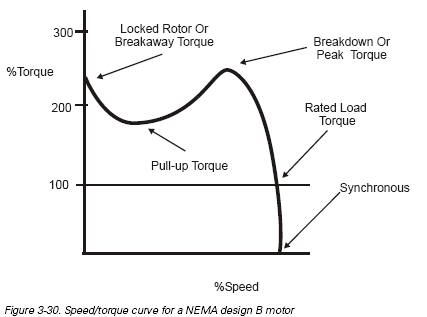
Motor torque, I believe, is proportional to the voltage squared, everything else being equal.

http://www.gohz.com/relationship-between-induction-motor-voltage-and-current

But that's not the whole story. If the voltage drops and the motor doesn't produce enough torque to drive the load, it will slow down. A characteristic of induction motors is that the torque increases as the motor speed slows down (within reason). It's termed a higher slip rate.

So, as long as the voltage does not drop too low, the motor will slow down until the motor torque equals the torque demanded by the load.

Register to Reply
4
Guru
United States - Member - New Member Engineering Fields - Power Engineering - New Member

Join Date: Sep 2006
Location: California, USA, where the Godless live next door to God.
Posts: 4665
Good Answers: 804
#2

Re: Low Voltage on a Motor

08/07/2016 9:34 PM

It's the Peak torque that varies by the cube of the voltage change, running torque varies the same as the voltage change. But it is the Peak torque that the motor used to re-accelerate a step change in load. So what rixter said still holds true, you are much more likely to have the motor slip back into where it stalls when the voltage is low.

If it is a centrifugal pump however, the load on the pump drops at the CUBE of the speed change. So if your pump loses running torque and slows down, the pump is shedding load on the motor at the same time, at a rate faster than the motor is losing torque. So until the motor torque drops all the way down to being below the load torque requirements, you may never even notice.

This is by the way is how some of the "energy savers" function, because as you teduce the voltage, you reduce the magnetic losses in the motor. It's not as much as their over blown claims are, but there is a small amount of savings.

__________________
** All I every really wanted to be, was... A LUMBERJACK!.**
Register to Reply Good Answer (Score 4)
Guru

Join Date: Apr 2010
Location: About 4000 miles from the center of the earth (+/-100 mi)
Posts: 9912
Good Answers: 1141
#3
In reply to #2

Re: Low Voltage on a Motor

08/08/2016 8:18 AM

Good Answer.

Register to Reply
Power-User

Join Date: Apr 2011
Posts: 104
Good Answers: 5
#4

Re: Low Voltage on a Motor

08/08/2016 8:23 AM

thanks that was what i was looking for.

__________________
deanpavil
Register to Reply
Guru

Join Date: Nov 2010
Location: Virginia, Georgia, Idaho
Posts: 1079
Good Answers: 30
#5

Re: Low Voltage on a Motor

08/08/2016 10:35 PM

An electric motor connected to a generator that runs a pump? I am no PE, as all of you know, but is that the best way to power a 7.5 HP max pump? Why not just power the pump with the motor?

__________________
PFR Pressure busts pipes. Maybe you need better pipes.
Register to Reply
Guru
United States - Member - New Member Engineering Fields - Power Engineering - New Member

Join Date: Sep 2006
Location: California, USA, where the Godless live next door to God.
Posts: 4665
Good Answers: 804
#6
In reply to #5

Re: Low Voltage on a Motor

08/09/2016 12:46 AM

Good point, but it's likely a larger generator used for the entire facility, not just this one pump. So when the generator gets loaded up by OTHER things in the facility, it drops the voltage to this pump. Not too uncommon of an issue.

__________________
** All I every really wanted to be, was... A LUMBERJACK!.**
Register to Reply
Guru

Join Date: Oct 2009
Location: sometimes Wales,UK.. was Libya, now Oman!
Posts: 1715
Good Answers: 117
#7

Re: Low Voltage on a Motor

08/09/2016 12:56 AM

are you not concerned as to why the gen set voltage is dropping?

__________________
The square root of nothing is what you make it!
Register to Reply
Commentator

Join Date: Nov 2015
Location: England
Posts: 86
Good Answers: 1
#8

Re: Low Voltage on a Motor

08/09/2016 4:42 AM

We had a similar issue with voltage when an electrical engineer replaced our mains incomer transformers, down sizing for more efficiency and reducing the voltage from 240V single phase to 220V without telling us, over the first couple of months all sorts of odd motor failures occurred. Eventually we traced most to pump motors running under voltage and drawing higher current leading to higher working temperatures in the windings resulting in insulation breakdown failures. Once found we retapped all surviving motors to run on the reduced voltage with no further failures thus far, though we know the thermal stresses are likely to have reduced the remaining life of the windings.

Register to Reply Score 1 for Good Answer
Guru

Join Date: Oct 2006
Location: 44.56024"N 15.307971E
Posts: 8277
Good Answers: 270
#9

Re: Low Voltage on a Motor

08/09/2016 6:16 AM

The motor interprets the voltage drop as an increase in load,and the rotor lags,or slips

as if it was loaded.

This will result in overheating of the motor and premature failure.

Heat is the number one enemy of electrical motors,and is accumulative...it cannot be

reversed.

Check your motor amps and you will see that they have increased beyond the name plate rating.

__________________
"A man never stands so tall as when he stoops to help a child." "Never argue with a stupid person.They will drag you down to their level and beat you with experience" "To create an apple pie from scratch, first you must create a universe"
Register to Reply
Guru

Join Date: May 2016
Posts: 1746
Good Answers: 87
#10

Re: Low Voltage on a Motor

08/09/2016 11:20 AM

The motor and pump will operate on the pump characteristic curve. For any given rpm, the pump will require a certain hp to deliver the flow rate from the characteristic curve.

The motor will draw the wattage required to deliver the required hp to the pump.

To deliver the required power, the motor will draw more amps to maintain the wattage. If the voltage drops from 440 to 380, then current will go from 5.3amps (50% load) to 6.1 amps to maintain the wattage, provided the frequency of the power is maintained.

I can't see that a 6.1 amp draw on a 10.6 amp rated motor should necessarily be a problem. Induction motors draw power based on the load that is applied to the motor. The only issue might be heating in the rotor of the motor due to the higher current, but I would expect the greatest issue would be on startups when you have higher load due to inrush and bringing the motor up to speed under load.

Register to Reply
Guru
United States - Member - New Member Engineering Fields - Power Engineering - New Member

Join Date: Sep 2006
Location: California, USA, where the Godless live next door to God.
Posts: 4665
Good Answers: 804
#11

Re: Low Voltage on a Motor

08/09/2016 11:54 AM

Back to the "Why is the voltage dropping" issue, another concern that should be explored is if the extreme loading that is causing the voltage drop is balanced or not. I would suspect not, because the fact that it happens at all indicates a general lack of attention to details.

So if the voltage is not only low, but also UNBALANCED, there might be significant "negative sequence current" that will cause extra heating of the motor regardless of the fact that the running amps are still below the nameplate rating. If so, most cheap simplistic OL relays will not pick that up in time to protect the motor windings. You may want to invest in a good solid state OL relay with phase current imbalance protection or a separate voltage imbalance relay that will drop the motor starter off line of that happens. If using current imbalance, set to no more than 30%, less is better. If using voltage imbalance, set it to 5%.

__________________
** All I every really wanted to be, was... A LUMBERJACK!.**
Register to Reply
Register to Reply 11 comments

Good Answers:

These comments received enough positive votes to make them "good answers".

"Almost" Good Answers:

Check out these comments that don't yet have enough votes to be "official" good answers and, if you agree with them, vote them!
Copy to Clipboard

Users who posted comments:

brich (1); deanpavil (1); HiTekRedNek (1); Jpfalt (1); JRaef (3); Neiljohn (1); PFR (1); Rixter (2)

Previous in Forum: API Bubbles   Next in Forum: Emergency Generator

Advertisement