Previous in Forum: Correct Delta Connection   Next in Forum: Harmonics & Mitigation, Power Factor, Damage from Harmonics and Power Costs
Close
Close
Close
20 comments
Rating: Comments: Nested
Active Contributor

Join Date: Nov 2016
Posts: 16

Open Loop Poles That Are Not There?

11/30/2016 3:38 PM

I have a simple open loop transfer function of a system. It comes from an example problem in the Ogata Controls books on page 343

Example 6.10

The book tells us we have an open loop transfer function of the following

Obviously there is an unknown variable k in the transfer function

The example then goes on to say that the closed loop transfer function is the following

The CLOSED loop tf has the following characteristic equation.

Ok fine also no surprise if you go out and do the math.

They then take this thing which is the denominator of the closed loop transfer function and say Now divide by the sum of the terms not involving k and you will arrive at the following

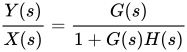
So now we can see that they have arranged the denominator of a closed loop TF in the standard form for unity feedback of G/1+G where G is the feedforward TF

Obviously the idea was to get the unknown term of K out of the denominator Here is what i don't get.

They solve the denominator of this new equation i just posted above set equal to zero and then say those are the OPEN loop poles. Aren't these the CLOSED loop poles????

They say the open loop poles are

How is this possible given the fact that if you do the same exact algebraic trick with the actual open loop transfer function you get a different answer.

So going back to step 1

Take the open loop TF

Take the characteristic aka the Open loop poles

S*(s+1)*(s+4)+20*k*s

and do the same thing. Divide by the sum of the terms not involving k and you would get

1 + (20*k*s)/ (S*(s+1)*(s+4)) = 0

Solve the denominator for the roots and get the OPEN LOOP POLES of

S=0,-1 -4

So my question is, how are they getting the open loop poles by solving the denominator of the closed loop transfer function for zero when any given day those would normally be the closed loop poles but yet solving the open loop transfer function denominator for zero does not yield the open loop poles?

I hope this made sense.

Any help greatly appreciated as I'm desperately trying to understand what the book is doing in the example problem.

Register to Reply
Pathfinder Tags: Control system help
Interested in this topic? By joining CR4 you can "subscribe" to
this discussion and receive notification when new comments are added.

Good Answers:

These comments received enough positive votes to make them "good answers".

"Almost" Good Answers:

Check out these comments that don't yet have enough votes to be "official" good answers and, if you agree with them, vote them!
Guru

Join Date: Apr 2010
Location: About 4000 miles from the center of the earth (+/-100 mi)
Posts: 9913
Good Answers: 1141
#1

Re: Open Loop Poles That Are Not There?

11/30/2016 7:14 PM

It's been a long while since I looked at Laplace transforms!

But here goes...

Here is a general form:

Your example has both an inner loop and output loop.

In the inner loop, G1 = 20/((s+1)(s+4)) and H1=k

In the outer loop, G2 = G1/((1+G1H1)) and H2 =1

Open loop poles are where the denominator of Gn is zero, whichever loop you are referring to (set Hn = 0)

Closed loop poles are where the denominator of Gn/(1+GnHn) is zero

https://en.wikipedia.org/wiki/Closed-loop_transfer_function

Register to Reply
Active Contributor

Join Date: Nov 2016
Posts: 16
#2
In reply to #1

Re: Open Loop Poles That Are Not There?

11/30/2016 9:04 PM

Hi

thanks for the reply

i understand everything you said wholeheartedly

however I'm confused because In there example what you typed and everything I know about controls is violated

hence my confusion

Register to Reply
Guru
Technical Fields - Technical Writing - New Member Engineering Fields - Piping Design Engineering - New Member

Join Date: May 2009
Location: Richland, WA, USA
Posts: 21017
Good Answers: 795
#3

Re: Open Loop Poles That Are Not There?

11/30/2016 10:43 PM

Denominators of zero are a big problem no matter what else may be the case.

__________________
In vino veritas; in cervisia carmen; in aqua E. coli.
Register to Reply
Active Contributor

Join Date: Nov 2016
Posts: 16
#4
In reply to #3

Re: Open Loop Poles That Are Not There?

12/01/2016 1:34 AM

Care to take a stab at it?

Register to Reply Score 1 for Off Topic
Guru
Technical Fields - Technical Writing - New Member Engineering Fields - Piping Design Engineering - New Member

Join Date: May 2009
Location: Richland, WA, USA
Posts: 21017
Good Answers: 795
#5
In reply to #4

Re: Open Loop Poles That Are Not There?

12/01/2016 2:07 AM

No. If you don't already know about division by zero, you are hopeless.

__________________
In vino veritas; in cervisia carmen; in aqua E. coli.
Register to Reply Off Topic (Score 6)
Active Contributor

Join Date: Nov 2016
Posts: 16
#7
In reply to #5

Re: Open Loop Poles That Are Not There?

12/01/2016 12:18 PM

you are funny

You really don't think i understand what a pole and zero are!

YOU ARE NOT READING THE QUESTION CAREFULLY ENOUGH!!!

Instead your opting to be a jerk and show your inability to read a question

You sir a hopeless.

READ THE QUESTION BEFORE GIVEN A WISE ANSWER!

Let me spell it out for you.

If you have the open loop transfer function ALL BY ITSELF

and you solve the denominator for = 0 you should get the OPEN LOOP POLES!

If you build the closed loop tf aka

g/1+gh

where GH is the "open loop transfer function"

YOU GET A DIFFERENT ANSWER!!!! then just taking the GH that was given initially!

That is the question Mr hopeless

Register to Reply Score 1 for Off Topic
Guru

Join Date: Apr 2010
Location: About 4000 miles from the center of the earth (+/-100 mi)
Posts: 9913
Good Answers: 1141
#6

Re: Open Loop Poles That Are Not There?

12/01/2016 10:37 AM

*** See my comments ***

I have a simple open loop transfer function of a system. It comes from an example problem in the Ogata Controls books on page 343

Example 6.10

The book tells us we have an open loop transfer function of the following

Obviously there is an unknown variable k in the transfer function

The example then goes on to say that the closed loop transfer function is the following

The CLOSED loop tf has the following characteristic equation.

*** So far, so good ***

Ok fine also no surprise if you go out and do the math.

They then take this thing which is the denominator of the closed loop transfer function and say Now divide by the sum of the terms not involving k and you will arrive at the following

*** If you divide by s3+5s2+4s+20, and if s=-5 or +/- j2, you are dividing by zero ***

So now we can see that they have arranged the denominator of a closed loop TF in the standard form for unity feedback of G/1+G where G is the feedforward TF

Obviously the idea was to get the unknown term of K out of the denominator Here is what i don't get.

They solve the denominator of this new equation i just posted above set equal to zero and then say those are the OPEN loop poles. Aren't these the CLOSED loop poles????

They say the open loop poles are

How is this possible given the fact that if you do the same exact algebraic trick with the actual open loop transfer function you get a different answer.

So going back to step 1

Take the open loop TF

Take the characteristic aka the Open loop poles

S*(s+1)*(s+4)+20*k*s

and do the same thing. Divide by the sum of the terms not involving k and you would get

1 + (20*k*s)/ (S*(s+1)*(s+4)) = 0

Solve the denominator for the roots and get the OPEN LOOP POLES of

S=0,-1 -4

So my question is, how are they getting the open loop poles by solving the denominator of the closed loop transfer function for zero when any given day those would normally be the closed loop poles but yet solving the open loop transfer function denominator for zero does not yield the open loop poles?

I hope this made sense.

Any help greatly appreciated as I'm desperately trying to understand what the book is doing in the example problem.

Register to Reply
Active Contributor

Join Date: Nov 2016
Posts: 16
#8
In reply to #6

Re: Open Loop Poles That Are Not There?

12/01/2016 12:23 PM

Guys you must read the question correctly!

I know how to find open loop poles! if i didn't i would just quit engineering all together!

That is not the problem!

The problem is there is a discrepancy in the ANSWER!

You must read the entire question!!!

Loop at the open loop transfer function!!

Take the denominator and set it equal to zero!

divide it by the sum of the non k terms to get the k out of the denominator.

then solve that denominator for zero!

YOU GET A DIFFERENT ANSWER THEN IF YOU DO IT IN THE CLOSED LOOP FORM!

How is it possible the STUDENT is the only one that sees the issues here!

Do us all a favor, unless you are going to take the time to really read and understand the issue and work it for yourself then just don't answer.

Im not a moron i know what a pole is. If you guys did the problem for yourself you would find the discrepancy.

If i go ask a 90 year old pain in the ass old fart professor about this he doesn't know why either.

What the hell was i thinking assuming the engineering community would offer any help what so ever

Register to Reply Score 2 for Off Topic
Guru
Hobbies - DIY Welding - Don't Know What Made The Old Title Attractive... Popular Science - Weaponology - New Member United States - US - Statue of Liberty - 60 Year Member

Join Date: Apr 2009
Location: Yellowstone Valley, in Big Sky Country
Posts: 7425
Good Answers: 295
#9
In reply to #8

Re: Open Loop Poles That Are Not There?

12/01/2016 3:22 PM

Wannabe, you said "If i go ask a 90 year old pain in the ass old fart professor about this he doesn't know why either."

Do you get something like this from the Old Fart?

__________________
Semper Ubi Sub Ubi
Register to Reply
Active Contributor

Join Date: Nov 2016
Posts: 16
#10
In reply to #9

Re: Open Loop Poles That Are Not There?
12/01/2016 4:38 PM

o man that was so funny

You have successfully demonstrated 2 things

One you can't read, other wise you would understand the question.

Two, you can't answer the question because you don't know anything about controls or what I'm asking.

And the reply from my professor was " I DONT KNOW WHAT THEY ARE DOING IN THE BOOK" because he doesn't have a clue just like you guys.

This is seriously the ieee forum? wow i hope the fate of the universe is not in your hands

Register to Reply Score 2 for Off Topic
4
Anonymous Poster #1
#11
In reply to #10

Re: Open Loop Poles That Are Not There?

12/01/2016 4:53 PM

I hope you are good at figuring things out on your own because working with others and inspiring others to help you don't seem to be on your list of strengths.

I don't know if you have done this internet thing before but when you ask a question you normally get 20% of the responses that you classify has trying to be helpful, 20% that are of a negative nature and 60% that you just don't know how to classify. If you want to benefit from the first 20% you can't be blowing up on the other 80%.

Of the 3 responders Rixter seems to have put quite a bit of HIS time and HIS effort into trying to help you. That is 33% helpful. I'd say you had a good thing going and blew it.

Another way to look at it. We are not in your class with you. You are not paying us to tutor you. I think you got far more than you paid for. I think short polite responses or no responses to the less helpful responses might have been a better choice.

Register to Reply Good Answer (Score 4)
Active Contributor

Join Date: Nov 2016
Posts: 16
#12
In reply to #11

Re: Open Loop Poles That Are Not There?

12/01/2016 6:34 PM

O right

the old turn the other cheek bs

i forgot I'm not allowed to defend myself against internet bullies that just spout off with nonsense replies and when you do you get ridiculed

good old internet

and thanks I am good at figuring stuff out in my own. When idiots reply with idiotic answers I should expect nothing less

no surprise

I never forced anyone to offer help but if your going to offer help at least make sure you have a fregin clue what your talking about which none of you do

comical

I found the answer I was looking or and everyone of you missed it

getting the open loop poles of a fictitious system is a method of plotting a loci when the fictitious system and the real system share closed loop poles

buy only one person rixter even attempted to understand what was going on

Register to Reply Score 2 for Off Topic
Guru
Technical Fields - Technical Writing - New Member Engineering Fields - Piping Design Engineering - New Member

Join Date: May 2009
Location: Richland, WA, USA
Posts: 21017
Good Answers: 795
#13
In reply to #12

Re: Open Loop Poles That Are Not There?

12/01/2016 7:19 PM

Illiterate drivel; not worth bothering to count the mistakes.

__________________
In vino veritas; in cervisia carmen; in aqua E. coli.
Register to Reply
Active Contributor

Join Date: Nov 2016
Posts: 16
#14
In reply to #13

Re: Open Loop Poles That Are Not There?

12/01/2016 7:40 PM

awwww but you just can't help but to reply can you.....

classic a88 holes on a forum

no surprise

Register to Reply Score 2 for Off Topic
Anonymous Poster #1
#15
In reply to #12

Re: Open Loop Poles That Are Not There?

12/02/2016 7:30 AM

We are grateful that you are taking such a strong stand against internet bullies.

Do others refer to you as "WannaBe" or is that just the way you are identified here?

Register to Reply
Active Contributor

Join Date: Nov 2016
Posts: 16
#17
In reply to #15

Re: Open Loop Poles That Are Not There?

12/02/2016 2:26 PM

I willingly call myself a wannabe because I wanna do controls but in reality I don't know jack because I have had to teach myself everything I do know with you tube videos because the tenure system at universities is single handedly responsible for over priced educations and graduating "engineers" that don't know squat.

When the professor has to ask the class what the run button in matlab does there is something wrong.

So I'm definitely a wannabe, but I'm trying to make something of myself so when I'm don't understand what is going on I'm searching out the answer.

Register to Reply
Guru
Hobbies - DIY Welding - Don't Know What Made The Old Title Attractive... Popular Science - Weaponology - New Member United States - US - Statue of Liberty - 60 Year Member

Join Date: Apr 2009
Location: Yellowstone Valley, in Big Sky Country
Posts: 7425
Good Answers: 295
#16

Re: Open Loop Poles That Are Not There?

12/02/2016 11:14 AM

There are several comments within this thread that seem a worthy exception to my general rule of not voting anything OT.

Wannabe, you said "This is seriously the ieee forum? wow i hope the fate of the universe is not in your hands" No, as disturbing as this thought is, the fate of the universe is in your capable hands.

__________________
Semper Ubi Sub Ubi
Register to Reply
Active Contributor

Join Date: Nov 2016
Posts: 16
#18
In reply to #16

Re: Open Loop Poles That Are Not There?

12/02/2016 2:30 PM

if its in my hands you should be smiling that a student who graduates this semester btw is in search of answers for something he does not understand

The rest of my class couldn't care less as long as they pass. I refuse to give up on this.

I spoke to another person today who teaches controls and he said the example is trying to demonstrate finding the closed loop poles of one system by finding the open lop poles of some "fictitious" system and exploiting some property that the systems have in common

Something about the real and fictitious system share closed loop poles but not open loop ?????

Which still makes no sense but atleast verified my point that something is a miss here.

They are not simply finding the open loop poles of the system. There is still something going on with this problem

Register to Reply
Anonymous Poster #1
#19

Re: Open Loop Poles That Are Not There?

12/02/2016 2:40 PM

Just in case you are wondering...

The original posting and postings 17 & 18 seem to be from someone who would fit in here pretty well. If the guy that wrote 7, 8, 10, 12 & 14 were to chill out I suspect most of us would welcome you.

Register to Reply Score 1 for Good Answer
Active Contributor

Join Date: Nov 2016
Posts: 16
#20

Re: Open Loop Poles That Are Not There?

12/02/2016 7:26 PM

Again the point I'm trying to make is the following

In step 1 they say the open loop transfer function is

Then after they do the algebraic manipulation to get the closed loop Tf in the form

g/1+gh

They say GH "aka the open loop transfer function"

is

Note the picture above is the CLOSED LOOP IN THE FORM

g/1+g*H

Therfore this G*H must equal the G*H from step one

and it does not

I wrote a matlab script to prove my point.

Pick any value of S and K plug them in and compare the answers.

The values are different.

THIS is the problem

syms k s

eq1 = 20/(s*(s+1)*(s+4)+20*k*s);

eq2 = 20*k*s/(s*(s+1)*(s+4)+20);

K = linspace(.1 ,20,100);

S = linspace(.1,20,100);

for x = 1:100

eq1C = subs(eq1,k,K(x))

eq2C = subs(eq2,k,K(x))

eq1C = subs(eq1C,s,S(x))

eq2C = subs(eq2C,s,S(x))

if eq1C == eq2C

disp('they are the same')

break

else disp('they are not the same')

end

end

Register to Reply Score 1 for Good Answer
Register to Reply 20 comments

Good Answers:

These comments received enough positive votes to make them "good answers".

"Almost" Good Answers:

Check out these comments that don't yet have enough votes to be "official" good answers and, if you agree with them, vote them!
Copy to Clipboard

Users who posted comments:

Anonymous Poster (3); Doorman (2); Rixter (2); Tornado (3); wannabeControlguy (10)

Previous in Forum: Correct Delta Connection   Next in Forum: Harmonics & Mitigation, Power Factor, Damage from Harmonics and Power Costs

Advertisement